


No, you should not use Tigo's with Victron, they don't work well together apparently.Assume it is fine with tigos?
You are using an out of date browser. It may not display this or other websites correctly.
You should upgrade or use an alternative browser.
You should upgrade or use an alternative browser.
Ronski's Solar & battery DIY build with whole house backup
- Thread starter Ron-ski
- Start date
More options
Thread starter's posts
well that saves me an expensive experiment!No, you should not use Tigo's with Victron, they don't work well together apparently.

I just typed this up for another forum, so thought I'd post it here as well.
I'd have no problem charging another battery overnight, as I have an 8kW inverter, so in six hours could fully charge a 48 kWh battery in theory.
I currently have 29 kWh of batteries, about 26 kWh useable, so far over this winter with the heat pump I have run out five times, the earliest being 21:21, electric pulled from the grid on those five occasions cost £2.63, so an additional £2 (63p being what it would have cost off peak).
I've had one day where plugging the car in really saved the day, that was last Sunday, our eldest daughter came down the day before, so Sunday was full on Christmas dinner day, not to mention dishwasher, washing machine, tumble dryer and the heat pump using a total of 18.8 kWh (five hot water runs!).
I looked at the system at 13:10 and the battery was down to 21% SOC, I plugged the car in, which was at 60% and requested 40%. We got a session straight away until 13:30, that was extended until 14:30, we then had a couple of more sessions throughout the evening, end result was I got a low battery warning at 23:30, literally just before it was scheduled to start charging.
Now I could add another 16 kWh battery for between £1500 to £2000, but I really don't think it's worth it at the moment. I could earn roughly £300 a year arbitraging with the battery and the few quid it will save me over winter. Thats around 6 years to pay back, IF import/export tariffs don't change for the worse, which they likely will at some point.
Now we're in January solar is going to improve, generation will roughly be about 50% better than December, although the weather will likely be colder, it was -2c last night so the heat pump will use more, so I'm sure we'll have a few more days where the battery doesn't last, but cost wise it's not going to amount to much.
I'd have no problem charging another battery overnight, as I have an 8kW inverter, so in six hours could fully charge a 48 kWh battery in theory.
I currently have 29 kWh of batteries, about 26 kWh useable, so far over this winter with the heat pump I have run out five times, the earliest being 21:21, electric pulled from the grid on those five occasions cost £2.63, so an additional £2 (63p being what it would have cost off peak).
I've had one day where plugging the car in really saved the day, that was last Sunday, our eldest daughter came down the day before, so Sunday was full on Christmas dinner day, not to mention dishwasher, washing machine, tumble dryer and the heat pump using a total of 18.8 kWh (five hot water runs!).
I looked at the system at 13:10 and the battery was down to 21% SOC, I plugged the car in, which was at 60% and requested 40%. We got a session straight away until 13:30, that was extended until 14:30, we then had a couple of more sessions throughout the evening, end result was I got a low battery warning at 23:30, literally just before it was scheduled to start charging.
Now I could add another 16 kWh battery for between £1500 to £2000, but I really don't think it's worth it at the moment. I could earn roughly £300 a year arbitraging with the battery and the few quid it will save me over winter. Thats around 6 years to pay back, IF import/export tariffs don't change for the worse, which they likely will at some point.
Now we're in January solar is going to improve, generation will roughly be about 50% better than December, although the weather will likely be colder, it was -2c last night so the heat pump will use more, so I'm sure we'll have a few more days where the battery doesn't last, but cost wise it's not going to amount to much.

Sums up my thoughts exactly.
Just because you can add more, doesn’t make it worth it.
The way IOG works, it’s always worth charging the car little and often and making sure to plug in on days you are marginal on battery power.
In my experience if you plug in, ask for 5%, you’ll get a peak time charging slot more often than not.
Just because you can add more, doesn’t make it worth it.
The way IOG works, it’s always worth charging the car little and often and making sure to plug in on days you are marginal on battery power.
In my experience if you plug in, ask for 5%, you’ll get a peak time charging slot more often than not.
Last edited:
It all depends how export rates go. If they stay at the flat rate but then drop, then it doesn't make sense to get more battery. If they go time of use and export rates are high at 4-7pm and next to nothing in the middle of the day, then it could possibly make sense. Time will tell.
Similar to yourself, Ive found about 27kWh to be about right for us. On the worst days like today it won't last, but we're on the up generation-wise now. I have to charge the car today so hopefully get some good slots.
Similar to yourself, Ive found about 27kWh to be about right for us. On the worst days like today it won't last, but we're on the up generation-wise now. I have to charge the car today so hopefully get some good slots.

Soldato
- Joined
- 19 Oct 2010
- Posts
- 3,533
I'm the same as well tbh. I've just done a quick look and i've used less than 5 peak units in the last 1000 days! I've only got 13.5kWh of storage. More panels will hopefully be added this year.
Export rates could stay the same, but import rates could rise, there is a multitude of ways it can go. As you suggest, I suspect export rates for peak time may increase, and decrease during the rest of the day. More batteries may well make sense then, but will be limited by the inverters power how much you can push out, and if it makes sense to store more power to save charging over night, but that only applies in the good months.If they stay at the flat rate but then drop, then it doesn't make sense to get more battery. If they go time of use and export rates are high at 4-7pm and next to nothing in the middle of the day, then it could possibly make sense. Time will tell.
I've got easy space for two 16 kWh batteries, so have the option if need be.
Watched another episode from Andy's Off Grid Garage last night, he's now got 200 kWh hooked up, and I'm sure he's got more batteries, luckily for him I'm sure most are FOC.

that’s some nice flow temperatures for radiators, about as good as it gets really.
Indeed. Here is me needing 70C to cope with this cold. Before it went into freezing territory the past week 55C was doing the job just about.
@TNA I was going to say, it sounds like you need some bigger radiators.
I'm amazed we have no issues, even the bathrooms with their towel rails are fine, we never upgraded a single radiator, we already had oversized radiators, but some were borderline on the heat loss calculation.
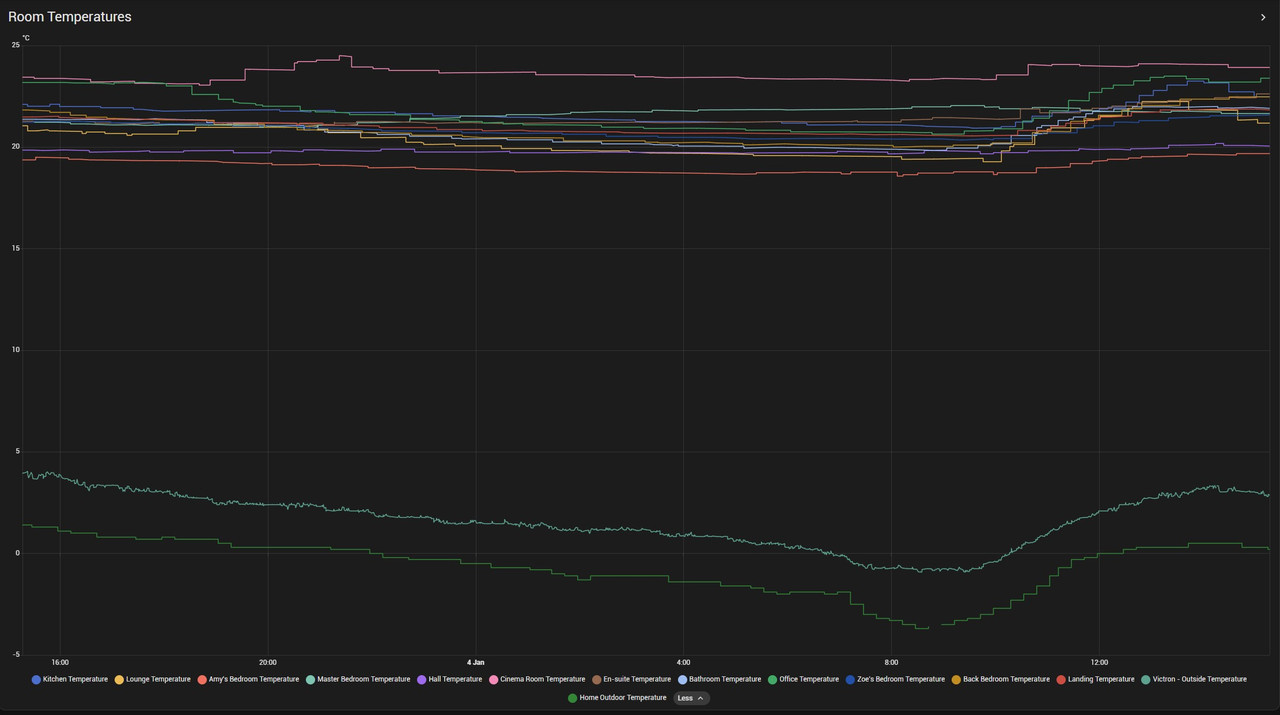
Top trace is the cinema room, I was in there from about 18:30 to 21:30 hence the temperature rise (the PJ kicks out quite a bit of heat), its fully soundproofed and thus highly insulated. Bottom trace is my daughters bedroom, which has always been the coldest room.
Solar gain can be seen on other rooms from midmorning.
I'm amazed we have no issues, even the bathrooms with their towel rails are fine, we never upgraded a single radiator, we already had oversized radiators, but some were borderline on the heat loss calculation.
Top trace is the cinema room, I was in there from about 18:30 to 21:30 hence the temperature rise (the PJ kicks out quite a bit of heat), its fully soundproofed and thus highly insulated. Bottom trace is my daughters bedroom, which has always been the coldest room.
Solar gain can be seen on other rooms from midmorning.
Last edited:
We can't run that low with our 10mm microbore. Ours sat at 41-43C LWT with an outside temp of -3C for the most of the night and kept most of the house at 21-22C. The lounge is a massive issue though - that sits at about 19.5C. Octopus actually wouldn't upgrade that radiator so I did it myself (which they fitted), yet it's still too cold. I think we can't physically get enough heat through the 10mm pipes to heat up the room, so would need another radiator. It was a problem with the gas boiler at 65C flow, needing many hours to reach 20C.
What are you using for the temperature sensors by the way?
What are you using for the temperature sensors by the way?
If its the pipework, then you need to change that, as you'd need to run new pipework for an additional radiator, so you might as well just replace the pipes to the existing radiator presuming its big enough for the room.
10mm microbore should be good for 2.5kW of heat at 41C, perhaps the pipe is damaged/restricted somewhere, or you have multiple rads running off a section of microbore.
Room sensors are Aqara temperature sensors, the lowest outside temperature is from the Vaillant system, the other is a sensor attached to my Victron system and poking out the garage wall. Sometimes its the same as the Vaillant, but most times its slightly warmer - likely affected for the garage wall temperature.
10mm microbore should be good for 2.5kW of heat at 41C, perhaps the pipe is damaged/restricted somewhere, or you have multiple rads running off a section of microbore.
Room sensors are Aqara temperature sensors, the lowest outside temperature is from the Vaillant system, the other is a sensor attached to my Victron system and poking out the garage wall. Sometimes its the same as the Vaillant, but most times its slightly warmer - likely affected for the garage wall temperature.
Annoyingly I didn't check what was in the cavity wall when they had the radiators off during the install. If it's 22mm piping down to each area and then 10mm plastic microbore off that, it's easily done. Being a 2019 new build though, I suspect it's just 10mm microbore in the walls. It used to be dual zone on the combi, so this will have been merged somewhere during the install. I suspect the upstairs rads are first in line, as they are always much warmer.If its the pipework, then you need to change that, as you'd need to run new pipework for an additional radiator, so you might as well just replace the pipes to the existing radiator presuming its big enough for the room.
10mm microbore should be good for 2.5kW of heat at 41C, perhaps the pipe is damaged/restricted somewhere, or you have multiple rads running off a section of microbore.
Room sensors are Aqara temperature sensors, the lowest outside temperature is from the Vaillant system, the other is a sensor attached to my Victron system and poking out the garage wall. Sometimes its the same as the Vaillant, but most times its slightly warmer - likely affected for the garage wall temperature.
I've found the standard temperature probe on the Daikin runs around 2C too warm. I have a very accurate Davis weather station (this is what shows on my PVOutput) so run my weather curve based on that (i.e about 41C LWT at 0C on the Daikin which is actually -2C in reality).