

You are using an out of date browser. It may not display this or other websites correctly.
You should upgrade or use an alternative browser.
You should upgrade or use an alternative browser.
DRAM Prices Surge 172% YoY with No Signs of Slowing Down
- Thread starter Nelly
- Start date
More options
Thread starter's postsOnce supply ramps up, things will gradually get better.
You are d:reaming.
the ram guys did that once and I doubt they will repeat that mistake again. The ramped up supply by building factories which pushed the prices down and left them with extra capacity when the demand withdrew. Unless forced to they will not increase supply or they are certain they have reached a new demand ceiling, they are happy here because they can charge more for the same thing.While I agree the trend is towards the Cloud, I don’t think the current crisis with RAM is the end of the line for PC gamers/enthusiasts. Once supply ramps up, things will gradually get better.
Its going to get much worse before it gets any better. Do you know how much a FAB costs ? it will require multi billion dollar investment and years to setup a fab and to meet the crazy demand they would need anywhere from 5-10 years of factory building and multiple fabs. This is not going to resolve in a binary way its going to improve SLOWLLLYYYYYYY and there is a lot of uncertainty too.
Last edited:

Agreed. The best short term gain they can make is improving wafer yield, but that's about it. Demand needs to drop to resolve this within a reasonable timeframe. Nothing else will.the ram guys did that once and I doubt they will repeat that mistake again. The ramped up supply by building factories which pushed the prices down and left them with extra capacity when the demand withdrew. Unless forced to they will not increase supply or they are certain they have reached a new demand ceiling, they are happy here because they can charge more for the same thing.
Its going to get much worse before it gets any better. Do you know how much a FAB costs ? it will require multi billion dollar investment and years to setup a fab and to meet the crazy demand they would need anywhere from 5-10 years of factory building and multiple fabs. This is not going to resolve in a binary way its going to improve SLOWLLLYYYYYYY and there is a lot of uncertainty too.

Soldato
- Joined
- 1 Jan 2003
- Posts
- 3,316
- Location
- Derbyshire


Soldato
- Joined
- 6 Sep 2016
- Posts
- 15,400
Wow, I think I've been living under a rock!
I bought 32GB of fast G.Skill Trident Z5 Neo from OCUK earlier in the year....£128
It's now £380!
Really glad I don't need an upgrade. What on earth are people doing that need to buy memory?
Spend money on another hobby I guess
time to sell and profit?Wow, I think I've been living under a rock!
I bought 32GB of fast G.Skill Trident Z5 Neo from OCUK earlier in the year....£128
It's now £380!
Really glad I don't need an upgrade. What on earth are people doing that need to buy memory?

time to sell and profit?
Pay off that mortgage! :

Looking back at my old purchase receipts sort of brings things a bit more into perspective. Back in 2019 i purchased 16 gb of 3600 mhz DDR4 team group 8 pack edition memory for £159.94 .
I now have another matching pair in my system. looking at selling i would probably get about £70 eack pair . So add £200 and i would easily get a nice 32gb ddr5. Yes it is expensive but to be honest all this doom and gloom i going a bit too far.
Sorry but being Christmas i wanted to find a little silver lining
I now have another matching pair in my system. looking at selling i would probably get about £70 eack pair . So add £200 and i would easily get a nice 32gb ddr5. Yes it is expensive but to be honest all this doom and gloom i going a bit too far.
Sorry but being Christmas i wanted to find a little silver lining
Last edited:

They can shove their subscriptions up their @%$. I will never rent a computer or computer parts. Unfortunately, we have a generation who will never know a time when you own your product, VHS, CD's and software that you buy. These tech bros and their media backers want to convince the younger generation it's normal to rent everything.These companies will rent you a PC/Parts, Own nothing and be happy!
Last edited:

Soldato
- Joined
- 14 Jun 2004
- Posts
- 8,195
off onterest to anyone
it does make me think though, if you get failed DDR5 ram, keep hold of it, and sell it as faulty it'll sell if people are using this method as they'll try and salvage the good memory modules for transplant.
and

 wccftech.com
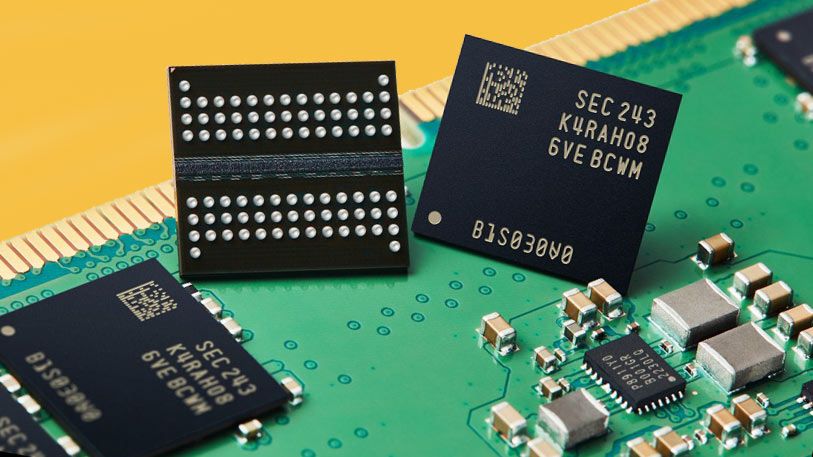
it does make me think though, if you get failed DDR5 ram, keep hold of it, and sell it as faulty it'll sell if people are using this method as they'll try and salvage the good memory modules for transplant.
and
ASUS Rumored To Enter DRAM Market Next Year To Tackle Memory Shortages
ASUS is rumored to enter the DRAM manufacturing segment by 2026, which should ensure a stable memory supply for its PC lineups.
Last edited:
Surely that will only be to supply themselves and their graphics cards, desktops and laptops? I find it unlikely they'll do retail or consumer sales TBH.off onterest to anyone
it does make me think though, if you get failed DDR5 ram, keep hold of it, and sell it as faulty it'll sell if people are using this method as they'll try and salvage the good memory modules for transplant.
and
ASUS Rumored To Enter DRAM Market Next Year To Tackle Memory Shortages
ASUS is rumored to enter the DRAM manufacturing segment by 2026, which should ensure a stable memory supply for its PC lineups.
off onterest to anyone
it does make me think though, if you get failed DDR5 ram, keep hold of it, and sell it as faulty it'll sell if people are using this method as they'll try and salvage the good memory modules for transplant.
and
ASUS Rumored To Enter DRAM Market Next Year To Tackle Memory Shortages
ASUS is rumored to enter the DRAM manufacturing segment by 2026, which should ensure a stable memory supply for its PC lineups.
Oh great, so their normal price will still be four times normal, it'll fry your VRMs and they won't honour any warranty.
It'll look cool though.
Gogogo fanboys.
They can shove their subscriptions up their @%$. I will never rent a computer or computer parts. Unfortunately, we have a generation who will never know a time when you own your product, VHS, CD's and software that you buy. These tech bros and their media backers want to convince the younger generation it's the normal to rent everything.
I refuse to even have game subscription services from either Sony or Microsoft. Unfortunately it seems that physical media is fast becoming obsolete, On the Nintendo switch 2 when you buy games, the box does not have a physical game anymore but a game key-card. Its only a matter of time until they stop completely. Not all the games are like this but most are because Nintendo's pricing for cartridges to game developers/publishers. Over the next 10 years there might not be disks or cartridges anymore for home consoles.
this news is confusing???off onterest to anyone
it does make me think though, if you get failed DDR5 ram, keep hold of it, and sell it as faulty it'll sell if people are using this method as they'll try and salvage the good memory modules for transplant.
and
ASUS Rumored To Enter DRAM Market Next Year To Tackle Memory Shortages
ASUS is rumored to enter the DRAM manufacturing segment by 2026, which should ensure a stable memory supply for its PC lineups.
Building a dedicated fab takes about 3-4 years and ASUS cant just pick and mix how much production they need from a facility, usually small/medium sized facility would have a baseline production capacity at minimum and I assume that alone would overshoot ASUS needs, which is good thing. The clean rooms would take roughly 2 years to produce and 1 years for calibrating machines and 1 year for production runs and yield optimisations. Also you cant just switch lines form DDR5 to GDDR7 like you are throwing a swich, normally this involves recalibrating machines for production runs and whether they use EUV or DUV for the GDDR7.
a medium sized facility would cost about 5-10 billion depending on the number of lines and EUV/DUV machines. depending on if they want to produce DDR6 where they need EUV machines. Where is ASUS going to get this money from? They would want this facility built for more modern DDR6 as its possible DDR5 demand might taper off. The problem is that although they can produce DDR6 using DUV machines using Multi-Patterning techniques, from what I understand they are inefficient and not economically viable to due resources required, ie multiple pass, chemicals, ect. BUT having said that EUV machines have a long lead time from ASML, apparently up to 3 years. That would delay production by possibly that amount of time, which would mean production starts in 2032 or there abouts. Also producing DDR6 using EUV is costly and would need volume production to be viable and expensive to set up lines, they would need large production run to achieve economics of scale. They could use a hybrid approach of EUV for some layers and DUV for others.
Regardless of what they want they are most likely going to get DUV machines and most likely from lines being retired from somewhere as ordering new from Nikon or ASML has two year lead time or possibly more for DUV machines.
Samsung, intel and micron are retiring some of they older equipment and moving onto HBM so there will definitely be possible to setup a fab FAST-ER by buying a current retiring line, so this might be the most realistic possibility.
assuming a small to medium sized facility, this would overshoot what ASUS would need by multiple factors. You cant just produce what ASUS needs, that would not be economically viable and push prices up per wafer. Asus would definitely need to overproduce to sell to others but the problem is the timeline. I hear many saying this ram crunch will last till 2028, if so what is the point of all this? ASUS is a small company the investment required for a line is going to be very high and the risk of future demand for DDR5 cold be unpredictable and volatile. This is risky strategy and to be honest if I was ASUS financial adviser, I would not be willing to take this risk unless there are multiple investors willing to share the risk.
what makes more sense is given the above, they are probably investing in a foundry-lite model or investing in another company like nanya or PSMC to build a line and they secure the output. I really doubt ASUS is going to be primary manufacturer like Samsung.
sorry for wall of text, just wanted to provide some context on why I don't believe the story or the way its written or implied.
Last edited:
Vexr
Vexr
Looking back at my old purchase receipts sort of brings things a bit more into perspective. Back in 2019 i purchased 16 gb of 3600 mhz DDR4 team group 8 pack edition memory for £159.94 .
I now have another matching pair in my system. looking at selling i would probably get about £70 eack pair . So add £200 and i would easily get a nice 32gb ddr5. Yes it is expensive but to be honest all this doom and gloom i going a bit too far.
Sorry but being Christmas i wanted to find a little silver lining
Glad someone else recalls those days.
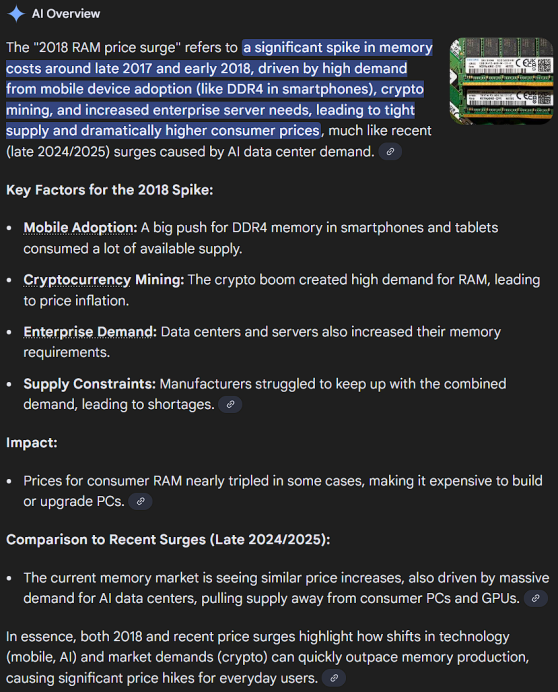
A history lesson (as summarised by AI with at least one inaccuracy, that being the current RAM price hike starting in late 2024 lol):
Checked my receipts from January 2019, a time when I got absolutely rinsed buying RAM:
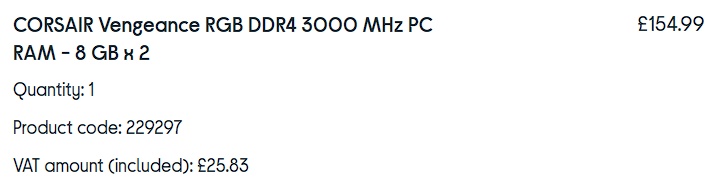
That's £200.33 in today's money for 2 x 8 GB of rather slow DDR4, which I'm still using

In the COVID-era graphics card famine, which seemed to go on forever, I was honestly wondering if the RTX 3080 and RDNA2 and the likes would be the last generation of graphics cards to be made commercially available (albeit at massive mark-up and with extreme scarcity) to regular people. The world seemed to only be getting more dysfunctional the longer that era went on, and yet the famine broke and life eventually resumed, and a measure of affordability more or less returned, and that was a more extreme scenario IMO.

You may have to settle in a bit longerWas really hoping to do a new build this year to retire the 5800X3D but looks like it will seeing me through 2026 too!
Maybe a GPU updated instead this year…
Samsung and SK Hynix reckon it'll persist until 2028. If this is true or they're just wanting people to buy at massive prices I don't know.
As for GPUs, Nvidia would prefer you rent a GPU off them each month and they'll reward you by limiting gameplay to 100 hours a month. That stinks.
Soldato
- Joined
- 14 Jun 2004
- Posts
- 8,195
thank you for your thoughts and analysis.sorry for wall of text, just wanted to provide some context on why I don't believe the story or the way its written or implied.
probably nothing will come of the asus thing, given costs and time line, if something did though, it would indicate to me time lines we have are wrong and they see the current issue going on for far longer, or they see an oppatunity for DDR6/t RAM and preparing for that entry, likely with other partners.