


• Notice regarding image hosts and attachments. See here.

Baking Paper Types

Soldato
Joined
24 Mar 2018
Posts
4,109
Location
Brighton
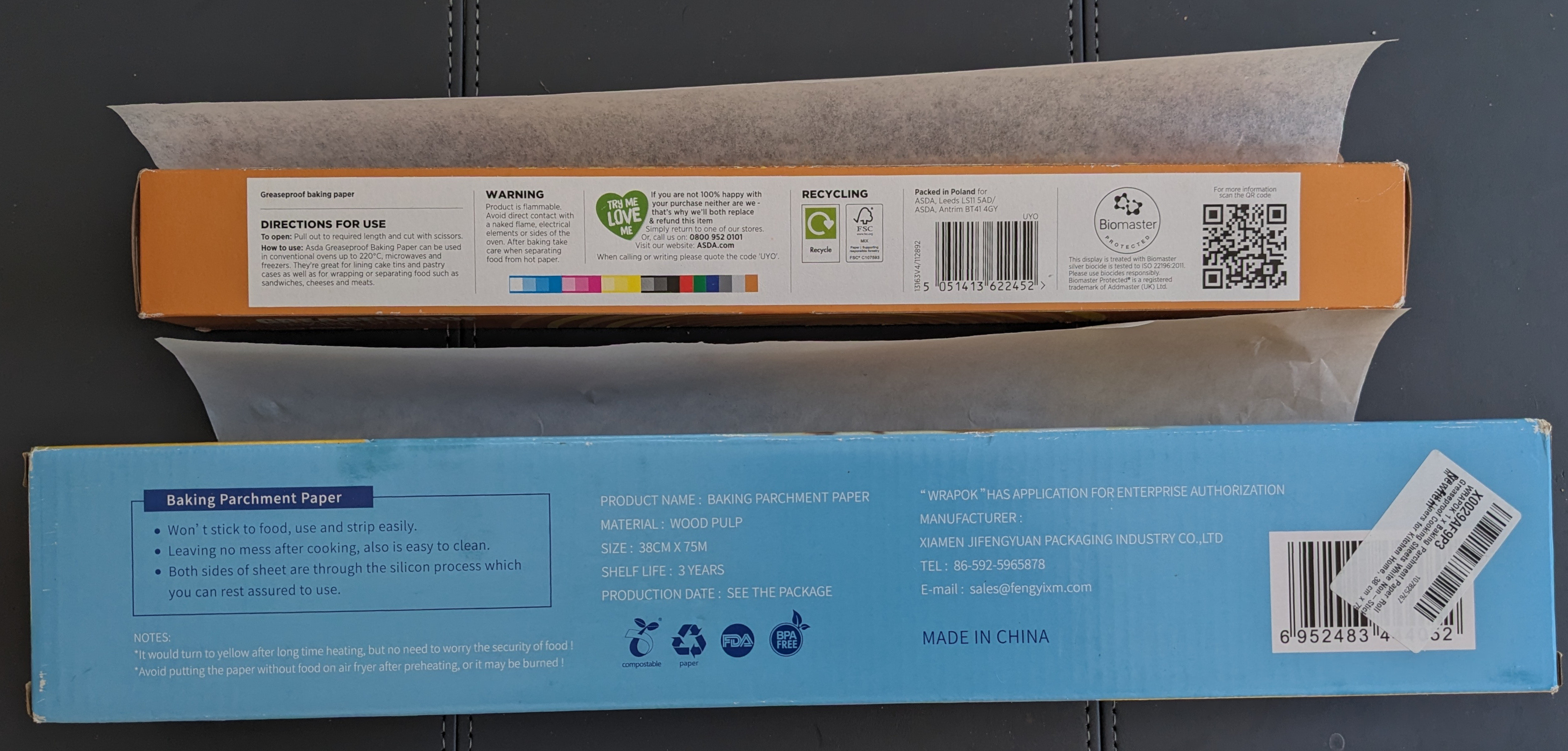
Been having a lot of trouble with my gluten free game with baking papers of late so here are a couple of paper types I've recently tried, the Orange Asda one coated with Biomaster vs the bottom one coated each side with what they say is silicone. So my pizza game rely's on a paper that does not hold a wetter mixture too tightly vs the silicon based one causing a sticky nightmare for me. So the question, is the paper just a tighter mix so not allowing water to penetrate soak in or maybe something else. I can't work out at this point clearly other than coatings and they way it's rolled. One has a Biomaster coating the other has Silicone Coating. Or does the top paper just draw moisture away and the other doesn't.
C4Hr3B4.jpg
 
Last edited:
As a term, Baking Paper seems to be used for all manner of products which can be wildly different in terms of their make-up and purpose. It's more important to look for terms like greaseproof and parchment as that tells you what you are getting.

Greaseproof, which is your top box, is stuff you'd use to wrap sandwiches in. Should be uncoated, rely on its weave to 'resist' grease and thus only be mildly, if at all, non-stick and will be a one use only product.

Parchment, which is the lower box, is the stuff you want for cooking and other applications where non-stick is essential. Will be silicone coated and thus very resistant to grease, very non-stick and reusable a few times before it wears out.

Biomaster won't do anything other than provide a mild antimicrobial factor - hence you'll find it on things used to wrap or store food.

Why are you using paper for pizza dough? Storage?
 
I think greaseproof will always end up absorbing moisture, but if you dusted the parchment with some of the flour you are using it ought to behave how you want.

If you end up looking for another product, compared to most alternatives this stuff is pretty magical. Reusable many times over, nothing sticks to it and it repels water pretty effectively as well.

 
would it stick to gently oiled tin-foil ? often use that for puff pastry stuff.

otherwise if you get a non-stick edgeless baking tray to prepare the pizza on can you use that rather than a pelle. -I use that sprinkled with some polenta.
 
I think greaseproof will always end up absorbing moisture, but if you dusted the parchment with some of the flour you are using it ought to behave how you want.

If you end up looking for another product, compared to most alternatives this stuff is pretty magical. Reusable many times over, nothing sticks to it and it repels water pretty effectively as well.


Thanks for your input, I'll have to try it and see if it works, if so I'll add it to my known good paper (The top one Asda) in my thread. Using more product becomes expensive at £7/8 a kilo and making bread and pizza with 166/6 gives no leeway for waste. I have a cupboard full of paper that I just can't use and most of it feels like the silicone based stuff. but not all of it. ie some of the brown paper wont work either.
It's just a case of trial and error. But the paper is much cheaper either way!

would it stick to gently oiled tin-foil ? often use that for puff pastry stuff.

otherwise if you get a non-stick edgeless baking tray to prepare the pizza on can you use that rather than a pelle. -I use that sprinkled with some polenta.

I've not tried, but I would say not, also It is par baked for 2 minutes then the paper is removed. In fact the paper also helps to get the colour on the bottom of the pizza.
 
For the last step pat down the centre and remove the paper, coat the edge with the egg yolk and build a Pizza
of your choice and pop it in the oven onto a steel or stone for 2 mins then remove the Pizza from the parchment paper and cook for another 2/3 mins.
Cook as hot as you can, ie my oven will do about 250C non fan.

now reading your recipe om par-baking - conduction of heat through the parchment from the stone must be low , so if pizza was par-baked on a thin non-stick baking sheet
and then transferred would that be any worse - silicon baking sheet seems only good for 220C though so maybe either is risky.

naked stainless sheet 0.8mm * 300*300 ?
 
The paper is more flexible as I keep turning in the process of making the pizza which is then wrapped into a paper bag shape with folded corners to keep the moisture in. Not saying it wont work I just think it would be more of a faff and might tear, I use a stone by default. the whole point here is I was trying to understand why the Dough sticks to one type of paper vs the other. It seems the Dough for some reason creates a strong bond to that type of paper which again is silicone based the other Asda paper I don't know how it's made, it just says made with pulp, but it works either way. Like I say maybe it draws moisture away rather than repelling it, so my other question I need to ask myself, is silver foil going to act like the silicone based one. Thanks for your thoughts.

Edit: you might need to read that again lol
 
Last edited:
As a term, Baking Paper seems to be used for all manner of products which can be wildly different in terms of their make-up and purpose. It's more important to look for terms like greaseproof and parchment as that tells you what you are getting.

Greaseproof, which is your top box, is stuff you'd use to wrap sandwiches in. Should be uncoated, rely on its weave to 'resist' grease and thus only be mildly, if at all, non-stick and will be a one use only product.

Parchment, which is the lower box, is the stuff you want for cooking and other applications where non-stick is essential. Will be silicone coated and thus very resistant to grease, very non-stick and reusable a few times before it wears out.

Biomaster won't do anything other than provide a mild antimicrobial factor - hence you'll find it on things used to wrap or store food.

Why are you using paper for pizza dough? Storage?
As glitch already said look for Greaseproof!
 
Back
Top Bottom