Can a single D5 handle this?

Soldato
Joined
6 Jan 2013
Posts
22,480
Location
Rollergirl
Can a single D5 handle the following loop:

  • CPU
  • GPU
  • Res
  • 240mm Rad
  • 480mm Rad
  • A few 90 bends here and there.

Will it manage to push the swishy stuff without trouble?

 
I've had a test run tonight with this, and I've decided I'd like to mount the 480 radiator under my desk. The slight issue, is with the fans. Can I run 4 fans off one PWM header? Also, is it OK to run a long 4pin extension cable and then use splitters to feed the 4 fans?

I'm thinking cable length may be an issue due to volts drop and resultant current?
 
Yeah as Disco states I'd run off one of those cables that takes power directly from the PSU. Whilst going from the header would probably work, it's a lot to expect from it.
 
Depends on the fans, most "silent" type fan you should be fine, using anything hard core or exotic might be too much.

To be on the safe side what the guys are suggesting above is a safer bet but involves a little more faff.

due to the low voltage I don't think a long cable is going to make THAT much different to volt droop etc.


What i actually did was buy a little external PSU with a molex connector on the end (Like what are used in kits to power HDD's temp connected by USB etc)
I then went for mega silent fans so even running at 12 v they are not noisy, I also have some 7v connectors i can add in to reduce noise.
 
I've ran 4 fans off a single mobo header before, those were 3 pin so probably drew more power (could be wrong though).

What you could do is provide the power for the fans directly from the PSU and then use the PWM signal from whatever control device you use. You could either ghetto rig this up yourself or spend a fiver for one of these: https://www.overclockers.co.uk/ek-water-blocks-ek-cable-splitter-4-fan-pwm-extended-wc-9cq-ek.html

How does that cable work? Does it power the fans from the Molex and then I would plug the fan cable into the mobo header and have control over pwm in the BIOS Qfan control?
 
I've had a test run tonight with this, and I've decided I'd like to mount the 480 radiator under my desk. The slight issue, is with the fans. Can I run 4 fans off one PWM header? Also, is it OK to run a long 4pin extension cable and then use splitters to feed the 4 fans?

I'm thinking cable length may be an issue due to volts drop and resultant current?

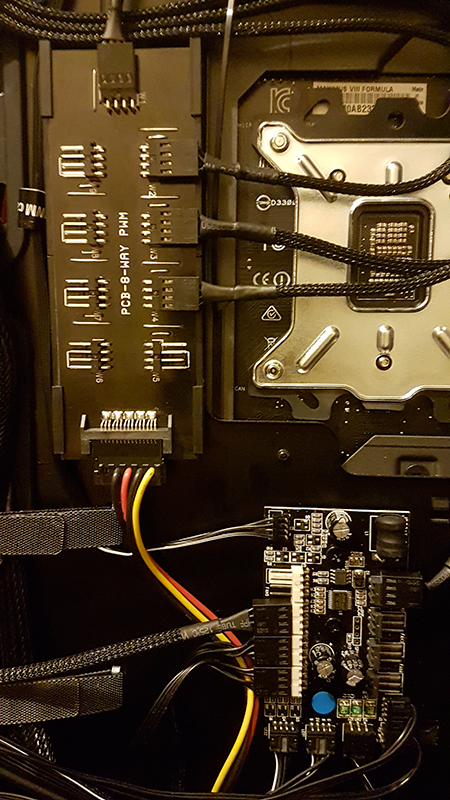
Hi String, I am currently running 8x PWM fans from 1x 8-way PWM controller. they all run perfectly fine!

Here's a picture: (the big one on the top left, imagine all the fans are plugged in, this picture was taken before I plugged them all in.)
drazek-pc-fan-controllers.jpg
21094.jpg
Here's another pic of the actual controller. - it uses a SATA connector to provide power, however it will draw power from the top (right most) PWM connecter if no SATA is connected.
 
I thought I would revisit this as my loop is now growing again and I'd like to ensure the pump can handle it.

Loop:
  • CPU
  • GPU
  • Res
  • 240mm Rad
  • 240mm Rad
  • 240mm Rad
  • 480mm Rad
  • Pump
  • A few 90 bends here and there.
There is also a 1m stretch of interlinking tube in the middle of the loop as my cooling kit is in the garage which is through the wall from my office/cave. I do have 2 x D5 Vario pumps available but should I stick with one?

Please note, as the pump is in the garage it can be run @ 100% speed as I won't hear it.
 
Hard to tell without a flow meter attached but I'd personally add a second D5 (in series of course) into your expanding loop. The rads and components aren't too bad but throw in some bends and the 1m extension and it's enough to warrant a second. Then again, I tend to go a bit overboard. I use dual D5 with just CPU, GPU, MB, 360 and 480 all mounted in a Corsair 900D. There is noticeably more "swirl" at the top of the reservoir when they're both going at full speed. Without the anti-cyclone there would probably be a little vortex.
 
Hard to tell without a flow meter attached but I'd personally add a second D5 (in series of course) into your expanding loop. The rads and components aren't too bad but throw in some bends and the 1m extension and it's enough to warrant a second. Then again, I tend to go a bit overboard. I use dual D5 with just CPU, GPU, MB, 360 and 480 all mounted in a Corsair 900D. There is noticeably more "swirl" at the top of the reservoir when they're both going at full speed. Without the anti-cyclone there would probably be a little vortex.

Any recommendation on a flow meter? I would be hooking it up to a Aquaero 6LT.
 
Any recommendation on a flow meter? I would be hooking it up to a Aquaero 6LT.

If you want one with minimal hassle then the Aquacomputer one: https://www.overclockers.co.uk/aqua-computer-flow-sensor-mps-high-flow-incl-usb-port-wc-177-aq.html

BUT it seems a tad pricey for a flow sensor. Then again, if the cost isn't an option...

You can usually guess based on the disruption in the reservoir. You can remove any anti-cyclone stuff if needed to see. Another completely non-scientific test is to see how quickly the water gets pulled through in an empty system (or recently flushed on) :cool:.

If the water slowly gets pulled in then the pressure is probably a bit low. If it sucks half a liter through in a blink of an eye...good!

Another option: Record temps under benchmarking or burn in with one pump and then again with a second. If they're the same then curse yourself for adding a second pump, then smile knowing you have some redundancy in case one fails.

Or if you want to be cautious and lazy (like me), just add the second pump and stuff the flow meter. Based on an old test from Martin's Liquid Lab the ideal flow rate is 1GPM (3.8L/min) with a negative performance drop off below 2.6L/min. Above this there are minimal to no advantages in performance (i.e. Lower temperatures). Noise and additional power consumption aside there are no realistic disadvantages to higher than needed flow. I use realistic as a caveat since it's bad if the flow is so higher that the water forms a large enough vortex to introduce air into the inlet. Possible not not really likely within any reasonable loop.
 
Thanks for the detailed response @Bugbait

Current set up is:
  • CPU
  • GPU
  • Res
  • 240mm Rad
  • 480mm Rad
  • A few 90 bends here and there.
I run the pump @ 40% which is around 1400rpm. It's mounted in the case right now, and at that speed it's near silent. However, I can barely see the water move at all in the reservoir. If I increase the speed to 70% then I can see a little ripple, and if I go to 100% I can see the water clearly swirl at the top but I couldn't put up with that noise. This is why I'm thinking of mounting the pump in the garage with the external radiator.

I have to say though, temperatures aren't vastly different between 40% and 100%. Probably 5 or 6 degrees on the GPU at full load (34C v 29C). The fluid inlet (water from garage radiator) just equalises with the fluid outlet (water going to garage radiator) in proportion with pump speed.

I take it there is no risk to damaging the pump if the flow rate is low, is there?

Here's some graphs of data:

Kx2Bdoe.png

ue3MtTw.png

Ipuoqq3.png


p.s. I think adding the other 2 radiators will mean I need to run it at 100% pump speed, but I'm not convinced it'll have the water swirling much with a single pump.
 
Is the pump noise from the motor or vibration? Curious since I was running mine at 40% at the start of my curve but quickly realized I couldn't hear it until 90%+ but even then it was very minor and only when my fan speeds were also very low. So I changed it to start at 60% @14C and only ramps up at 65% @19C before climbing to 100% at 31C - All based on water temperature. For non gaming they sit at around 80% and are inaudible (about 1.2m from ears to front top of case when standing and the pumps are 65-70cm below that). Ripple is probably indicating a decent flow rate, especially if that's with an anti-cyclone fitted.

From an overclocking and cooling perspective 5-6C is lots! Will 30C versus 35C make a difference for overclocking? No.

Only way to damage the pump is if it runs dry or gets physically jammed by something. You can run it at 20% all day long and it won't hurt it, might kill your cooling performance though!
 
The noise is the pump whine. It's mounted in an acrylic case (Parvum).

I think I'll relocate it to the garage and add the rads to see how it goes. I can always add the second pump if required.

Thanks again.
 
I've never run 2 pumps in a loop before, so quick question if anyone could answer:

Can I have 1 pump running top speed and the other running low speed or even passive (off)?
 
Back
Top Bottom