How would it work exactly? Would it just run the MiSTer front end and cores, or would you make something specifically for this.
I'm not sure the speedrun angle would necessarily work, at least when it comes to 'serious' speedrunning they have rules around what devices are allowed to be used.
Initially it would use the TangCore front end developed by nand2mario. It still needs a lot of work and I would need to entice an FPGA developer to pick up where he left off.
NESTang is an FPGA Nintendo Entertainment System implemented with Sipeed Tang Primer 25K, Nano 20K and Primer 20K boards - nand2mario/nestang

github.com
Although I'm sure you are doing this, I think you'd need to venture further than here for feedback on this, in that being 8-bit only it's a limited audience. Albeit £50 is very much in that 'take a punt' category that the RPi's and such like were.
- Is it being limited to 8-bit to keep the price to a cheap enough FPGA?
- The SNES controller port adds cost personally. I would prefer USB to open up options like 8-Bitdo controller, or SNAC adapters, although I suspect I'm in a minority. At a guess I assume the use of the SNES port is to keep costs low and not have to worry about digital input/output?
- Ideally it would need to come with a pre-configured OS for 8-bit cores. Something akin to Mr.Fusion but to make the act of getting up and running quickly.
- Does it have a SD card reader, or how does it do storage?
I'm also not sure on the speed running angle here. I so think it needs a clever 8-bit moniker, maybe a small logo, something to give it that clever name that help it take off. Apologies this might already be something you've considered.
- Is it being limited to 8-bit to keep the price to a cheap enough FPGA?
Yes, pretty much. Someone has ported the NES core to the Tang Nano 9K which only uses 6.5k LUTs.
They can be had for £13
- The SNES controller port adds cost personally
True but they are only a couple of quid and i'm not a fan of modern controllers, give me an original SNES or NES controller any day. However, this feature hasn't been ported to the Tang Nano 9K and only supported on the Tang Nano 20k and above. Would need an FPGA developer to carry on the project.
The Tang Nano 9k does support BlueRetro but that would add to the cost of also having to include an ESP32.
- Ideally it would need to come with a pre-configured OS for 8-bit cores. Something akin to Mr.Fusion but to make the act of getting up and running quickly.
There's already the TangCore OS which runs on the Tang Nano 20K, I would need a FPGA developer to get it working on the 9K if trying to keep the price down as low as possible. The Tang Nano 20k boards are roughly £10 darer than the 9K boards.
- Does it have a SD card reader, or how does it do storage?
Yes both the Tang Nano 9K and 20K have an SD Card slot where all the roms and cores sit, HDMI (720p) and USB-C for power / programming.
Which FPGA are you thinking of?
To start either the Tang Nano 9K or Tang Nano 20K which are prototype boards for Gowin FPGAs. The number at the end corresponds to the number of Logic Elements.
--------------------
If there is a lot of interest for a dedicated cheap 8 Bit FPGA machine, then there's always the option to go down the custom PCB route using the same Gowin FPGAs, rather than rehousing one of the prototype boards etc
You can also use a Raspberry Pi Pico with a NFC reader to launch roms. But that would need a software developer to contribute to the project for that to work, but it is possible.
My dream would be to have no frontend at all, only a splash screen, and then you tap a NFC card to launch the game of your choice.








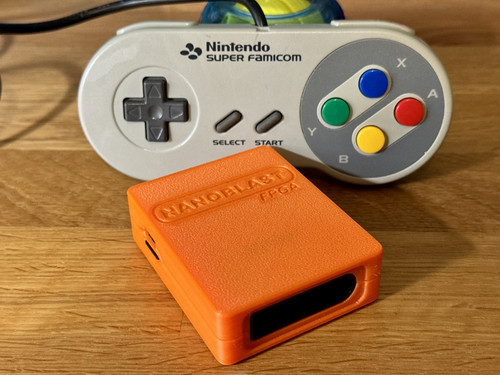
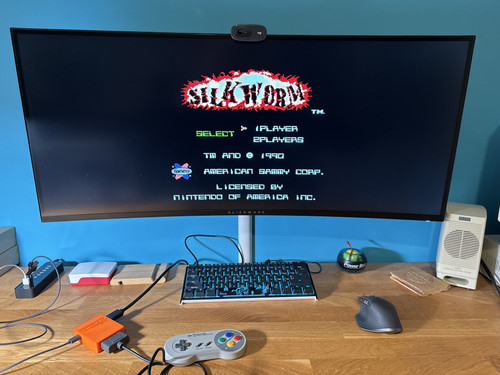
 .
.