• Competitor rules

    Please remember that any mention of competitors, hinting at competitors or offering to provide details of competitors will result in an account suspension. The full rules can be found under the 'Terms and Rules' link in the bottom right corner of your screen. Just don't mention competitors in any way, shape or form and you'll be OK.

Downclocked 3570k vs 2500k?

Associate
Joined
26 May 2011
Posts
6
Hi guys,

I was planning to build a fanless system with NoFan 95C but Ivy Bridge seems to made things worse in terms of temperature.

So I decided to buy ASUS P8Z77-V DELUXE and Sandy but then I noticed this:

2500k runs at 3.3 Ghz while 3570k is set to 3.4 Ghz.

Would downclocking IB to 3.3 Ghz reduce the temperatures to the level of SB?

Can maybe someone with the system test it out?

 
I'm planning a 3570K in a SFF system. Firstly I would be very nervous of fanless on a 77W TDP part - I think a PWM controlled cooler that is very quiet most of the time but with the ability to spin up if needed is a much safer soluton.

For a given clock, or more correctly a given processing throughput, Ivy should be lower power than Sandy so it's the better choice for SFF. Even though I have a K I fully intend to underclock and if possible undervoit. There is always speedstep and turbo to throw some extra clocks in when needed.

Much has been said about Ivy temps and despite various efforts people are still confusing heat and temps. A higher core temp may be a fact of life with Ivy and the way the temp shoots up with higher volts and clcoks is bad for overclokers but doesn't affect this kind of system. If the (lower) heat isn't getting through the cooler into the case then maybe there isn't actually a problem.

Ivy may need different thinking than Sandy!
 
The higher temperatures come from the higher volts of overclocking the chip and the architecture's inability to dissipate heat quick enough... at stock frequency and volts, the 3570K will run cooler than a stock 2500K due to the Tri-gate Transistors and their efficiency AFAIK.
 
Theres also a lower power 66w ivybridge.
There are SKUs with lower TDPs down past 45W and below due out. I interpret TDP as being a guideline to a PC manufacturer as to power and cooling requirements, with lower TDP parts being sold simply with lower stock clocks and volts (and a higher price tag). There isn't a single value for power consumption.
We can just as easily lower our power consumption simply by changing BIOS settings. I don't believe the chips are fundamentally different, but perphaps they might bin the parts that are happy at lower volts in the same way as they bin for speed grade.
 
At stock IB runs at about 30C... at stock IB actually does better than SB for power consumption as well as the temps being identical basically.
 
Last edited:
I'm planning a 3570K in a SFF system. Firstly I would be very nervous of fanless on a 77W TDP part - I think a PWM controlled cooler that is very quiet most of the time but with the ability to spin up if needed is a much safer soluton.

For a given clock, or more correctly a given processing throughput, Ivy should be lower power than Sandy so it's the better choice for SFF. Even though I have a K I fully intend to underclock and if possible undervoit. There is always speedstep and turbo to throw some extra clocks in when needed.

Much has been said about Ivy temps and despite various efforts people are still confusing heat and temps. A higher core temp may be a fact of life with Ivy and the way the temp shoots up with higher volts and clcoks is bad for overclokers but doesn't affect this kind of system. If the (lower) heat isn't getting through the cooler into the case then maybe there isn't actually a problem.

Ivy may need different thinking than Sandy!

Hi, can you clarify what you mean by dangerous 77W? Are you saying it's too low?

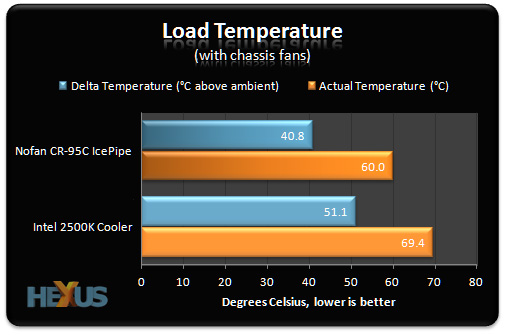
NF 95C supports 2500k and is much better than stock cooler, so I assume 3570k is also fine? It's rating is 95W max while new copper version will raise it to 100W.

graph-2.jpg
 
Hi, can you clarify what you mean by dangerous 77W? Are you saying it's too low?
I didn't use the word dangerous, and i don't know the capabilities of a NF 95C .
Athough IB is more efficient than SB the 77W TDP isn't a maximum power consumption - it's a class if you like. It's also becoming apparent the Ivy reports higher temperatures as it seems unwilling to dissipate heat. Putting in greater cooling than SB seems a waste of money.
Nevertheless I would feel happier having a variable RPM fan knowing that as the CPU workload increases the cooler's ability to dissipate heat is also able to increase. There must be plenty of fans sufficiently quiet at lower RPMs.
Passive may be OK upto a few dozen watts TDP but even then I would expect forced air case cooling - defeating any advantage.
 
I didn't use the word dangerous, and i don't know the capabilities of a NF 95C .
Athough IB is more efficient than SB the 77W TDP isn't a maximum power consumption - it's a class if you like. It's also becoming apparent the Ivy reports higher temperatures as it seems unwilling to disapate heat. Putting in greater cooling than SB seems a waste of money.
Nevertheless I would feel happier having a variable RPM fan knowing that as the CPU workload increases the cooler's ability to disapate heat is also able to increase. There must be plenty of fans sufficiently quiet at lower RPMs.
Passive may be OK upto a few dozen watts TDP but even then I would expect forced air case cooling - defeating any advantage.

Actually you don't spend much more on cooling Ivy than you do Sandy just depends what you want really. Since the OP is asking about downclocking a 3570k the heat would be the same as sandy and ivy stock is anyway...
 
Actually you don't spend much more on cooling Ivy than you do Sandy just depends what you want really. Since the OP is asking about downclocking a 3570k the heat would be the same as sandy and ivy stock is anyway...
The heat is less with Ivy but you still have to contend with say 60W to 150W-200W to be got rid of. People may then push the volts to get the clocks they want and then the power will go up but that's no way to treat an Ivy.
The spend more is just in case anyone believes they will be able to drop the temps - again to get these higher clocks - maybe LN2 will create a sufficient thermal gradiant - but I'm not hearing users benefit from top-range coolers.
 
Personally I find my alpenfohn K2 to do a fine job (tis seated wrong but will be fixed on monday) keeps everything at a pretty decent temperature. I can always drop about 10C if I turn hyperthreading off. my idle temps don't even go beyond 45C yet and the stress test temps are literally just on the borders of 90C (should drop about 4-5C after my heatsinks reseated) doesn't really bother me that Im hitting 90C in a stress test Im never likely to use more than 70% of my cores at any one time anyway.
 
Maybe 90C for Ivy is emerging as a possible acceptable limit for stable O/C under high-load benchmark conditions, assuming near stock volts that is, with the knowledge that normal working temps would be that much lower.
 
Back
Top Bottom