


• Competitor rules

    Please remember that any mention of competitors, hinting at competitors or offering to provide details of competitors will result in an account suspension. The full rules can be found under the 'Terms and Rules' link in the bottom right corner of your screen. Just don't mention competitors in any way, shape or form and you'll be OK.

Xeon Phi going back to slot....

Soldato
Joined
23 Apr 2010
Posts
12,607
Location
West Sussex
http://newsroom.intel.com/community...or-discovery-with-intel-xeon-phi-coprocessors

And..


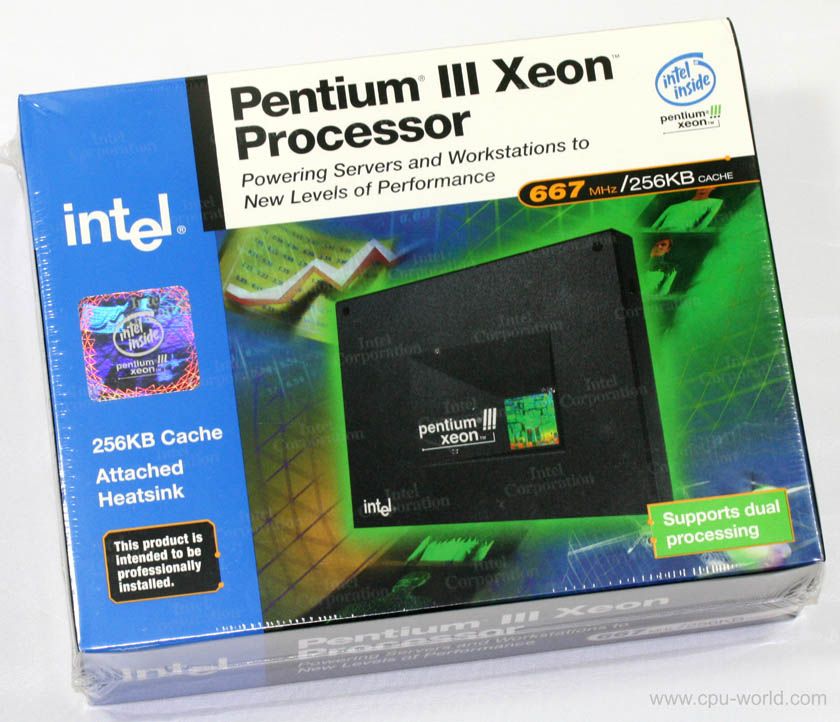
Kinda reminds me of the old days when I had two of these...


Does this mean that....

A. Intel are returning to making true Xeons and not just identical desktop parts and...

B. Desktop boards could return to slot?

It would certainly eradicate the bent pin problem they've had for years (not that they care they don't have to do the RMA)

Would be nice to see a proper true Xeon that absolutely trumps the desktop part though. Up until the P3 Xeon (and including, I had a pair of 867 2mb) I always ran dual CPUs. I started out with dual P2s, then moved onto P2 Xeons for the 2mb full speed cache. Last time I used them was dual P3/2mb.

 
Irregardless means the same as regardless, but the negative prefix ir- merely duplicates the suffix -less, and is unnecessary. The word dates back to the 19th century, but is regarded as incorrect in standard English.
 
They were selling these dirt cheap a couple of months back in an attempt to get more developers on board. The issue with these is you need to write software specifically for them, you can't just drop one in your machine and use the extra CPU power.
 
Can't believe you haven't seen these before, since they launched in Q4'12....... They are simply co-processors, used in addition to the normal socketed xeons.
 
A. Intel are returning to making true Xeons and not just identical desktop parts and...

B. Desktop boards could return to slot?

A. The current Phi (Knight's Corner) and next year's slotted version (Knight's Landing) use many airmont/silvermont cores, which are the same as used in Atom CPUs. So no, they're not specially designed cores, but the implementation of them is unique.

B. Knight's landing will come in expansion card and socketed forms.

http://www.anandtech.com/show/8732/intels-xeon-phi-after-knights-landing-comes-knights-hill

72-core Xeon next year anyone? ;)

Code name for the second generation MIC architecture product from Intel.[26] Intel officially first revealed details of its second generation Intel Xeon Phi products on June 17, 2013.[6] Intel said that the next generation of Intel MIC Architecture-based products will be available in two forms, as a coprocessor or a host processor (CPU), and be manufactured using Intel's 14nm process technology. Knights Landing products will include integrated on-package memory for significantly higher memory bandwidth.

Knights Landing will be built using up to 72 Airmont (Atom) cores with four threads per core,[35][36] support for up to 384 GB of DDR4 RAM and 8–16 GB of stacked 3D MCDRAM. Each core will have two 512-bit vector units and will support AVX-512F (AVX3.1) SIMD instructions with Intel AVX-512 Conflict Detection Instructions (CDI), Intel AVX-512 Exponential and Reciprocal Instructions (ERI), and Intel AVX-512 Prefetch Instructions (PFI), along with Intel's full x86 instruction set except TSX.[37] Knights Landing's TDP will range from 160 to 215 W.[citation needed]

https://en.wikipedia.org/wiki/Xeon_Phi#Knights_Landing

They were selling these dirt cheap a couple of months back in an attempt to get more developers on board. The issue with these is you need to write software specifically for them, you can't just drop one in your machine and use the extra CPU power.

It's true, they're very difficult to tune for. Mainly because they have peculiar cache arrangement.
 
Last edited:
I thought that in terms of raw power a top end GPU easily outstrips what top end mainstream CPUs are capable of? If the PCI CPUs (they are PCI right?) need bespoke coding why not just use a top end GPU and charge the 2k for the firmware / software to tap into that power?
 
I thought that in terms of raw power a top end GPU easily outstrips what top end mainstream CPUs are capable of? If the PCI CPUs (they are PCI right?) need bespoke coding why not just use a top end GPU and charge the 2k for the firmware / software to tap into that power?

Good question. The answer is that these have x86 cores as opposed to GPU shaders. You can get similar power from a Phi as a top GPU (TFLOPS) but coding for one is like a CPU with a bit more effort on cache optimisation, compared to say CUDA which is totally different.
 
Can't believe you haven't seen these before, since they launched in Q4'12....... They are simply co-processors, used in addition to the normal socketed xeons.

Nope new on me !

Last night a mate says "Hey have you seen those new Xeons". Didn't check for the date...
 
Last edited:
Nope new on me !

Last night a mate says "Hey have you seen those new Xeons". Didn't check for the date...

Genuinely suprised by that Andy, I would have thought you would have been aware that these essentially were Intel's attempt at making a GpGpu to compete with Nvidia and Amd back in the 2008-2009 days, under the Larabee project.
 
Genuinely suprised by that Andy, I would have thought you would have been aware that these essentially were Intel's attempt at making a GpGpu to compete with Nvidia and Amd back in the 2008-2009 days, under the Larabee project.

Nope had never heard of them !

Ah well, seems I got a bit excited over nothing.
 
Actually I have received two Phi, they are on sale at the moment (paid £121 per card!)

These acts as /independant/ system, not just as coprocessor. Basically, they run linux on board, and appear as an ethernet card on the host -- on top of also share the host memory space and acts as accelerators.
I have a few nefarious projects for that... a small system with 57 cores (* 4 threads) is a pretty cool toy in my book :-)

IMG_20141211_105841.jpg
 
I know, thats how it felt to me too :-)
These cards are made to do lots of vectorial, they have a 512 bits wide vector units, the cores themselves aren't that powerful, but theres LOADS of them, w00t :>
Thats one teraflop per card. Scary!

So yes, for me the first test is going to be a compile farm, and see if I can offload some simulation work I do, too.

Once thing people don't realize is that these cards can run x86_64 normal code, as long as it's not using MMX/SSE -- so you can run normal programs, on a 'normal' linux box.
 
It's kinda hard to get in the UK. One seller quoted me $115 shipping for one card -- so in the end we ordered 10 as a group, and it went down fairly well, but we had to go thru a company, 'import' them, have DHL account and do forth. That was not easy :/
 
Back
Top Bottom



