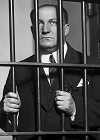
Should inmates on death row be allowed to choose what their last meal is?

Do you have an 'evil test' that society can administer? Because I'm fairly sure one doesn't exist.

Err... I think you'll find the evil test does exist, it's measured on how long a moustache or how tall their top hat is. Capes will also add evil points and at the end if the total of evil points outweighs the good points then that person is deemed evil. It's a real thing you know.

 
Err... I think you'll find the evil test does exist, it's measured on how long a moustache or how tall their top hat is. Capes will also add evil points and at the end if the total of evil points outweighs the good points then that person is deemed evil. It's a real thing you know.
I've found a flaw in your test:

dr-evil.jpg
 
Heads of organised crime families/syndicates, etc. where they or their organisation have committed atrocities would be one potential area I'd consider it
I just can't get my head around the logic of it...

As a means of punishing someone who killed others for not following his rules, we kill him for not following ours? We are entitled to self defence, but we needn't kill him for that.
 
It should keep the ignorant masses quiet. Better than X Factor, they would love it. ;)

Deathrace was better imo

But I suppose you could have seasons, deathrace car driving type, gladiatorial, hunts (what was that Arnie film, running man?)

Plenty of opportunity for torturing/killing people that we have suddenly decided that killing humanly (as much as that is possible) is too harsh on ;)
 
I was a soldier, I was a Royal Marine. However my previous occupation has no bearing to the discussion in this thread or civilian justice systems so I fail to see the point of the question.
The relevance, as I see it, is that you believe -
Besides which we should never be the arbiters of life and death
Yet you used to take payment from an organisation who do just that.
 
The relevance, as I see it, is that you believe -

Yet you used to take payment from an organisation who do just that.

Then you see it wrong. There is no connection to be made from combat situations where each party is fighting against the other and a civilian justice system where the defendant has already been neutralised and taken into custody.

If every enemy combatant put down their arms tomorrow and surrendered it would be illegal to arbitrarily decide whether they lived or died. The decision each combatant makes (including me) means that the arbiter of your own fate rests in your own hands, not that of another. The death penalty in a civilian court doesn't allow for that self determination.

I was not a state sponsored assassin, I was a soldier. I was not paid to decide who lived and died. The enemy decided that for themselves.
 
Last edited:
And yet the organistaion you worked for, and possibly you personally have been the "the arbiter of life and death".

No, because neither the organisation or the individual judge whether a person should live or die. The combatant makes that judgement for themselves.

An enemy soldier can lay down his arms at any time and surrender. They can choose for themselves whether to fight and face the consequences of those actions. A person fighting a war is not the judge and jury, to kill someone who has laid down their arms is murder.

In a civilian court the defendant doesn't have that choice, he cannot lay down his arms and surrender, he cannot decide whether he lives or dies, his fate is decided by others. Others that have a valid alternative to killing.

That is why my previous occupation has no bearing on this discussion whatsoever.
 
Last edited:
An enemy soldier can lay down his arms at any time and surrender.
And if they don't the decision is made to kill them?

I'm not trying to draw a direct comparison between capital punishment and killing in the army, I was merely curious how a former military employee can resolve the differences between both forms of death dealt by the state.
 
And if they don't the decision is made to kill them?

The decision remains theirs, if they are killed, it is because of their choice to remain combatants. The consequence of their actions depends upon their choices, at any time they can lay down their arms and walk away. A soldier is effectively defending himself and others, they kill through necessity not through choice.

Assassination is illegal.

I'm not trying to draw a direct comparison between capital punishment and killing in the army, I was merely curious how a former military employee can resolve the differences between both forms of death dealt by the state.

Because they are not comparable. I was not an assassin and so I was not ultimately the arbiter of life or death.
 
The decision remains theirs, if they are killed, it is because of their choice to remain combatants. The consequence of their actions depends upon their choices, at any time they can lay down their arms and walk away.
But you are not a mere machine so ultimately the decision has to be made to kill.
 
But you are not a mere machine so ultimately the decision has to be made to kill.

But I was not their judge, neither did I kill them if there is any alternative available to me. I was not the arbiter of their fate, I was simply the mechanism of it.

The killing is by necessity, not by choice. The combatants are taking an active part in the hostilities and as such there is no relevance between War and Capital punishment.

I think you need to look up the definition of the word Arbiter before you flog this to death.
 
Not a major fan of the death penalty, and I do think they should have a last meal, as long as its reasonable. Whatever they have done, they are still human. Plus, justice shouldn't happen on a revenge based system.
 
Back
Top Bottom