Mid-Week Brain Teaser

The additional information supplied in scenario 2 is redundant because everyone can already see that there is at least one red hat.

This isn't quite true, as I've tried to point out.

Take an example where there are 2 reds and 5 blacks. Everyone can see that there is at least 1 red. But each of the red hats only see's 1 'other' red hat. This means that from the knowledge they have available the 'other' red hat might be looking at 'all blacks'.

So not strictly the same as specifically being told that there's at least 1 red hat. However, as long as there are at least 3 reds (as per the OP), then the same knowledge can be determined. So I do agree that the information is redundant in the specific example in the OP, but not quite for the reason you've given.
 
What exactly is wrong with my logic here, except that you disagree with it?

There is nothing wrong with your logic. It is not the general rule, logic or solution we are disagreeing on here.

What I am asking is why, using your logic as posted, can't the first group also do the same thing.

It's not the inductive logic we are debating but the practical difference between what the first and second group knows when they start the game.

My (and RDM, Bloomfield and div) position is the second group have no more information than the first group do. Both groups know there is "at least one hat" whether the teacher tells them that or not and that is the crux of this disagreement.

I'm not claiming neither group can solve the problem using logic, I'm claiming that BOTH groups can solve it, hence the question is badly worded (or rather misleading as it suggest the second groups needs that information to solve it when they don't).

It might just be that the question is deliberately misleading and test people to see if they go down the wrong path.
 
Think about what the 'other' players must be seeing.

First let's assume that all players know there is a mix of hats (at least one of each). This could be established by the teacher telling them, but can also be deduced visibly at the start of the game, but is a little complex to be done visibly, for the reasons I've already posted).

Anyway, let's assume that 1 bit of knowledge, as it is crucial (at least 1 of each hat).

Player 1 sees a mix of hats, he has no idea what his hat is, so he says 'don't know'.

Player 2 knows what player 1's hat is, but also sees a mix of colours (2 blacks), so he says 'don't know'.

All other players know player 2 is black, so they know he saw at least 1 other black hat. If he didn't see other black hats, then he's the 1 and only back hat'.

We continue thus until player 4's turn. He also see's two black hat's (2 and 9). Now player 2 might have only seen 1 black (player 9), or he might have seen 2 (4,9). So he's unsure if he (4) is red or black and say's 'don't know'.

When we get to player 9's turn, he knows that if he's red, then player 4 must have only seen 1 black (2). And so player 4 would have won the game, knowing he (4) was the only black.

This means the player 4 must have seen 2 and 9 as black, which means that 9 knows he must be black.

Probably not explained the best, sorry.

I see it now, but I don't see how class 1 couldn't have done the same work.
 
Last edited:
This isn't quite true, as I've tried to point out.

Take an example where there are 2 reds and 5 blacks. Everyone can see that there is at least 1 red. But each of the red hats only see's 1 'other' red hat. This means that from the knowledge they have available the 'other' red hat might be looking at 'all blacks'.

So not strictly the same as specifically being told that there's at least 1 red hat. However, as long as there are at least 3 reds (as per the OP), then the same knowledge can be determined. So I do agree that the information is redundant in the specific example in the OP, but not quite for the reason you've given.

Yeah, you're right, so there's 3 ways that it could work, 1 red hat, 2 red hats, everyone having their eyes shut (therefore not seeing all the red hats) until they're asked and leaving the room afterwards.

I blame having to do work for missing that one :p.
 
This isn't quite true, as I've tried to point out.

Take an example where there are 2 reds and 5 blacks. Everyone can see that there is at least 1 red. But each of the red hats only see's 1 'other' red hat. This means that from the knowledge they have available the 'other' red hat might be looking at 'all blacks'.

So not strictly the same as specifically being told that there's at least 1 red hat. However, as long as there are at least 3 reds (as per the OP), then the same knowledge can be determined. So I do agree that the information is redundant in the specific example in the OP, but not quite for the reason you've given.

I probably worded it wrong, I was only specifically talking about the two scenarios from the OP.

However you scenario is wrong, even with two red hats as soon as all the people with a red hat you can see has said "I don't know" and the next black hat says "I don't know" the last red hat wearer knows his hat is red.

The only situation that the additional information would matter is 1 red hat.
 
Maybe the person who wrote the riddle worked out that you need that information for 0, 1 and 2 red hats (although I'm still not clear on 2 if I'm honest as it still isn't 'new information' to any of the children), stopped there and presumed that would continue to be true no matter how much you scale up?
 
Last edited:
Guys, stop trying to play guesswork with the number of hats. The puzzle can be phrased with Xs and Ys and still works.

estenabrey, RDM, Bloomfield - the key issue with your logic is that you keep making statements without showing why they are true. Yes, it is true that the last person wearing a red hat is the person who is able to conclude that their hat is red. But you are not explaining why. You seem to be taking it for granted that the previous "I don't know" answers make this true. Please, show your reasoning and we'll see if it holds.
 
Last edited:
Guys, stop trying to play guesswork with the number of hats. The puzzle can be phrased with Xs and Ys and still works.

The two scenarios as described by the OP could both be worked out by both classes because both classes have exactly the same information, the additional information supplied by the teacher in scenario 2 is not additional as they already know it, the can see either 6 or 7 red hats.
 
Again, no one is saying the puzzle can't be solved, we are saying it can be solved in both scenarios.

And I'm saying it can't, and have posted a number of times as to why (see post #59). You keep claiming that the "I don't know" answer from all previous red hat wearers enables the last red hat wearer to know that his hat is red. This isn't the case in classroom 1.

The two scenarios as described by the OP could both be worked out by both classes because both classes have exactly the same information, the additional information supplied by the teacher in scenario 2 is not additional as they already know it, the can see either 6 or 7 red hats.

We've had this conversation. The extra information is *nothing to do with what they can see*, but it allows conclusions to be drawn from the "I don't know" statements of previous players which *cannot* be drawn in classroom 1 (see post #59).
 
Think about what the 'other' players must be seeing.

First let's assume that all players know there is a mix of hats (at least one of each). This could be established by the teacher telling them, but can also be deduced visibly at the start of the game, but is a little complex to be done visibly, for the reasons I've already posted).

Anyway, let's assume that 1 bit of knowledge, as it is crucial (at least 1 of each hat).

Player 1 sees a mix of hats, he has no idea what his hat is, so he says 'don't know'.

Player 2 knows what player 1's hat is, but also sees a mix of colours (2 blacks), so he says 'don't know'.

All other players know player 2 is black, so they know he saw at least 1 other black hat. If he didn't see other black hats, then he's the 1 and only back hat'.

We continue thus until player 4's turn. He also see's two black hat's (2 and 9). Now player 2 might have only seen 1 black (player 9), or he might have seen 2 (4,9). So he's unsure if he (4) is red or black and say's 'don't know'.

When we get to player 9's turn, he knows that if he's red, then player 4 must have only seen 1 black (2). And so player 4 would have won the game, knowing he (4) was the only black.

This means the player 4 must have seen 2 and 9 as black, which means that 9 knows he must be black.

Probably not explained the best, sorry.

I actually got what you were saying in the end with that, so thanks!
 
Last edited:
I actually got what you were saying in the end with that, so thanks!

Still, the original scenario is technically wrong as the first correct kid in my scenario would assert that they are wearing a black hat not as the OP said a red one. ;) :p

You mean "not a red hat" because the kids don't know there are only two colours.
 
And I'm saying it can't, and have posted a number of times as to why (see post #59). You keep claiming that the "I don't know" answer from all previous red hat wearers enables the last red hat wearer to know that his hat is red. This isn't the case in classroom 1.


We've had this conversation. The extra information is *nothing to do with what they can see*, but it allows conclusions to be drawn from the "I don't know" statements of previous players which *cannot* be drawn in classroom 1 (see post #59).

But you can't just disregard what they can see though like that. Otherwise it's a silly question. Why would the kids disregard what they can see from their inductive thinking? It doesn't make sense.

It's like me showing you three eggs and saying "forget the fact you can see three eggs and tell me how many eggs there are". You would rightly reply "well there's three because I see that and I can't pretend to wipe that from my mind just because you say so".
 
Guys, stop trying to play guesswork with the number of hats. The puzzle can be phrased with Xs and Ys and still works.

estenabrey, RDM, Bloomfield - the key issue with your logic is that you keep making statements without showing why they are true. Yes, it is true that the last person wearing a red hat is the person who is able to conclude that their hat is red. But you are not explaining why. You seem to be taking it for granted that the previous "I don't know" answers make this true. Please, show your reasoning and we'll see if it holds.

You have a red hat on. 6 others have red hats on. 10 people have black hats on.

When everyone with a red hat has been asked you know that all red hats you can see have been accounted for. When the next black hat is asked and they say I don't know then you know that they can still see a red hat that hast been accounted for, this has to be you as you can see that all the remaining hats are black.

This is the same for both scenarios.

The only way it wouldn't work is if no black hat is asked before asking the last red hat, however this is the same for both scenarios.
 
I probably worded it wrong, I was only specifically talking about the two scenarios from the OP.

However you scenario is wrong, even with two red hats as soon as all the people with a red hat you can see has said "I don't know" and the next black hat says "I don't know" the last red hat wearer knows his hat is red.

The only situation that the additional information would matter is 1 red hat.

No it doesn't, the last red hat doesn't know that thev first red hat didn't say don't know, because the first red hat might have seen 'all blacks'. Remember that from the second reds point of view, the first red could think that if he doesn't know there's at least 1 red.
 
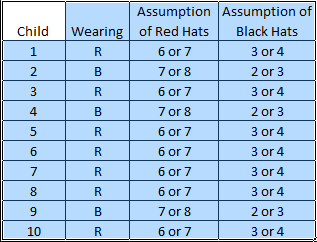
Hat_Table_zpsf340329a.png


Honestly i feel so dumb, i just can't see how this works...

If you're decent with Excel maybe my example (and formula) helps explain a little better...

28b6tzk.png


Now that formula is only considering red hat wearers, I did this for simplicity but you can extend to formula to work both ways and the result would be the same
 
Maybe the person who wrote the riddle worked out that you need that information for 0, 1 and 2 red hats (although I'm still not clear on 2 if I'm honest as it still isn't 'new information'), stopped there and presumed that would continue to be true no matter how much you scale up?

Assume we know theres two colours and at least one of each.

For 2 hats
=======
If theres 2 red hats, when #1 looks around and sees another red hat, he doesn't know if theres 1 or 2 hats so he can't say.
#2 red knows #1 red saw another red, can't see any more reds, so assumes it's himself.

For 3
=======
#1 red sees 2 red, but doesn't know if theres 2 or 3.
#2 red sees 2 red, knows theres at least 2 and accepts that #3 might be what #1 say to say "I don't know".
#3 sees 2. Knows that #1 sees 2 (not including #1) and #2 sees 2 (not including #2) so by looking about he can figure out its himself.

For 4
====
#1 red sees 3 red, but doesn't know if theres 3 or 4.
#2 red sees 3 red, knows theres 3 or 4 but can only know #1 sees at least up to 2.
#3 red sees 3, he knows theres either 3 or 4, but knows #1 can see 2 and #2 can see 2 but not whether either of them can see 3.
#4 can see 3. He knows that if there was 3 hats, #3 should have been able to guess the colour so he's able to deduct theres 4 hats and since he can only see 3, it's him.

You can continue this for infinity, as it'll always come down to "the number before me should have guessed this if it if there was n-1 hats.


The class needs to know theres only two colours at least 1 of each. The reason they need to knows theres at least one red is because when you have only 1 in play, the guy can assume theres 0, where as when theres 2 in play, red #2 can't assume red #1 actually sees any reds because there might be 0.

When you have 3 reds in play. #1 can see 2. #2 can see 2. #3 knows they can both see 1 and normally would assume #2 should have guessed but since #2 might only see 1 red and #2 might think #1 can see 0, #3 can't actually solve it.

So yeah the riddle worked, I'm just slow until I wrote it down. :)
 
You have a red hat on. 6 others have red hats on. 10 people have black hats on.

When everyone with a red hat has been asked you know that all red hats you can see have been accounted for. When the next black hat is asked and they say I don't know then you know that they can still see a red hat that hast been accounted for, this has to be you as you can see that all the remaining hats are black.
What do you mean "accounted for"? What about your scenario is "accounting for" the hats? Can you explain?
 
You have a red hat on. 6 others have red hats on. 10 people have black hats on.

When everyone with a red hat has been asked you know that all red hats you can see have been accounted for. When the next black hat is asked and they say I don't know then you know that they can still see a red hat that hast been accounted for, this has to be you as you can see that all the remaining hats are black.

This is the same for both scenarios.

The only way it wouldn't work is if no black hat is asked before asking the last red hat, however this is the same for both scenarios.

A red hat saying "don't know" means that there is still a red hat that hasn't been asked. It doesn't matter whether a black or red was asked before the last red :).
 
Back
Top Bottom