I can't wait for the 29th June so we can see some proper reviews and find out the real performance.
Something being announced on 24th iirc. Seen it a few pages back. Someone had a link to it.
Please remember that any mention of competitors, hinting at competitors or offering to provide details of competitors will result in an account suspension. The full rules can be found under the 'Terms and Rules' link in the bottom right corner of your screen. Just don't mention competitors in any way, shape or form and you'll be OK.
I can't wait for the 29th June so we can see some proper reviews and find out the real performance.
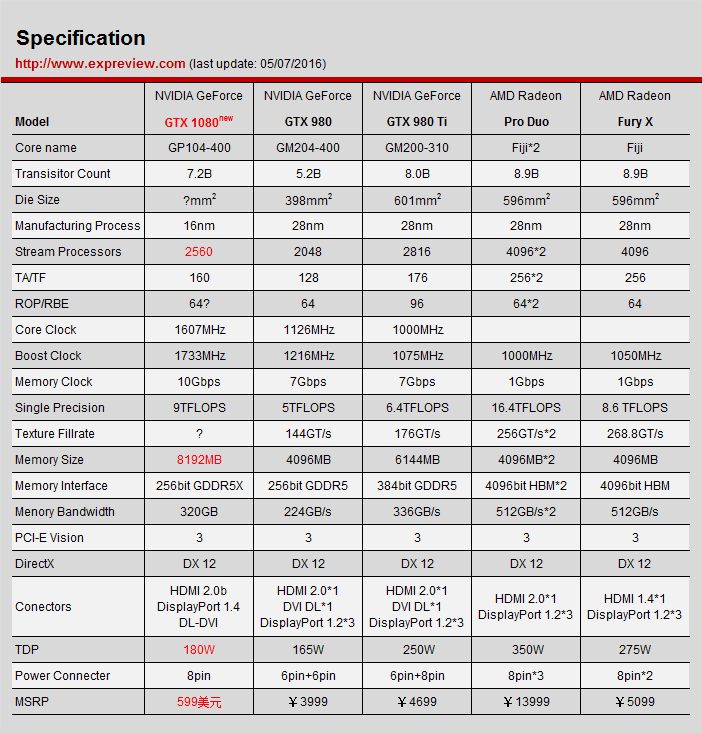
You realise the 980 Ti and 1080 both have about the same number of active transistors
As it looks now the rx480 will be around 2000-2100 Danish krones and the 390x can be had for 2600 Danish krones(DKK) so up front if the rx 480 is exactly 390x performance wise im not that impressed either. That said however it looks like the rx 480 will bring major overclocking potential with it and that is to me what makes it worth the 2000 DKK including ofcouse the power saving and hopefully noise reduction..
So you're saying you would spend more on a 390x at the same performance, but with more heat and power consumption and noise? Logical
This is what I see, besides clock speeds they don't have anything over Titan X and Ti.
the problem with the vr stuff doesnt the 480 (like the 10xx's) have superior vr magic hardwired in to it so by rights even if its slower than some cards in non vr it could very well be fast in vr ?
i dont know how the vr test works but id expect that said vr trickery would help that score up ?
Something being announced on 24th iirc. Seen it a few pages back. Someone had a link to it.
the problem with the vr stuff doesnt the 480 (like the 10xx's) have superior vr magic hardwired in to it so by rights even if its slower than some cards in non vr it could very well be fast in vr ?
i dont know how the vr test works but id expect that said vr trickery would help that score up ?
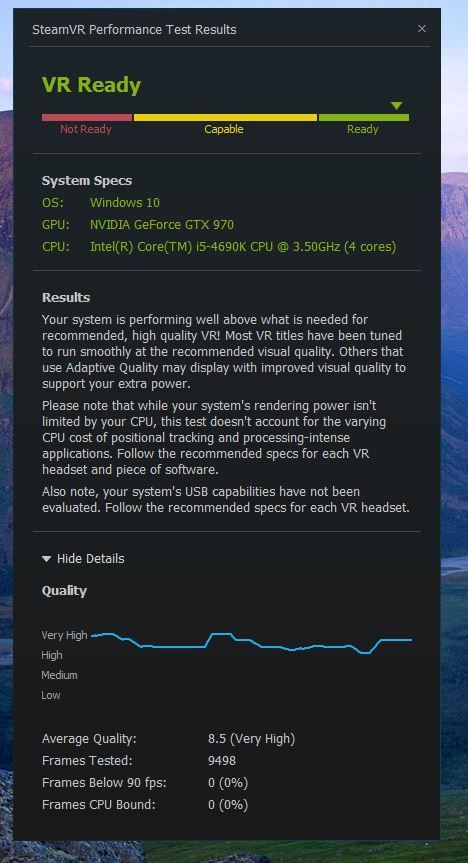
Should actually be around 7.5 or more then @ 1266Mhz.
As a comparison reminder.
970 @ Ref Stock 6.8
@ 1500/1950 8.5
Unlike the 10xxs which have specific technologies to give them a boost in vr, no such thing has been announced for polaris as far as I'm aware.
The question really becomes if the 480 was intentionally down clocked to offer "vr at low power." If not, then I have to wonder why anyone who is already planning on the ~600 dollar headset purchase wouldn't be willing to save just a little more for a 390x/980.
I can't wait for the 29th June so we can see some proper reviews and find out the real performance.
AMD haven't said anything about specific hardware for VR. Which is somewhat worrying IMO but we will see on the 29th.
Unlike the 10xxs which have specific technologies to give them a boost in vr, no such thing has been announced for polaris as far as I'm aware.
The question really becomes if the 480 was intentionally down clocked to offer "vr at low power." If not, then I have to wonder why anyone who is already planning on the ~600 dollar headset purchase wouldn't be willing to save just a little more for a 390x/980.
With the 1080 it is all about clockspeeds, there is nothing wrong with high clockspeeds but that is where the performance comes from.
The transistor count on that chart for the 980 Ti are not all active as the chip has some disabled compared to the TitanX.

I think we're saying the same thing


the problem with the vr stuff doesnt the 480 (like the 10xx's) have superior vr magic hardwired in to it so by rights even if its slower than some cards in non vr it could very well be fast in vr ?
i dont know how the vr test works but id expect that said vr trickery would help that score up ?
We are.
It does not matter how you get the performance as long as it is there.
i thought they said something at computex about it having vr wizardry in it, have to rewatch that now when i get chance.
Does make the situation seem even more artificial though (as in let's keep stuff off the card for when we'll need to get a Titan out).
(seriously wrong on the 980 a-sync part btw!I know, TFlops is just a theoretical performance calculation based on Shaders and Mhz.
Its not the be all and end all of performance.
Look at the 980 for example, it has 5 TFlops to the 390X 5.9 and yet they are very similar in performance.
The difference is the 980 has better tessellation culling, it has a better front end so can run more of its Shaders A-synchronously, at least in DX11.
 )
)