

You are using an out of date browser. It may not display this or other websites correctly.
You should upgrade or use an alternative browser.
You should upgrade or use an alternative browser.
Brexit thread - what happens next
- Thread starter Gilly
- Start date
- Status
- Not open for further replies.
More options
Thread starter's posts
Soldato
- Joined
- 1 Mar 2010
- Posts
- 6,316
The "hilarious" part is that we will simply adopt them as ours rather than make new ones.
But hey, putting a lion and unicorn onto a seal makes it all right. British stamps for British laws!

We may have been a big voice, but not to the same level of France and certainly not Germany.
They ultimately get the support of all other nations in the EU, even within it we were alone.
Perhaps in part because we voted in a bunch of MEPs that were actively hostile to Europe (that's if they turned up - see garages attendance history earlier in the thread))...
There is no reason we shouldnt have as large and active a voice as France and Germany, unless we just aren't very good at negotiating and diplomacy - in which case the next couple of years is going to get us a good kicking.

Soldato
- Joined
- 23 Oct 2002
- Posts
- 13,599
very pessimistic of you... we're perfectly capable of making our own agreements and/or linking up with others if needed
EFTA would be a good move... some sort of close arrangement with countries such as Australia, Canada, New Zealand etc.. would be a good long term move.
Who are part of two trade blocs APEC and NAFTA. You are swapping EU rules and regs for their rules and regs. You cannot pick off one country anymore, the world has been moving to trading Blocs. TTIP was meant to be a trade deal between two trade blocs.
The 250 back to February levels.

What happened in February related to Brexit though ?
Soldato
- Joined
- 1 Mar 2010
- Posts
- 6,316
Out of interest was there actually anything that banned us from doing that as part of the EU? Out of the schlagen area we were allowed to set our own visa terms and have our own visas for skilled workers for example, with someone with a skilled worker visa in the UK needing another visa to work/visit the rest of the EU.
We could've started non-EU free movement any time we wanted to, especially unilaterally, but it would've needed actual spending on infrastructure and very different rhetoric. The headline numbers would've sent nutters into a tailspin too.

Out of interest was there actually anything that banned us from doing that as part of the EU? Out of the schlagen area we were allowed to set our own visa terms and have our own visas for skilled workers for example, with someone with a skilled worker visa in the UK needing another visa to work/visit the rest of the EU.
as far as visas are concerned, no not really (at least not directly). Though the tightening of immigration requirements for the rest of the world is partly because we've also had so many people coming from EU countries unrestricted - a large chunk of whom wouldn't be allowed here under non-EU rules - this lead to political pressure to crack down on immigration which can only be applied to non-EU migrants which as meant things like foreign students no longer able to stay on in the UK for a year after graduation etc.. people in Australia, New Zealand, Canada would like to see a relaxing of restrictions on movement between those countries which could be feasible if we can control/tighten EU migration.
but as far as trade is concerned we're now(or will be) free to crack on and likely to get deals done much more efficiently with those countries
Last edited:
The "hilarious" part is that we will simply adopt them as ours rather than make new ones.
Costliest EU regulations
In 2013 prices, Open Europe estimates that the total cost to the UK economy of the top 100 most expensive EU regulations is £27.4 billion a year. The figure is based on data from the UK Government’s Impact Assessments (IAs) of these regulations. This includes the cost of EU laws that have already been passed, but have yet to come into force – such as the new capital rules for the insurance sector (Solvency II).
According to the Impact Assessments (IA), the top 100 EU regulations provide a total benefit of £57.1 billion a year. Of this, £45.1 billion stems from just three items (EU climate targets – £20.4 billion; rules on the capital held by banks – £15.3 billion; and rules on payments across the EU – £9.4 billion). However, these benefits are almost certainly vastly over-stated. For example, the estimated benefit of the EU’s climate targets was dependent on a global deal to reduce carbon emissions that was never struck. In fact, Open Europe estimates that up to 95% of the benefits envisaged in the UK Government’s IA have failed to materialise.
Taking the regulations individually, the UK Government’s own IAs show that, for 24 of the top 100 EU laws, the estimated costs outweigh the estimated benefits. Therefore, these regulations clearly result in a net cost to the UK economy – which comes to a combined total of over £3 billion a year. These regulations include the Temporary Agency Workers Directive and the Energy Performance of Buildings Directive.
A further 33 of the costliest EU regulations present a ‘net cost’ simply because the benefits either haven’t been quantified or the benefits are intangible and therefore ‘non-quantifiable’ (such as a better work-life balance in the case of EU working time rules or stronger investor protection in the case of EU rules on hedge funds). For example, the Working Time Directive represents an estimated cost to the UK economy of £4.1 billion a year and the benefits are unknown.
EU regulation can come with benefits, particularly if it helps facilitate trade across the single market. It would also be wrong to assume that, if the UK were to leave the EU, the costs described above would disappear overnight. The reality is that the UK would be likely to keep a good number of these laws in part or in full, such as rules on anti-discrimination, some health and safety rules, food safety standards, and so forth. At the same time, the UK would no longer benefit from many of the EU rules that give British business access to European markets – such as ‘passporting rules’ for financial firms.
Recommendations
Open Europe recommends that the best option for now is for the UK to seek to change these rules from within the EU. To this end, initiatives such as the report on how to cut EU red tape, prepared by the UK Government’s ‘Business Task Force’, are welcome – but they need to be followed by concrete action to reduce the existing and future burden of EU regulation on European and British businesses.
In addition, Open Europe believes that serious thought must also be given to creating a mechanism for national parliaments to review and repeal EU laws that impose a net cost on the economy or do not, in practice, deliver the benefits promised.
Frankly this is a google copy and paste but none the less, with less regulation by the EU we can out manufactor it with lower cost. I'd imagine that they are quite worried to be fair, and I wish our government would walk into talks, with some sense, (over inflated or not) that we do potentially hold a set of aces.
![[TW]Fox](/data/man-of-honor/2009.png)
What happened in February related to Brexit though ?
Referendum date announced.

So are you saying EU immigrants shouldn't get in-work benefits like locals, or that they shouldn't get away with fraud?
I thought the "emergency brake" we heard so much about was basically this, a way to halt in-work benefits?
Might be worth reading this:
http://www.telegraph.co.uk/news/201...d-cameron-asked-for-and-what-he-actually-got/
Effectively we got something towards what we wanted but it sounds very watered down, with Brussels have the say when you can invoke it and a pro-rata scheme, it isn't that useful.
We could do that already.
We can't. In the EU you can not have your own free trade agreement. For example the EU does not have an agreement with Canada but Norway does. What makes it better to have your own is it is tailored to your needs. You do not need to accommodate the needs of all of the other 27 countries.
Who are part of two trade blocs APEC and NAFTA. You are swapping EU rules and regs for their rules and regs. You cannot pick off one country anymore, the world has been moving to trading Blocs. TTIP was meant to be a trade deal between two trade blocs.
no other trade block has required the political union that the EU has and they being members of those trade blocks doesn't stop them from negotiating with us... again unlike the EU. Their trade blocks don't restrict them like that, EFTA doesn't restrict countries like that... the EU does though!
And yes you can pick off one country - it wasn't NAFTA that did a deal with the EU it was Canada! And you're wrong on TTIP too - that is a deal between the US and the EU... again country to trade block not trade block to trade block.
In the longer term there is nothing stopping us from forming another trade block (and indeed strengthening EFTA if we join that... there might still be other countries leaving the EU too)
Last edited:


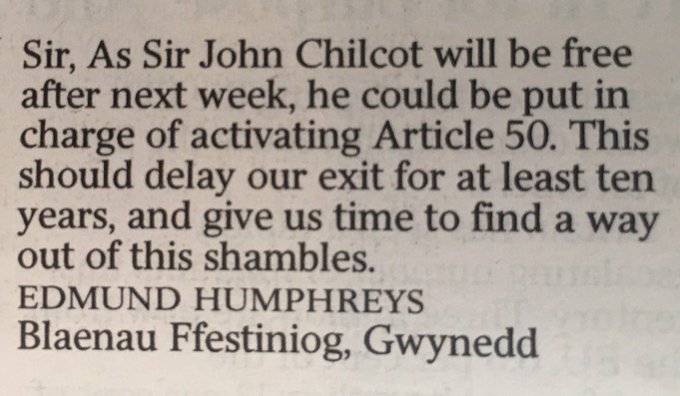
I suggested that in another forum, Sir John Chilcot maybe our only last hope.

as far as visas are concerned, no not really (at least not directly). Though the tightening of immigration requirements for the rest of the world is partly because we've also had so many people coming from EU countries unrestricted - a large chunk of whom wouldn't be allowed here under non-EU rules - this lead to political pressure to crack down on immigration which can only be applied to non-EU migrants which as meant things like foreign students no longer able to stay on in the UK for a year after graduation etc.. people in Australia, New Zealand, Canada would like to see a relaxing of restrictions on movement between those countries which could be feasible if we can control/tighten EU migration.
but as far as trade is concerned we're now(or will be) free to crack on and likely to get deals done much more efficiently with those countries
Spot on. This is a good read:
http://www.cityam.com/241014/back-o...ealth-friends-and-allies-would-welcome-brexit
Soldato
- Joined
- 14 Feb 2004
- Posts
- 14,316
- Location
- Peoples Republic of Histonia, Cambridge
It really is tough love for Scotland
http://www.bbc.co.uk/news/uk-scotland-scotland-politics-36656980
http://www.bbc.co.uk/news/uk-scotland-scotland-politics-36656980
Wow. Never heard anyone say this before. Enlighten us all on why the EU will collapse in the three or so months.
I can't see into the future, it is just another option that can happen, are you so sure it will be in the next 3 months?
That's a common British take on this, and as expats can attest it's also commonly wrong. We are far from 'same', heck even Kiwis and Aussies aren't clones in terms of their approach to issues like consumer rights, workers, markets, etc, and it doesn't remove the legal difficulty of forging trade links, staff requirements and time for those links to bear meaningful fruit.
Moreover, people also labour under the illusion that Commonwealth countries will hand us any more favourable deal that for say Vietnam, Singapore, SK or the like, merely on a good feeling. I'd wager they'll argue for fairly tit-for-tat terms, angling for advantage just as hard if not harder than the EU, knowing our difficulties in Europe. So although we might get to dictate to New Zealand, Canada and Australia would end up dictating a few uncomfortable things back, again re food, raw materials, services and other magical things.
Then you wake up one day and face several more trade deficits and more expensive shipment costs in a less regulated market. Isn't the Commonwealth wonderful?
I'd be very interested to know how the British sheep farmers would react to a as being free sell its sheep tarrif free in the UK, in return for no state subsidy. Same with whether the Canadian beef industry would be happy with trading commonwealth wide on the same terms as the Australian beef industry. There would also be lumber industries.
Those are just three things I can think off the top of my head that could make a single market very interesting to negotiate between four apparently similar nations.
Soldato
- Joined
- 1 Mar 2010
- Posts
- 6,316
We can't. In the EU you can not have your own free trade agreement. For example the EU does not have an agreement with Canada but Norway does. What makes it better to have your own is it is tailored to your needs. You do not need to accommodate the needs of all of the other 27 countries.
But you can't sell them that much in terms of access to the EU either, which is what we like to do, essentially being (erstwhile) brokers of the bloc. That's in essence our trade strategy. Particularly worrying in terms of the EU getting the common services market sorted, and us falling behind that.
It really is tough love for Scotland
http://www.bbc.co.uk/news/uk-scotland-scotland-politics-36656980
Very good news for remain though (and not breaking up the UK) I imagine. Scotland will definitely be pushing for an overturn even more now
 .
.[TW]Fox;29714196 said:Referendum date announced.
Bwahahaha
We are sooo ******!
This is god-damn tragic and yet people are trying to spin the whole exit as a success story for the common man.
The common man is a god-damn idiot.
- Status
- Not open for further replies.