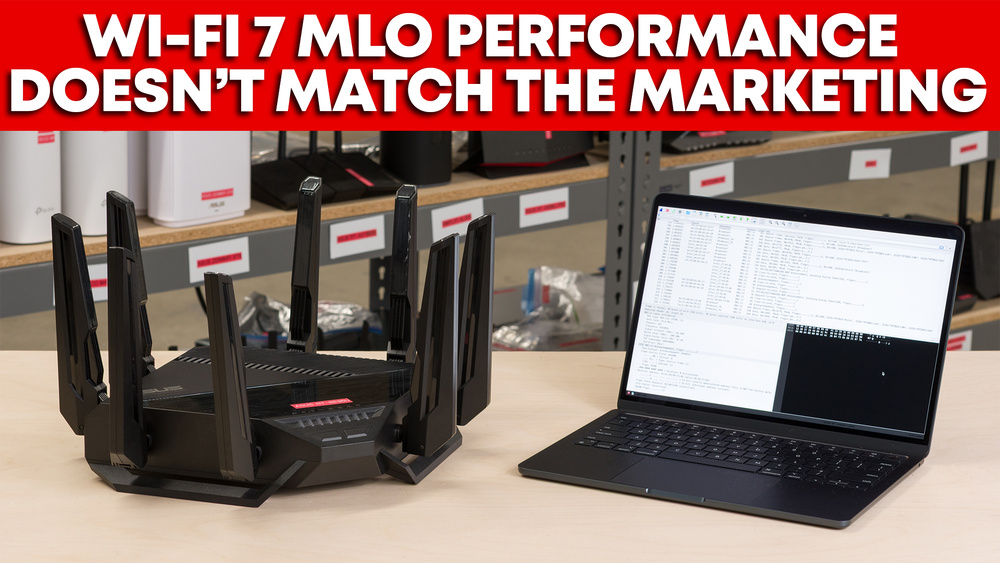

The disappointing reality that no consumer Wi-Fi 7 routers feature the full feature set

WiFi6 is currently good enough for me
Set it up well with good placement of APs and channel selection and you're golden

I get good latency and a minimum of 400mbps no matter where I am in the house. (800+ in the same room as an AP)
 
WiFi7 is half baked and its more desirable features are usually implemented poorly. It needs more time to mature, be adopted, and be better implemented.

And unfortunately the average consumer not realise and believe the marketing and high price is worth it
 
Last edited:
IIRC Wifi7 spec has been a bit half-arsed since it's creation, with a lot of "optional" features, meaning that a device could technically be wifi7, but has very little benefit from wifi6.

I've only upgraded to wifi6 at home this year, I'd been running wifi5 for ages, and tbh I probably still would be if I didn't get a good price on some wifi6 WAPs. If I want speed/reliability in my connection, the device gets hardwired, wifi is just a unfortunate neccessity for the few devices that need to be mobile, and there's no massive data requirements on those.
 
It was much the same with Wifi 6, not every device supports all the features, this is nothing new.
 
New tech is always like this. 6 was the same, it took a short while to establish, the biggest feature for me was OFDMA. It's only time before the gen2 WiFi7 AP's come along and really nail MLO. That and when "most" consumer hardware starts shipping with WiFi7 as that's the biggest driver.
 
Last edited:
Won't matter anyway as people will still be unnecessarily using separate ssids for each frequency band as it it's 2009
</Sarcasm>
 
It’s usually the same pattern, early adopters are sold over priced hardware that fails to deliver/support the ratified standard fully/what is marketed, and in practical terms they will rarely use the capabilities of anyway.
 
I guess manufacturers must roll out hardware and then apply for certification later?

Shame they didn't put any Zyxel devices on there (I use the NWA130BE units). Given these only cost me £139 ex. vat I don't feel too ripped off. :cry:
 
Won't matter anyway as people will still be unnecessarily using separate ssids for each frequency band as it it's 2009
</Sarcasm>
Unfortunatly I still have some devices (main one I can think of is my Harmony Hub) that has problems with a joined SSID, so I need to keep a seperate 2.4 network.
 
Unfortunatly I still have some devices (main one I can think of is my Harmony Hub) that has problems with a joined SSID, so I need to keep a seperate 2.4 network.
Having a separate 2.4ghz is fine, but there is no reason not to have all available bands on your main SSID these days. (Whereas we keep seeing people recommending 6ghz and 5ghz only ssids)
 
I have no excitement over Wifi 7. 6 speeds are more than ample for 99% of my needs on wireless devices.

From what I've seen a lot of the Wifi 7 AP's are quite power hungry and run hot, some even with active cooling. They are also very expensive for what little gains I'd really see.

I have separate 2.4 and 5Ghz SSIDs, but the 2.4GHz one is purely for IOT devices on a separate VLAN. All other devices like phones and laptops are 5Ghz only, works a charm.
 
Last I checked I think the MediaTek Wifi 7 chips got MLO support about 2 months ago in commits.

Funny that an open source project coded in spare time is ahead of companies with literally hundreds of millions going into it.
 
I guess manufacturers must roll out hardware and then apply for certification later?

Shame they didn't put any Zyxel devices on there (I use the NWA130BE units). Given these only cost me £139 ex. vat I don't feel too ripped off. :cry:
A fellow Zyxel lover! I was going to mention the 130BE but you get told to sit in the naughty corner on here if you mention anything not UBNT :p
 
Back
Top Bottom