• Competitor rules

    Please remember that any mention of competitors, hinting at competitors or offering to provide details of competitors will result in an account suspension. The full rules can be found under the 'Terms and Rules' link in the bottom right corner of your screen. Just don't mention competitors in any way, shape or form and you'll be OK.

9800X3D Failures/Deaths in the UK?

Failures consistent with the symptoms have been seen on other boards and CPUs but far less often - there are probably like 1 instance on Gigabyte for every 200+ on ASRock - 9800X3D + ASRock combination seems to be several orders of magnitude more likely to encounter the issue. The issue also seems to be far more likely on specific batches but other batches don't make you 100% immune to it (this potentially goes for both CPU batch and motherboard batch as there seems to be more than one factor involved).

It is a bit of a weird one.

Ironically for all the drama about Intel's 13th and 14th gen degradation there are far more actual reports of 9800X3Ds failing - there is 1-3 reports a day currently of AMD CPUs failing with symptoms consistent with these issues.

EDIT: I will also add here that 9800X3D failure rates at retail are still very very low - it is still one of the least returned by percentage of sold, though due to the fairly high volume of sales makes up a considerable percentage of returned CPUs by unit.


It seems, like the drama concerning that of Intel 13th and 14th Gen, it can be difficult to understand the scale of the actual problem and, this AMD situation, how far that extends beyond that of Asrock, chipsets and CPU types.
Whilst my soft spot for Gigabyte is largely based on familiarity and excellent customer service based in the UK, it seems the yare not as greatly affected, albeit that could well be influenced by the popularity of the Asrock boards.
In some ways, for me, it is becoming a moot point as RAM pricing may well influence any thoughts of a family member considering a replacement build.

 
It seems, like the drama concerning that of Intel 13th and 14th Gen, it can be difficult to understand the scale of the actual problem and, this AMD situation, how far that extends beyond that of Asrock, chipsets and CPU types.
Whilst my soft spot for Gigabyte is largely based on familiarity and excellent customer service based in the UK, it seems the yare not as greatly affected, albeit that could well be influenced by the popularity of the Asrock boards.
In some ways, for me, it is becoming a moot point as RAM pricing may well influence any thoughts of a family member considering a replacement build.

Yup. It's crazy the ram prices are right now.
 
Mate I can only speak from experience and my cpu died on the asrock. I've been building pc since 486 days and I've never ever ever had a cpu die on me.

Have done some Crazy stuff with builds from custom water blocks. Over clocking etc etc.

Heck I have motherboard and cpu that's that I bought when we was still a member of the EU mate and all working fine.

I jumped on asrock because they at the time had the best lane sharing but not anymore.

Have been a Asus fan before then and past 3 or 4 gens have been Asus board.
Same here, Asus ROG and Gigabyte SOC boards, never had a CPU fail and been happily playing around with PC"s since socket 462.

Really wish we had a definitive answer and statement from Asrock regarding this.
 
Same here, Asus ROG and Gigabyte SOC boards, never had a CPU fail and been happily playing around with PC"s since socket 462.

Really wish we had a definitive answer and statement from Asrock regarding this.
Yep me too, loved ASUS and MSI personally and kind of wish I had gone MSI as it seems I can get away with 3 drives and a working PCI slot for my sound card. However I have to say as long as my Nova doesn't kill my 9800X3D it's the best most feature complete board I have ever owned.
 
Last edited:
Before the 9000 series of CPU's came out there could have been a very limited issue going on, noting the 7800x3D, although with a sample size of one that might be insignificant for a wider issue.

I think this is what you are referring to a few years ago that stopped with some BIOS updates.

There been a few times that a bios had to be released to address burning CPU issues as the bios settings where too aggressive or the stock setting is Intel's extreme power setting at release but I guess its encouraged as it get favourable reviews and it has to be this way as a lot of reviewers have next to no BIOS/tuning knowledge.

I have not read about any official AMD response to this..? Remembering that it can seem to be an occasional occurrence on other brands of boards, not like Asrock though..?
There's this from one of my previous posts in this thread though ASRock are by far the worse offender:


There was something else about the bios issues on ASRock boards being down to memory compatability on the earlier bios versions.
 
Failures consistent with the symptoms have been seen on other boards and CPUs but far less often - there are probably like 1 instance on Gigabyte for every 200+ on ASRock - 9800X3D + ASRock combination seems to be several orders of magnitude more likely to encounter the issue. The issue also seems to be far more likely on specific batches but other batches don't make you 100% immune to it (this potentially goes for both CPU batch and motherboard batch as there seems to be more than one factor involved).

It is a bit of a weird one.

Ironically for all the drama about Intel's 13th and 14th gen degradation there are far more actual reports of 9800X3Ds failing - there is 1-3 reports a day currently of AMD CPUs failing with symptoms consistent with these issues.

EDIT: I will also add here that 9800X3D failure rates at retail are still very very low - it is still one of the least returned by percentage of sold, though due to the fairly high volume of sales makes up a considerable percentage of returned CPUs by unit.

Yes, the drama of the Intel event, did give an impression of being far greater than the actual failure rate. I suppose the point being that both Intel and the board manufacturers, possibly all of them for the higher spec boards, were typically using settings way outside of a recommended only setting, as well as later microcode changes that stopped various voltage spiking occurring during load transitions. There may well be more to that than I can remember.
I remember buying my first AL, a 12700k, and a Gigabyte Z690 board, both of its power limits were set to unlimited at the time, BIOS defaults only used, no performance profiles etc. Even at the very start I assumed that was not good, but only part of the issue it turned out, and so used Intel's recommended power limits.
I get the impression that those power limits were typically ignored, perhaps Asus being the worse offender for aggressive settings. The situation made far worse when the RL 14th Gen arrived. Not only power limits, but general high vcore and power spikes from the problems with the CPU's.

There did seem to be something to actually point at with the Intel / board manufacturers deteriorating situation. If Intel actually had something meaningful to replace AL and RL before they pumped out the 14th Gen, thinking more 14900KS then some of the frying / failings might have been avoided, at least at the sensational level.

With this AMD / Asrock / Others though, isn't it a little more obscure as to its causes, and, seemingly, less orchestrated by events, unlike Intel....?
 
Last edited:
Yes, the drama of the Intel event, did give an impression of being far greater than the actual failure rate. I suppose the point being that both Intel and the board manufacturers, possibly all of them for the higher spec boards, were typically using settings way outside of a recommended only setting, as well as later microcode changes that stopped various voltage spiking occurring during load transitions. There may well be more to that than I can remember.
I remember buying my first AL, a 12700k, and a Gigabyte Z690 board, both of its power limits were set to unlimited at the time, BIOS defaults only used, no performance profiles etc. Even at the very start I assumed that was not good, but only part of the issue it turned out, and so used Intel's recommended power limits.
I get the impression that those power limits were typically ignored, perhaps Asus being the worse offender for aggressive settings. The situation made far worse when the RL 14th Gen arrived. Not only power limits, but general high vcore and power spikes from the problems with the CPU's.

There did seem to be something to actually point at with the Intel / board manufacturers deteriorating situation. If Intel actually had something meaningful to replace AL and RL before they pumped out the 14th Gen, thinking more 14900KS then some of the frying / failings might have been avoided, at least at the sensational level.

With this AMD / Asrock / Others though, isn't it a little more obscure as to its causes, and, seemingly, less orchestrated by events, unlike Intel....?
Well i am just enabling XMP and thats it, no more tweaking the cpu.
 
Well i am just enabling XMP and thats it, no more tweaking the cpu.


Indeed, albeit I'm using the 265k. Prior to the various microcode changes, when I had the 14700k, I would reduce both power limits to Intel's recommended and then run with a negative vcore offset. I hoped that helped, needing the later microcode releases to help with the power spikes when loads would transition.
 
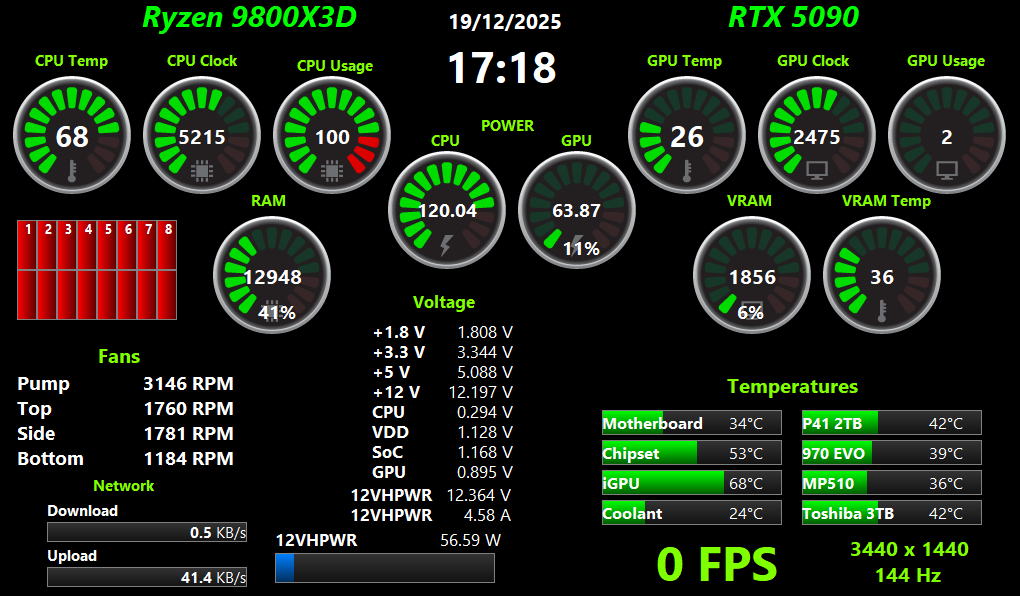
I did drop SOC voltage to 1.15 and SOC LLC to Level 2 (default level 3, not sure why) as some people suggest. Hope it lives a nice long life
(CPU voltage is wrong, AIDA might need an update).

Screenshot-2025-12-19-171855.png
 
I did drop SOC voltage to 1.15 and SOC LLC to Level 2 (default level 3, not sure why) as some people suggest. Hope it lives a nice long life
(CPU voltage is wrong, AIDA might need an update).

With the SOC voltage, at stock my ASUS board was putting 1.25v. I've set it to 1.2v, but is 1.15 what the recommendation is?

If so are most 9800X3D stable at that voltage or would I need to stress test the same way I would if I tried setting a -40 curve lol.
 
I'm increasingly thinking G.Skills RAM massively increases the chances of these failures happening though can't be sure or say why. Though other combinations don't make you immune to the problem. I've been noticing for awhile it seems to be prominent with these failures even when factoring in the sales share (as it is a popular combination) though I don't think the RAM itself is at fault so to speak.

Just seen another instance on Reddit where someone had a 9800X3D and 9850X3D die in a short space of time while using G.Skills Neo and an acquaintance online hasn't had a repeat death so far since changing out their previous G.Skills RAM when they upgraded to 64GB along with the replacement CPU after having more than one 9000 series CPU fail on their ASRock board amongst several similar instances (and most of the people who reply on these posts saying they haven't had a problem and listing their specs are using other brands of RAM).
 
Last edited:
I'm increasingly thinking G.Skills RAM massively increases the chances of these failures happening though can't be sure or say why. Though other combinations don't make you immune to the problem. I've been noticing for awhile it seems to be prominent with these failures even when factoring in the sales share (as it is a popular combination) though I don't think the RAM itself is at fault so to speak.

Just seen another instance on Reddit where someone had a 9800X3D and 9850X3D die in a short space of time while using G.Skills Neo and an acquaintance online hasn't had a repeat death so far since changing out their previous G.Skills RAM when they upgraded to 64GB along with the replacement CPU after having more than one 9000 series CPU fail on their ASRock board amongst several similar instances (and most of the people who reply on these posts saying they haven't had a problem and listing their specs are using other brands of RAM).
Just for the sake of posterity, my 9800X3D died with Kingston RAM in the system.
 
Just for the sake of posterity, my 9800X3D died with Kingston RAM in the system.

Was wondering what RAM you were using. Certainly avoiding G.Skills doesn't make you immune but it seems to significantly elevate the chances for some reason. I wonder if there is still some obscure AGESA bug which is incorrectly duplicating the memory voltage into VSOC or something under certain circumstances.
 
Was wondering what RAM you were using. Certainly avoiding G.Skills doesn't make you immune but it seems to significantly elevate the chances for some reason. I wonder if there is still some obscure AGESA bug which is incorrectly duplicating the memory voltage into VSOC or something under certain circumstances.
That could well be one of the causes, but who can say? It's absolutely wild that there is still no headway on this issue being figured out by AMD and the board vendors affected.
 
When these CPU's fail has it ever been noted that other Ryzen CPU's could also fail in a similar catastrophic way, I mean those that are not x3d type..? There should be people using non-x3d type Ryzen's with similar memory brands and boards as used by those with frazzled x3d ones..?
 
Back
Top Bottom