RISC OS PC

Associate
Joined
30 Jan 2019
Posts
1,104
About 5 years ago I built a small RISC OS PC from an old mini retro beige PC case complete with a 3.5 inch floppy drive and small 32GB SSD, Raspberry Pi with PS/2 mouse/keyboard input, Audio/mic output but it was never probably completed as I needed to find a way to connect the floppy drive to the Pi. It has the original PC PSU to drive the Pi and to power other things like USB and floppy drive. It has also got two external USB ports on the back. I also have the power L.E.D to redo because I used the wrong resistor and hook up the HDD L.E.D indicator. If I can remember rightly it was 580 ohm resistors that I need to use.

I'm going to get it back out because I want to play Badger Trails, its got the Raspberry Pi version of RISC OS but I want the original Acorn RISC OS ROM but I'm also wondering if I could get a modern internet browser going on it but no problems if not I got more games and stuff to load into it. I've still got to find more of the old educational games I remember playing back in school in the 90s.
 
Last edited:

There used to be a browser maintained for the proper RISC OS but it is relatively limited to compared to a modern PC browser, no idea about the Raspberry Pi flavour but I suspect as that is more regularly maintained someone is doing it. (EDIT: Think it is https://www.netsurf-browser.org/ but it has been awhile since I dipped into this stuff).

There is a fairly comprehensive emulator Red Squirrel and/or Virtual Acorn if you are able to get hold of the ROMs. There are archives around of many of the old Acorn User, etc. magazine discs which have a lot of demo and full versions of the old educational games, etc. unfortunately I'm a bit out of touch but a lot of that stuff was available in various archives online i.e. https://arcarc.nl/archive/Magazine Discs/Acorn User/
 
Last edited:
Some years back I wanted to build a RISC OS Acorn PC which was the easy part but finding all the old educational games that I played a lot were impossible to find because many titles had completely disappeared from history but this evening I've made a breakthrough with at least finding some traces of the history of the titles. Unfortunately none of them are available for download other than Fun School 4 which isn't the full version of the game. Its great to finally find something even if it is just some info and a few pictures of the old games.

Badger Trails - many people remember this game and its documented but no way of getting a download.

Darryl The Dragon - There is some documentation of this game but no download

Space City - I finally found it in the Acorn Archimedes history site after years and years of finding nothing on this game at all plus a picture of the game cover. No download tho but I am happy just to find some kinda history on it after all these years.

Table Aliens - it seemed to be a remembered game by others but no history other than a bit of text in A.I google search to say it was a common RISC OS educational math game in schools in the 90s

Around the World in 80 Days - Seems to be plenty of history on this although the game had many different versions for other systems throughout the 90s and 2000s but I am only interested in the RISC OS version from the early 90s.

Granny's Garden - There was a version of this game for RISC OS on the Acorn Archimedes A3000 but all history on that version has gone. all I can find is info on the version made for the BBC Micro.
 
Last edited:
Just gonna say I played grannies garden in junior school age 10? Lol that's a blast from the past

What was the survival one called?
You picked your starter kit and used it to progress.
 
I remember spending many a lunch break playing Chocks Away with my friends in the Tech departments Archimedes at high school. Always liked them but most of us had Amiga's at home. Its a shame because Archimedes where very capable machines in some ways they might even had been more powerful than the Amiga's at that time.
 
Bought an Archimedes 310 at the beginning of my final year at uni (1989). Used it for my final year project involving speech recognition.

Build an analogue to digital convertor interface board and wrote the software involving a machine code fast Fourier transform algorithm.

Happy days - kept it until the thing stopped booting in about 2015
 
I remember spending many a lunch break playing Chocks Away with my friends in the Tech departments Archimedes at high school. Always liked them but most of us had Amiga's at home. Its a shame because Archimedes where very capable machines in some ways they might even had been more powerful than the Amiga's at that time.

The Archimedes was a lot more powerful then the A500, despite dumping pretty much all the work on the CPU. The problem was the CPU was basically bespoke, while everything else on the desktop was using Intel or Motorola 60000 chips. If some of the big names in software had supported the platform it could well have done very well.

The other problem with the processor, well it was quite good. Apple started using it a their Newton, and DEC (who at the time were almost as big as IBM, in the mini computer space) wanted to develop their own version as well.

Suddenly their computer business was basically a side hustle, and their main job was licensing their CPU designs or in some cases just the instruction set.

They accidentally developed a new model, where a company could basically license however much of the CPU technology they wanted and then do the rest themselves.

Their CPU division changed it's name to Advanced Risc Machiness and the rest is history.

As a footnote, I'm a recent convert to the Mac. The other day I learned how Mac applications get packaged. It's basically the same way it was done on the Archimedes.
 
I remember writing machine code for a variety of CPUs and DSPs in the 80s and 90s. Acorn Risc was by far my favourite. The simplicity of the instruction set made optimisation so much easier.
 
I remember writing machine code for a variety of CPUs and DSPs in the 80s and 90s. Acorn Risc was by far my favourite. The simplicity of the instruction set made optimisation so much easier.

I really wish I'd got more into coding back in the day, I only got as far as basic. Unfortunately when I was at school computer science had been completely marginalised and replaced with ICT.
 
The Acorn Archimedes was well ahead of its time. I remember back in 1999 the school was throwing away all the Acorn gear because all the computers were getting replaced with PC's So I rescued an Acorn A3000 with its mouse and Acorn color monitor. When I bought it home some of my mates thought it was glorified calculator or about advanced as there Nokia 3310 only to see it actually had a desktop with photograph graphics and could run games that were not far off from what you could do in a Windows 95 PC.
 
The OS was well ahead of its time, even if a few bits are clunky today and/or the "3D" graphic overhaul with 3.5 looks a bit silly now.

Anyone remember the Icon Sprite virus? - when I was at school I wrote a comprehensive antivirus to defeat it because it was spreading on the school network (Nexus?) and while relatively harmless it was a bit annoying and my IT teach laughed at me :( they did eventually put some kind of antivirus on the network, possibly !Killer but it wasn't very good - so I quietly embedded my own and it was still running, and actively slapping the odd virus down, until the school replaced the Acorns with RM PCs.
Spent far too many hours playing with the template editor.
 
The OS was well ahead of its time,

There was actually quite a lot of exciting stuff going on in the early to late 90s. The trouble is we were very much moving from a world with many platforms to fit many niches to a world were one platform would dominate. The thing that made the PC very successful was the vast number of businesses working on it. At some point Commodore, Atari, Acorn and Apple all dropped the ball in one way or another as did IBM. However the thing that made the difference was other manufacturers picked up the slack. The competition also brought down prices.

It also helped that Microsoft were very much leading the software side of things, and had a way of dealing with their competition. They were pragmatic, most of the competition (except Apple!) wanted an OS that ran impeccably and pleased computer scientists. Microsoft however had realised their efforts were better invested making sure their OS was on majority of machines and ran the software businesses wanted.
 
Last edited:
I remember when the school got Windows 95 PC's although there was an Acorn computer running Windows 95 but I can't remember what model it was, my guess is that it had a Intel 486 plugin board to run Windows 95 and would have had to have at least 8MB of RAM to run it. The launch Windows 95 was like a revolution and was ran on PC's considered cutting edge at the time but that quickly changed when Windows 98 came out and the school got its first lot of Windows 98 PC's probably Pentium II machines and then all the Acorn machines were getting scrapped, either getting thrown out or given away.
 
Last edited:
I remember when the school got Windows 95 PC's although there was an Acorn computer running Windows 95 but I can't remember what model it was, my guess is that it had a Intel 486 plugin board to run Windows 95 and would have had to have at least 8MB of RAM to run it. The launch Windows 95 was like a revolution and was ran on PC's considered cutting edge at the time but that quickly changed when Windows 98 came out and the school got its first lot of Windows 98 PC's probably Pentium II machines and then all the Acorn machines were getting scrapped, either getting thrown out or given away.

Yeah I can't remember details now but I think it was a 386 plug-in board - we had one setup like that at school running Windows 95. I remember early versions of it did something odd where the system HDD was mapped to A: and floppy drives would start at C: which was just confusing.

EDIT: Aleph One that's the thing (at least the flavour we had at school) there was later 486 models but most of them were 386 based.

 
Last edited:
Yeah I can't remember details now but I think it was a 386 plug-in board - we had one setup like that at school running Windows 95. I remember early versions of it did something odd where the system HDD was mapped to A: and floppy drives would start at C: which was just confusing.

EDIT: Aleph One that's the thing (at least the flavour we had at school) there was later 486 models but most of them were 386 based.


Plug in boards to add CPUs was a very Acorn thing, their earlier BBC B machines had a 'Tube Port' to allow extra processors. You could pretty much add any CPU you wanted. Oh and those ARM processors they invented, well they needed something to try them in before Archimedes had been fully developed. So the processor that's basically taken over the world, well it started it life in those funny computers that you only used to see in schools.

 
Plug in boards to add CPUs was a very Acorn thing, their earlier BBC B machines had a 'Tube Port' to allow extra processors. You could pretty much add any CPU you wanted. Oh and those ARM processors they invented, well they needed something to try them in before Archimedes had been fully developed. So the processor that's basically taken over the world, well it started it life in those funny computers that you only used to see in schools.

Just out of interest what is the processor chip called?

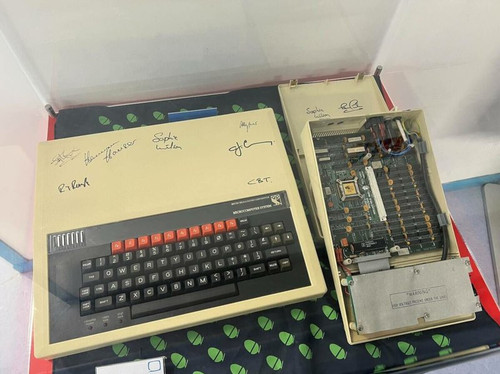
I still have one BBC Micro but one of the chips failed... if I remember rightly it was something on the lines of 2625 something chip, or it could be called 652 something?

I will have to bring it out and have a look at it to see if there are any part numbers on the bad chip to get a replacement.

I sold the others I had but I remember swapping the chips to see which one was bad from a working one I had but I've since sold the other BBC Micros I had. There are two of those chips and I think they were for the ROM but only one is bad. If I'm going to sell the broken one on I'd rather sell it working by finding a replacement chip but I am in two minds on whether to keep it.

Edit: I think its the 62256 chip I need.
 
Last edited:
Back
Top Bottom