

I know I have a "tech toys" addiction and have been trying VERY hard to NOT buy moreIn fairness when I last did a bit of a consolidation, it was really an excuse to buy new toys.
You are using an out of date browser. It may not display this or other websites correctly.
You should upgrade or use an alternative browser.
You should upgrade or use an alternative browser.
Electricians?
- Thread starter GR63
- Start date
More options
Thread starter's posts
But if you get one new toy to replace two old toys that’s a problems halved right?I know I have a "tech toys" addiction and have been trying VERY hard to NOT buy more

But if you get one new toy to replace two old toys that’s a problems halved right?
Having cleared out my Dads and now my Mum'sthings when they died... I cannot in all good faith leave my son all this junk to sort out!
Either way the first extension will have a 13A fuse so that’s the most you can draw from it.
...
This is wrong, this is the spec for fuses
(from https://www.pat-testing-training.net/articles/fuse-operation-characteristics.php)
BS 1362 also specifies the fusing current as 1.9 times the rated current. If the current exceeds the fusing current, the fuse must blow within 30 minutes.
So a 13A fuse must blow within 30 minutes when carrying a current that exceeds 24.7A.
This is wrong, this is the spec for fuses

(from https://www.pat-testing-training.net/articles/fuse-operation-characteristics.php)
Ooooh facts... can you advise then the safest way for me to connect my 20-odd devices (not all powered at same time, total under 2000W easily) ??
This is wrong, this is the spec for fuses

(from https://www.pat-testing-training.net/articles/fuse-operation-characteristics.php)
Sigh, I’m well aware that fuses (and MCBs, RBCO etc.) have a failure or trip curve. That detail isn’t really relevant to the conversation.
The point is that the cable they are protecting isn’t going to melt before that fuse blows if the devices are designed correctly and are not being used in a very dangerous way (e.g. keeping a cable spooled). A 1mm cable doesn’t suddenly melt at 13.1A, if it did, it wouldn’t be protected by a 13A fuse.
I’m not suggesting daisy chaining extensions is a good idea but doing it isn’t suddenly going to cause the first one to melt. You have to do other things wrong at the same time to get into trouble. For example, an old lead may be damaged or the terminations partially pulled out from use which can cause issues.
If you are only plugging in a load of low power electronics into a few daisy chained extension leads isn’t suddenly going to cause them to burst into flames. Stick in a 3 bar heater and put it on full whack and you might have a point.
Last edited:
Ooooh facts... can you advise then the safest way for me to connect my 20-odd devices (not all powered at same time, total under 2000W easily) ??
Keep your knickers on, I wasn't replying to you.
People glibly (myself included) go "oh it's ok the plug has a 13A fuse in it" without realising it won't blow at 13A and will continue to pass more current down wires that aren't spec'd for it and start to overheat.
Sigh, I’m well aware that fuses (and MCBs, RBCO etc.) have a failure or trip curve.
The point is that the cable they are protecting isn’t going to melt before that fuse blows if the devices are designed correctly and are not being used in a very dangerous way (e.g. keeping a cable spooled). A 1mm cable doesn’t suddenly melt at 13.1A, if it did, it wouldn’t be protected by a 13A fuse.
I’m not suggesting daisy chaining extensions is a good idea but doing it isn’t suddenly going to cause the first one to melt. You have to do other things wrong at the same time to get into trouble.
If you are only plugging in a load of low power electronics into a few daisy chained extension leads isn’t suddenly going to cause them to burst into flames. Stick in a 3 bar heater and put it on full whack and you might have a point.
Sigh, then why say
Either way the first extension will have a 13A fuse so that’s the most you can draw from it.
I'm not saying the cable will melt, I'm saying it and overheat.
Extention cables are normally routed behind desks, chairs etc where dust collects (wait for OP to say that isn't not the case there!), often be spooled up to handle excess cable which as you say can increase heat.
My issue is with the complacency that can set it with this.
You could have years of being ok, then something(s) new gets plugged in and and it starts to push the daisy chain beyond it's capacity.
You guys do want you want.

Soldato
- Joined
- 25 May 2008
- Posts
- 4,244
- Location
- North Wales
Yeah was gonna say that most 13 amp fuses will happily let you draw almost double that before popping which is when things become really hairy.
One of the big reasons why you don't want to daisy chain or why 20way PDU's aren't a thing domestically is if the missus comes in and plugs an old 3000w vacuum cleaner or a fan heater or the daughter comes in with hair straighteners and a hair dryer and goes 'oh there's a spare plug!'
One of the big reasons why you don't want to daisy chain or why 20way PDU's aren't a thing domestically is if the missus comes in and plugs an old 3000w vacuum cleaner or a fan heater or the daughter comes in with hair straighteners and a hair dryer and goes 'oh there's a spare plug!'
Last edited:

Associate
- Joined
- 20 Feb 2009
- Posts
- 2,277
- Location
- Ashton-Under-Lyne
My wife did that the the desk mount sockets I have. they have 3.15A fuses in them & she just though "oh, there's a convenient place to plug in the iron", and when the iron seemingly didn't work, she plugged it in the other socket & blew that one too! Although in my case, the current would be so far over the blow current, they probably didn't last more than a second or so.Yeah was gonna say that most 13 amp fuses will happily let you draw almost double that before popping which is when things become really hairy.
One of the big reasons why you don't want to daisy chain or why 20way PDU's aren't a thing domestically is if the missus comes in and plugs an old 3000w vacuum cleaner or a fan heater or the daughter comes in with hair straighteners and a hair dryer and goes 'oh there's a spare plug!'
IMO just because there's more sockets in a 20way PDU doesn't make it any worse than a 4way extension (if anything, the PDU is probably capable of a higher continuous load), it's more about not exceeding the total suitable load, and any high powered device (or combination of devices) shouldn't be plugged into an extension lead, unless it's properly rated for that load.
It's a bit of a shame really that the fuse flow curves are what they are, they give a false sense of security to a lot of people. A lot of people just think "if it's too much, it'll blow the fuse & it'll be safe", but really, fuses are really poor at protecting against overload conditions, which is probably a bigger concern for most situations (especilly as a short would trigger the MCB on the circuit anyway). It's mostly just due to cost savings in a lot of cases though. a 0.75mm or 1mm cable is cheaper & works fine for most situations in an extension lead, and probably gets a 13A fuse, but really you want a 1.5mm+ (dependant on conditions, length & if it's pure copper, or CCA) for a 13A fuse to properly protect the wiring.
Yeah was gonna say that most 13 amp fuses will happily let you draw almost double that before popping which is when things become really hairy.
One of the big reasons why you don't want to daisy chain or why 20way PDU's aren't a thing domestically is if the missus comes in and plugs an old 3000w vacuum cleaner or a fan heater or the daughter comes in with hair straighteners and a hair dryer and goes 'oh there's a spare plug!'
Imo thats slightly irrelevant and an education issue, you should never plug those things in to any extension lead, regardless of quantity of sockets or how many are free. Most user manuals will tell you so for high power devices.
Things like these are great to save on plug sockets, for devices with low power draw.
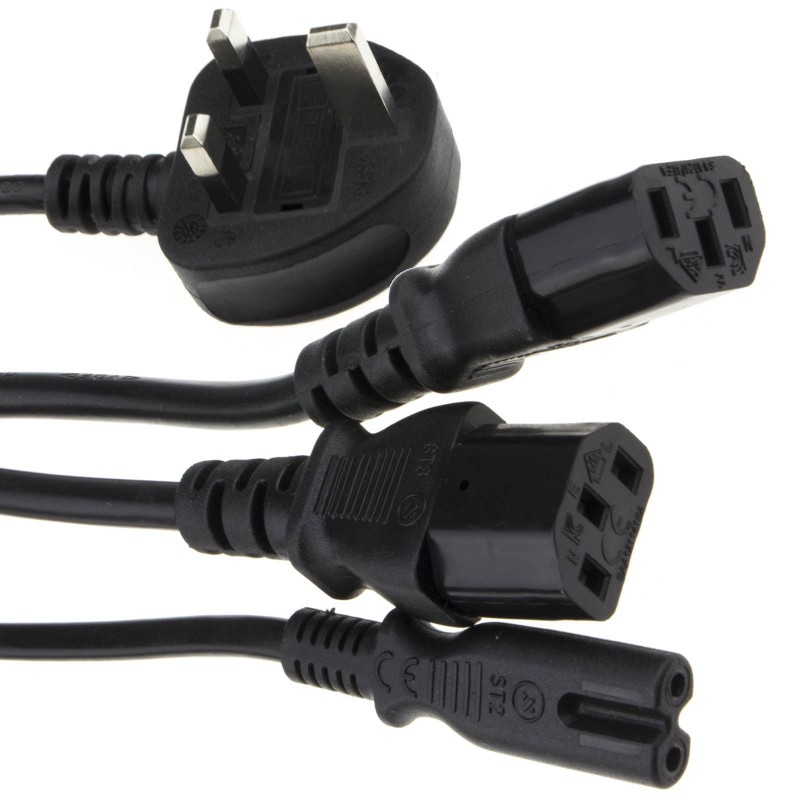
 www.kenable.co.uk
Loads of options with different ends to fit a great deal of appliances/devices.
3 Pin 13A UK Plug to 2 x IEC C13 Kettle Plugs & 1 x C7 Fig 8 (Figure 8) 1.2m
A 3 pin UK plug to 2 x IEC C13 connectors and 1 x C7 Figure of eight plug. Perfect for connecting multiple devices from UK power supply. Supplied with 5 amp fuse and 0... [see below for full description]
www.kenable.co.uk
Loads of options with different ends to fit a great deal of appliances/devices.