Electronics help plz

Associate
Joined
21 Jul 2007
Posts
763
Location
Cheshire
Ok then, I've done a bit of research but cant find much.

Basically...is it possible for me to mock up a little circuitboard with an inertia switch/sensor that will illuminate an increased number of leds as the G's increase?

Any guides or books I could read into how to wire it all up would be great?

Thanks guys

 
How many dimensions do you want to measure in? And do you want to show the sum of g's, or the number of g's per axis?

Either way, an accelerometer + ADC + microcontroller + shift register is probably your best bet.
 
Yes, yes you can. Good luck.

Are you building a spaceship?

I built one once. It was rubbish.

How did you know??? Wanna help?

Ok, so it looks like i just need the same stuff as a g meter but how can i display the output as bar graph as it were?

Also, anyone know where i can get a single axis accelerometer and do i need digital or analogue output?? thanks


edit:ADC = analogue to digital converter??
 
Last edited:
Either way, an accelerometer + ADC + microcontroller + shift register is probably your best bet.

That sounds like a decent option.

You might also consider doing it with a load of comparators of varying thresholds and feed in an amplified signal from the accelerometer.
 
That sounds like a decent option.

You might also consider doing it with a load of comparators of varying thresholds and feed in an amplified signal from the accelerometer.

Being a n00b of this sort of thing, which is going to be easier?

I was hoping the link to the video I gave you had those answers. Sorry.

This is the link I pulled it from:

http://www.embedds.com/diy-personal-g-force-meter/

Cheers dude, seems I have a possible shopping list in there which has helped.
 
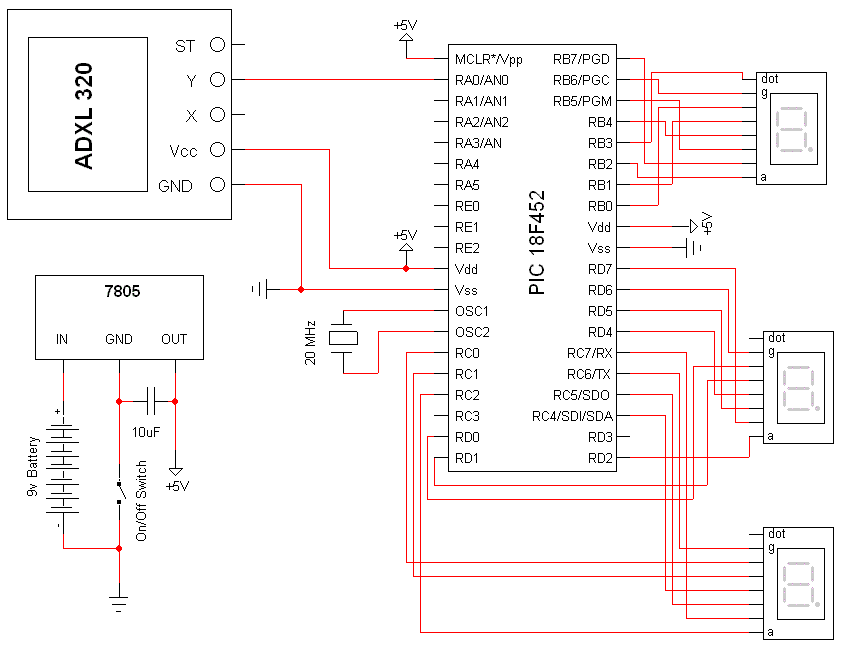
could i use this curcuit from the link above...
schematic.gif


but display the value in a bar meter type thing?

Thanks for all the help guys
 
Yes, and No. You'll have to look at the datasheet for the ADXL and for the PIC, you'll also need a PIC programmer (or build the programming pins into you circuit). You will also have to find a bar meter thingy and figure out how it works and how to incorporate it into the circuit. Finally, you'll have to program the PIC.
 
You are gonna need an accelerometer, not an inertia switch. That will only do on or off depending on it's angle.

So get an accelerometer: £20 - £30 inc. breakout board.

Now you need a microprocesser - Get an Arduino - ace and easy to program. Get the Freeduino version, it is only £13

Finally, you need an output, you want leds, so get a LED bargraph - £1 - £2

Now for the code.

As the accereometer increases in "acceleration" so does it's output voltage 0-3v. With the Arduino you can read this on an analogue pin.

So, with 3v ref you have 0 - 700 odd incoming to the Arduino.

Set point in the code to trigger an LED at a certain value eg. 10 LED graph = 700/10 = 70.

Xpin = the accelerometer
ledPin1 = 1st on the led graph
ledPin2 = 2nd on the led graph
....

If Xpin > 0 & < 69
{
digitalWrite(ledPin1, HIGH);
}
else if Xpin >70 & < 79
{
digitalWrite(ledPin2, HIGH);
}

So on etc...

http://www.arduino.cc/

Try to avoid PICs as you need burners and what not. I moved away from these and started using the Arduino platform, very flexible and you will also be able to log the acceleration values to SD cards or the serial port.
 
Now thats an answer and a half!!! Cheers dude, exactly what I need and it all looks dead interesting, may have to take up a few more projects like this.

Thanks all.
 
No problem.

There are quite a few examples of using the accelerometer with the arduino, Google is your friend on this one.

As for suppliers (none are OCUK competitors):

http://www.coolcomponents.co.uk/catalog/product_info.php?cPath=36&products_id=95

For the accelerometer.

And

http://www.nuelectronics.com/estore...s_id=1&zenid=c08a64fb237c3e4fb573a492d147dc4c

For the Freeduino (Clone of the original Arduino, and 100% compatable - hey it is open source anyways).

You will need the Arduino IDE software and that is free and based on C. It is easy to learn, and as I said there are tonnes of examples.

Have fun, and post back if you get it working.

:-)
 
The method being described above will undoubtedly work, but I can't help thinking it can be done much simpler. The PIC approach would be great fun as a learning excercise, however.

Here's how I'd do it:

ledswx4.png


That's only for 2 LEDs but you simply increase the length of the resistor ladder and add some more op amps. The signal from the accelerometer might need amplifiying too, but that depends on which one you choose.
 
Back
Top Bottom