I have checked with a few AI bots to compare materials
Why This Matters for Your P2S Riser

PA6-GF: Avoid unless you live in a desert
The hidden killer: Hydrolysis attacks amide bonds in humid air → progressive embrittlement. After 6 months at 50% RH, impact strength drops 60%+ and creep accelerates nonlinearly.
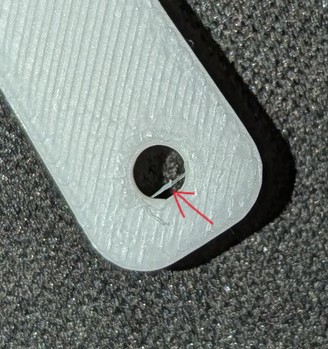
Real-world consequence: Your riser prints fine initially, but after 3–4 months of daily printing (enclosure cycling 30°C→50°C), it develops microcracks at the mounting holes. One day, it snaps mid-print — destroying your print and potentially damaging the printer frame.
Verdict: Only consider if your workshop is consistently <30% RH (e.g., climate-controlled lab). For 95% of users, it’s a ticking time bomb.

PETG-CF: The "Good Enough" Compromise (with caveats)
Pros: Low cost, easy to print, good baseline stiffness. Creep stabilizes after initial settling (no runaway degradation).
Cons: Reversible moisture absorption causes dimensional drift. At 50% RH, expect 0.1mm+ deflection over 6 months — enough to cause intermittent layer shifts on large prints. Vibration damping is adequate but not optimal (CF reduces resonance but doesn’t absorb energy like nylon).
Real-world consequence: You’ll need to re-level the bed every 2–3 weeks as the riser slowly creeps. Humidity spikes (e.g., rainy season) cause sudden misalignment. Still functional, but annoying for precision work.
Verdict: Acceptable if you tolerate maintenance — but not ideal for a "set-and-forget" riser. Best for users who level daily anyway.

PA12-GF: The Optimal Choice (Yes, it’s worth it)
Why it wins: PA12’s extra methylene group in the polymer chain makes it hydrolysis-resistant — unlike PA6, it doesn’t absorb enough water to break bonds. At 50% RH, it absorbs <0.5% moisture (vs. 2.0%+ for PA6-GF), so properties stay stable.
Pros: Near-zero creep acceleration, excellent vibration damping (PA12’s natural flexibility + GF reinforcement), and maintains impact strength for years. Handles P2S enclosure temps (40–50°C) with ease.
Cons: Slightly trickier to print (needs 260–280°C nozzle, 80–100°C bed, enclosure recommended — but your P2S has this!). Cost is ~20% higher than PETG-CF.
Real-world consequence: Print it once, install it, and forget it for 2+ years. No bed leveling drift from the riser, no vibration-induced ringing, no surprise cracks. It’ll outlast your printer’s nozzle.
Verdict: The clear winner for functional longevity. If you value precision and hate re-leveling, PA12-GF pays for itself in saved time and frustration.