

You are using an out of date browser. It may not display this or other websites correctly.
You should upgrade or use an alternative browser.
You should upgrade or use an alternative browser.
Global warming
- Thread starter andicole0
- Start date
More options
Thread starter's posts

Isn't plastic now the latest threat to the planet anyway? now that global cooling, global warming and the re-branded catch all term 'climate change' has failed to gain control over the entire world economy.
Warning: Bad language but brilliant:
Warning: Bad language but brilliant:

Isn't plastic now the latest threat to the planet anyway? now that global cooling, global warming and the re-branded catch all term 'climate change' has failed to gain control over the entire world economy.
Warning: Bad language but brilliant:
Good job missing the point of your own link.
andicole0 indicated that climate change is increasingly affecting us directly, in the context of Trump's ignorance on the matter. Carlin's rant is about people, not about how/why/if people affect the environment with their actions. If you got out of your alt-right or whatever weirdo bubble you frequent and if you searched for his views you would find this:
Offering his provocative opinion on The View Wednesday morning, Carlin paraphrased an old comedy rant of his, and characterized the fires as cosmic payback from a planet stretched to its breaking point.
“People are selfish,” he said. “These people with the fires and the floods and everything, they overbuild and they put nature to the test, and they get what’s coming to them, that’s what I say.”
Joy Behar replied, “That’s a little harsh, George.”
But the 70-year-old comic continued: “People think nature is outside of them. They don’t take into [themselves] the idea that nature is a part of them.” Pointing to his chest, he said, “Nature is in here, and if you’re in tune with it, like the Indians – the balance of life, the harmony of nature – if you understand that, you don’t overbuild, you don’t do all this moron stuff.”
http://people.com/celebrity/george-carlin-jamie-lee-curtis-blame-humans-for-fires/
Record low for a May day bank holiday is -5.9 way back in 2012. Today I see record highs of 24.2.
So Mr Trump explain that
Andi.
Is called WEATHER and nothing to do with the warming of the oceans which takes centuries to take effect not just 6 years.
Let alone it lasts 3 days for heaven sake. On Wednesday is back to 15C and by Saturday 13C.

We were told in 1997 that ice caps would be all gone. They are here and have grown.
We were told in the late 90's that Polar Bears would be extinct inside of 30years... There numbers are reportedly growing.
We were told sea levels will rise by several feet. Now we have an average of +0.25" in some oceans.
We were told global temperatures are the worst ever seen in the US.... But we must ignore the 1930's
We were told extreme weather was occurring... But we must ignore a period in the 1970's.
The only one they are vaguely correct on is CO2 levels rising. But the levels are nowhere near as high.
If anyone wants a chuckle. Look for the discussion about the great barrier reef on Youtube. A Climate change professor got demolished by two other experts. The Prof asserted sea temperature rises would kill the GBR coral. The other expert was a Marine Biologist specializing in corals and instantly shut his argument down by saying temp rises would be a boon for corals and cited higher temperatures in the Indonesian reefs where coral grow better as a result.
The solar cycles have the biggest impact on global temperatures rising. Volcanic eruptions have the biggest effect on cooling.
There was a wacky Viscount who hired his own expert team to look into the assertions and what not and it was found to be lacking.
We were told in the late 90's that Polar Bears would be extinct inside of 30years... There numbers are reportedly growing.
We were told sea levels will rise by several feet. Now we have an average of +0.25" in some oceans.
We were told global temperatures are the worst ever seen in the US.... But we must ignore the 1930's
We were told extreme weather was occurring... But we must ignore a period in the 1970's.
The only one they are vaguely correct on is CO2 levels rising. But the levels are nowhere near as high.
If anyone wants a chuckle. Look for the discussion about the great barrier reef on Youtube. A Climate change professor got demolished by two other experts. The Prof asserted sea temperature rises would kill the GBR coral. The other expert was a Marine Biologist specializing in corals and instantly shut his argument down by saying temp rises would be a boon for corals and cited higher temperatures in the Indonesian reefs where coral grow better as a result.
The solar cycles have the biggest impact on global temperatures rising. Volcanic eruptions have the biggest effect on cooling.
There was a wacky Viscount who hired his own expert team to look into the assertions and what not and it was found to be lacking.

Soldato
- Joined
- 25 Nov 2005
- Posts
- 12,755
It's a shame we don't have records of temperatures during the Cretaceous and Jurassic periods where I'd imagine global mean temps were way way hotter than they are now
Our records go back what ? 200 years ? for a planet that is billions of years old... in any other line of statistics one would consider there to be insufficient data for analysis
Our records go back what ? 200 years ? for a planet that is billions of years old... in any other line of statistics one would consider there to be insufficient data for analysis

We do, there are a number of proxies we can use. Tree rings, ice cores from the poles, sea sedment layers amongst others.It's a shame we don't have records of temperatures during the Cretaceous and Jurassic periods where I'd imagine global mean temps were way way hotter than they are now
Our records go back what ? 200 years ? for a planet that is billions of years old... in any other line of statistics one would consider there to be insufficient data for analysis
![[FnG]magnolia](/styles/overclockers/avatars/9.png)
Caporegime
- Joined
- 29 Aug 2007
- Posts
- 28,851
- Location
- Auckland
You have to try a little bit harder darlingGlobal warming like Evolution could be all a huge fraud.
 Never do the full reveal, always keep something back so it's not clear whether troll or dumbass.
@RaohNS
Care to provide any evidence to any of that?
For example the corals:
https://www.google.ca/amp/s/www.csm...peratures-spark-mass-coral-death-in-Indonesia
https://www.google.ca/amp/s/www.csm...peratures-spark-mass-coral-death-in-Indonesia
Now that’s not to say all coral is being bleached. There are some corals that appear to be doing ok with the increased sea temperatures. There’s currently a lot of work going on to try and expand the range of these specific corals. They are the exception rather than the norm however.
And as for the increase in ice sheet volume. A 2016 NASA study does corobberate this, however it’s a little more complex than that, as the author says:
That ties with the general consensus. A warming planet can increase precipitation in some parts of the world. Currently the increased precipitation in parts of Antarctica are offsetting the melting, however the author thinks that will change in the next decade or two.
And as for the 1930s US weather, it’s pretty irrelevant in the grand scheme of things. It’s about trends on a global scale, not just nitpicking certain areas in certain years. Global air temperatures have been rising, global sea level temperatures have been rising. In some areas that will correspond to a coldening, in most areas that will correspond to a warming. In some areas that will correspond to greater precipitation (and potentially more flooding) and in other areas that will correspond to less precipitation (and potentially more drought). Not that that is necessarily relevant to the US example. That could just be related to short term climate variability, which is realistically the same with the OP.
As for the polar bears, again rather more complex than you make out. Some populations are growing, some are shrinking. Even this conservative Canadian news outlet agrees (if you read the whole, article rather than just the misleading headline).
https://www.google.ca/amp/nationalp...to-be-hanging-on-in-the-arctic-study-says/amp
Climate change (and other issues) can’t be 100% accurately predicted, but the general trend is usually pretty accurate.
Most climate change deniers like to select individual pieces of evidence, usually outliers, to try and disprove the current scientific consensus, missing the fact that it’s a massive combination of things that have lead to that consensus, and a couple of outliers aren’t going to change anything.
No, climate change is still an issue, but governments are now starting to realize how big an issue plastics are too. They’re also starting to realize how big an issue habitat and biodiversity loss is too, amongst others. All are symptoms of one bigger problem. A human population too large to be sustained, especially with the current wasteful and polluting society we live in.
I’m sure someone else can pick apart and show you’re wrong or misleading with all the other comments you made.
Care to provide any evidence to any of that?
For example the corals:
https://www.google.ca/amp/s/www.csm...peratures-spark-mass-coral-death-in-Indonesia
However, there is a decreasing trend of coral growth from 1982 to 2014. There are three lowest peak were observed during El Niño event in 1983, 1993, 1998 with the growth rate respectively are 0.9cm/year, 0.7cm/year, and 0.5cm/year.
The Growth Rate of Coral Porites Lutea... (PDF Download Available). Available from: https://www.researchgate.net/public...henomena_at_Tunda_Island_Banten_Bay_Indonesia[accessed May 07 2018].
https://www.google.ca/amp/s/www.csm...peratures-spark-mass-coral-death-in-Indonesia
In May, the WCS sent marine biologists to investigate coral bleaching reported in Aceh — a province of Indonesia — located on the northern tip of the island of Sumatra. The initial survey carried out by the team revealed that more than 60 percent of corals in the area were bleached.
Subsequent monitoring of the Indonesian corals completed in early August revealed one of the most rapid and severe coral mortality events ever recorded. The scientists found that 80 percent of some species have died since the initial assessment, and more colonies are expected to die within the next few months.
Now that’s not to say all coral is being bleached. There are some corals that appear to be doing ok with the increased sea temperatures. There’s currently a lot of work going on to try and expand the range of these specific corals. They are the exception rather than the norm however.
And as for the increase in ice sheet volume. A 2016 NASA study does corobberate this, however it’s a little more complex than that, as the author says:
But it might only take a few decades for Antarctica’s growth to reverse, according to Zwally. “If the losses of the Antarctic Peninsula and parts of West Antarctica continue to increase at the same rate they’ve been increasing for the last two decades, the losses will catch up with the long-term gain in East Antarctica in 20 or 30 years -- I don’t think there will be enough snowfall increase to offset these losses.”
*****
Zwally said that while other scientists have assumed that the gains in elevation seen in East Antarctica are due to recent increases in snow accumulation, his team used meteorological data beginning in 1979 to show that the snowfall in East Antarctica actually decreased by 11 billion tons per year during both the ERS and ICESat periods. They also used information on snow accumulation for tens of thousands of years, derived by other scientists from ice cores, to conclude that East Antarctica has been thickening for a very long time.
“At the end of the last Ice Age, the air became warmer and carried more moisture across the continent, doubling the amount of snow dropped on the ice sheet,” Zwally said.
That ties with the general consensus. A warming planet can increase precipitation in some parts of the world. Currently the increased precipitation in parts of Antarctica are offsetting the melting, however the author thinks that will change in the next decade or two.
And as for the 1930s US weather, it’s pretty irrelevant in the grand scheme of things. It’s about trends on a global scale, not just nitpicking certain areas in certain years. Global air temperatures have been rising, global sea level temperatures have been rising. In some areas that will correspond to a coldening, in most areas that will correspond to a warming. In some areas that will correspond to greater precipitation (and potentially more flooding) and in other areas that will correspond to less precipitation (and potentially more drought). Not that that is necessarily relevant to the US example. That could just be related to short term climate variability, which is realistically the same with the OP.
As for the polar bears, again rather more complex than you make out. Some populations are growing, some are shrinking. Even this conservative Canadian news outlet agrees (if you read the whole, article rather than just the misleading headline).
Stirling said that the plight of Canada’s polar bears were akin to a calm before the storm, or a candle burning brightest before it goes out.
Bears may be dealing well with reduced ice in seal-rich areas, but they still risk being utterly thrashed if they’re suddenly hit with two to three years of longer summers.
Warming is not universal, and is having a unique effect on every region and every polar bear population. But, says Stirling, “warming will eventually reach them all unless we are able to slow or stop it in time.”
https://www.google.ca/amp/nationalp...to-be-hanging-on-in-the-arctic-study-says/amp
Climate change (and other issues) can’t be 100% accurately predicted, but the general trend is usually pretty accurate.
Most climate change deniers like to select individual pieces of evidence, usually outliers, to try and disprove the current scientific consensus, missing the fact that it’s a massive combination of things that have lead to that consensus, and a couple of outliers aren’t going to change anything.
No, climate change is still an issue, but governments are now starting to realize how big an issue plastics are too. They’re also starting to realize how big an issue habitat and biodiversity loss is too, amongst others. All are symptoms of one bigger problem. A human population too large to be sustained, especially with the current wasteful and polluting society we live in.
I’m sure someone else can pick apart and show you’re wrong or misleading with all the other comments you made.



Associate
- Joined
- 6 Jan 2012
- Posts
- 116
That's a strange definition of global, you have there, not to mention the dubious claims of ice caps growing and polar bear numbers increasing (the antarctic has a net gain at the moment but artic and Greenland ice sheets summer minimums have been decreasing, the 2 populations of polar bears that have had growth recorded have had hunting bans put in place, while 2 more remote populations with less direct human influences have declined).We were told global temperatures are the worst ever seen in the US.... But we must ignore the 1930's
Am sure when I was at school in the early 80's they were going on about all the oil/fuel would run out in about 20 to 30 years timeGlobal warming like Evolution could be all a huge fraud.
Soldato
- Joined
- 25 Nov 2005
- Posts
- 12,755
We do, there are a number of proxies we can use. Tree rings, ice cores from the poles, sea sedment layers amongst others.
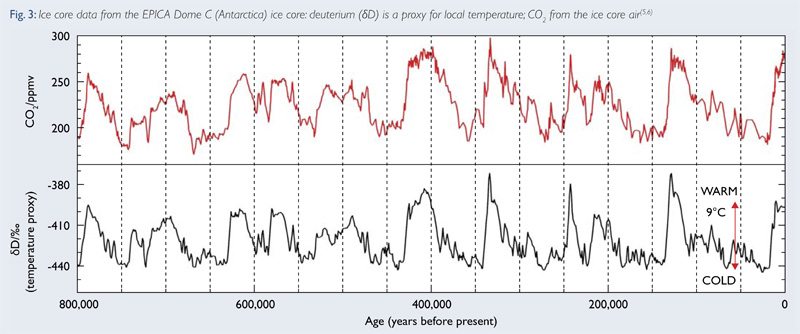
There are no tree rings billions of years old (oldest only goes back 14,000 year) and the oldest ice core data goes back only 800,000 years which is still a drop in the ocean compared to billions of years of climate change
Even using 800,000 year old ice core data, it shows a cyclical nature in both temperature and CO2
Also sea sediment data we have only goes back as far as 1.5million years and it's not exactly a precise science and only gives a rough estimation
snip[/QUOTE]
So first you acknowledge it's not only 200 years.
Secondly I did not say it was just those, there's a whole bunch of these measurements.
Of course it's rough estimates, what are you expecting. They still give a good ball park.
Soldato
- Joined
- 25 Nov 2005
- Posts
- 12,755
fail quote
Records as in recorded temperatures which is always quoted when most sensationalist news says "x hundred degrees over previous record since records began 200 years ago" ice core, sea sediment and tree ring is never used when it comes to comparing record breaking temperatures.
I mean I understand why we use it because we can't say that 750,000 in May on Tuesday it was x degrees but really we shouldn't be spouting sensationalist "omg our skin is going to melt off our bodies" nonsense on 200 year old records getting broken when the data is infinitely small in the grand scale of the life of the planet
Becuase they use since records began, what's the issue with that?
You also known global warming does not mean that temperatures in a particular spot rise, or rise all year round. The average global temperature rises, what happens at a local level can be very different.
Scientists aren't sprouting such things.
Organisations that want money do and they sensationalise everything. I wouldn't even call them news sites. You want proper news go to the source of the stuff you are interested in, follow the instructions, scientists etc on Facebook.
You also known global warming does not mean that temperatures in a particular spot rise, or rise all year round. The average global temperature rises, what happens at a local level can be very different.
Scientists aren't sprouting such things.
Organisations that want money do and they sensationalise everything. I wouldn't even call them news sites. You want proper news go to the source of the stuff you are interested in, follow the instructions, scientists etc on Facebook.