

You are using an out of date browser. It may not display this or other websites correctly.
You should upgrade or use an alternative browser.
You should upgrade or use an alternative browser.
Spec me a NAS setup!
- Thread starter katie279
- Start date
More options
Thread starter's posts
Cool! What's your file transfer speeds like with that setup??
I've seen speeds upwards of 6 Gbps. Basically as fast as the SATA SSD.

Soldato
- Joined
- 31 Jan 2022
- Posts
- 3,648
- Location
- UK
Are you 100 sure this figure is right? This is about 10x what the specs state for idle.
It's funny you say that, because that's about what mine takes - around the sort of 14W. And that's mostly the drives, the CPU and RAM use very little power indeed when idle.
Given the circumstances, I wonder if it wouldn't be better to just pop in new drives to both increase capacity and reduce power consumption. I guess it depends on priority here.

Associate
- Joined
- 22 Jun 2018
- Posts
- 1,839
- Location
- Doon the watah ... Scotland
One of my big goals is to get file transfers between the two workstation PCs as fast as possible - so loving the idea of 10/25GBps vs what I currently have.
Am thinking:
- Lots of HDDs in an array to speed up read/write access to maximum possible
- Cat 7 between NAS and PCs
- Decent CPU, RAM and MB to deal with the transfers...
I think you're being starry eyed in notions of fancy spec lists at the moment, and haven't really thought through / specced out the end to end setups of all machines in the network and what you really NEED out of them.
When you say between work stations transfers, is that sending a file directly from Workstation 1 (W1) to Workstation 2 (W2) across the network. Or is it that W1 saves on NAS, and the W2 pulls the file from the NAS later ?
If the former, you would be better spending money on fast storage on the workstations and the network link between them, and worry less about the NAS. If the latter, then all machines will need fast storage and fast networks links.
... but ...
what sort of files are you really going to be transferring between the machines most often? Are they huge multi-gigabyte files getting moved repeatedly, or are they smaller, sub-gigabyte file sizes? I would argue that unless you need significant sustained transfer rates for multi-gigabyte files on a repeated basis, then even normal 1G ethernet will generally suffice and be reasonably performant.
And are you going to need fast access to ALL your data all the time ? Or is it more that you'll be working mainly on a current project folder ( or similar ) and have other folders which are archives of previous projects that you keep to be able to go back into from time to time if needed.
If so, then you can set up tiered storage on things like Unraid and TrueNAS ... so the current project folder could be made to only use fast SSD devices, and the archives sit on different devices like spinning hard drives. The SSDs will give fast response to read and writes. The HDD's will be slower for browsing old projects.
That way, if the bulk of your work is on the current project, then the SSD's will use less power, and the HDD's can spin down when not in use ... greatly reducing power usage.
As I say, I think you need to spec out your actual working practice first, and then try and best match it with hardware. Not the other way round.

- Low watts running/idle
Low Watts and 25GBps don't really seem to go togetherOne of my big goals is to get file transfers between the two workstation PCs as fast as possible - so loving the idea of 10/25GBps vs what I currently have.

It's worth bearing in mind power consumption of the additional NICs/SFP+ or SFP28 modules and whatever switch you would have in mind:
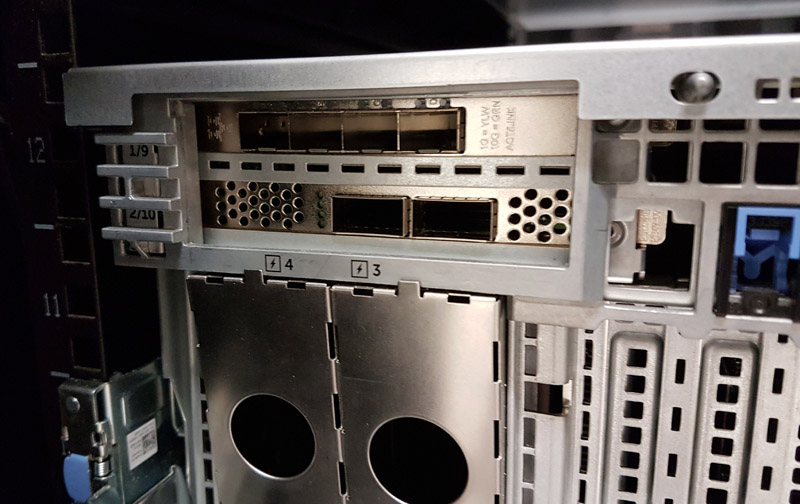
QSFP+ v. SFP+ v. 10Gbase-T - Testing power consumption differences
We test QSFP+, SFP+ and 10Gbase-T networking options (40GbE and 10GbE) to see the differences in absolute power consumption and power consumption per Gbps
 www.servethehome.com

SFP+ to 10Gbase-T Adapter Module Buyers Guide
Our buyer's guide for SFP+ to 10Gbase-T adapters. We purchased nine popular models and tested their performance, power consumption, and Nbase-T support
www.servethehome.com
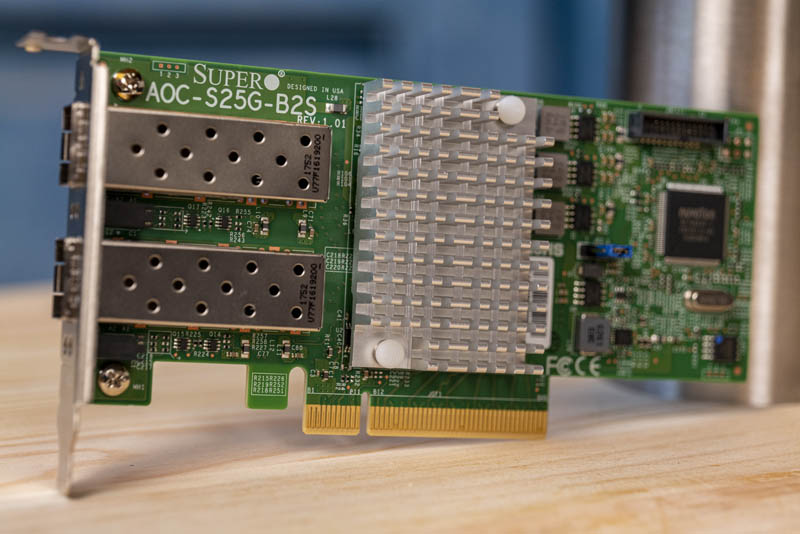
Supermicro AOC-S25G-b2S 25GbE NIC Review
The Supermicro AOC-S25G-b2S is a dual 25GbE SFP28 NIC based on the Broadcom NetXtreme-E BCM 57414 Ethernet controller bringing features and speed to servers
www.servethehome.com
Better to use SSD Caching / Storage Tiering. In theory this also allows hard drives to spin down (reducing idle power), until data needs to be copied across from the cache.Am thinking:
- Lots of HDDs in an array to speed up read/write access to maximum possible
No point in Cat 7 - it isn't a TIA/EIA recognised standard, shouldn't actually be used with RJ45 plugs (requires GG45 or TERA connectors), and offers nothing over Cat6A (or in a home environment Cat6). If you are dead set on future proof performance, then you should be looking at Fibre.- Cat 7 between NAS and PCs
It was often mis-quoted as a requirement for the primary filesystem (ZFS) that TrueNAS uses. ZFS is focused on preventing data loss through corruption, so it makes sense that using ECC memory to help prevent possible in-memory corruption (due to very occasional ram bit-flip errors and the like) further improves the data loss protection.(some people seem to swear by ECC RAM for NAS'?)
FWIW Most consumer NASes (including majority of Synology and QNAP) do not have ECC. Additionally most PCs, Laptops, Phones etc do not have ECC memory, so there is always (an extremely tiny) possibility of data corruption by the device transferring data to the NAS in the first place.
I think you're being starry eyed in notions of fancy spec lists at the moment, and haven't really thought through / specced out the end to end setups of all machines in the network and what you really NEED out of them.
Good adviceAs I say, I think you need to spec out your actual working practice first, and then try and best match it with hardware. Not the other way round.
Don't underestimate the viability of a USB SSD drive (or usb to NVMe adapter) these days, given how cheap and fast they are these days. If the files don't actually need to be on the NAS, no point spending loads of money upgrading things, if you could just move them quickly with a USB drive.When you say between work stations transfers, is that sending a file directly from Workstation 1 (W1) to Workstation 2 (W2) across the network. Or is it that W1 saves on NAS, and the W2 pulls the file from the NAS later ?
Last edited:
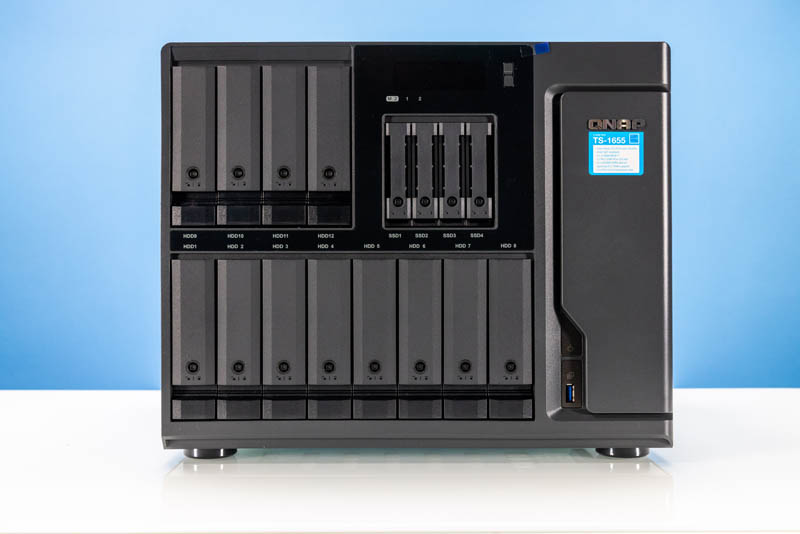
This just showed up on my Google News feed - from a hardware point of view leagues ahead of the Synology you were looking at
 www.servethehome.com
QNAP TS-1655 12-Bay Plus 4-Bay NAS Revew with an Intel Atom C5125
The QNAP TS-1655 is an awesome NAS that offers ZFS, 2.5GbE, and one can use 18 storage drives with (12x 3.5", 4x 2.5", 2x NVMe) and more
www.servethehome.com