Soldato
- Joined
- 16 Jan 2003
- Posts
- 10,970
- Location
- Nottingham
What's the stock voltage of these processors supposed to be, my mobo set to auto sets it to 1.3, isn't that a bit high? Isn't it meant to be around 1.2?
Please remember that any mention of competitors, hinting at competitors or offering to provide details of competitors will result in an account suspension. The full rules can be found under the 'Terms and Rules' link in the bottom right corner of your screen. Just don't mention competitors in any way, shape or form and you'll be OK.
Mine needs 1.4v for 4.0 Ghz+. Thats why I were never able to go over 3.8 Ghz first because I were afraid to raise it past 1.3v, but I didnt get a lucky golden chip like everyone else


Good point, though one thing i did notice with s775 cpu's, low vid chips tended to generate a lot more heat when overclocked, both my s775 quads (q6600 and q9550) were mid range vid wise, 1.2750 and 1.200 respectively, both clocked pretty well, 3.8ghz each and both ran cool, albeit the q6600 was lapped.People correlete low vid with a high overclocking chip. Evidence for this is a bit sparse,


Mine needs 1.4v for 4.0 Ghz+. Thats why I were never able to go over 3.8 Ghz first because I were afraid to raise it past 1.3v, but I didnt get a lucky golden chip like everyone else
Have a look and see if the UD3R implement's DVID in the latest bios.
It has the option for DVID, what do I have to change with it?
With DVID, couple of things you need to start with.
- Vcore needed for your 100% loaded stable clock.
- Your cpu's default voltage, differs from chip to chip.
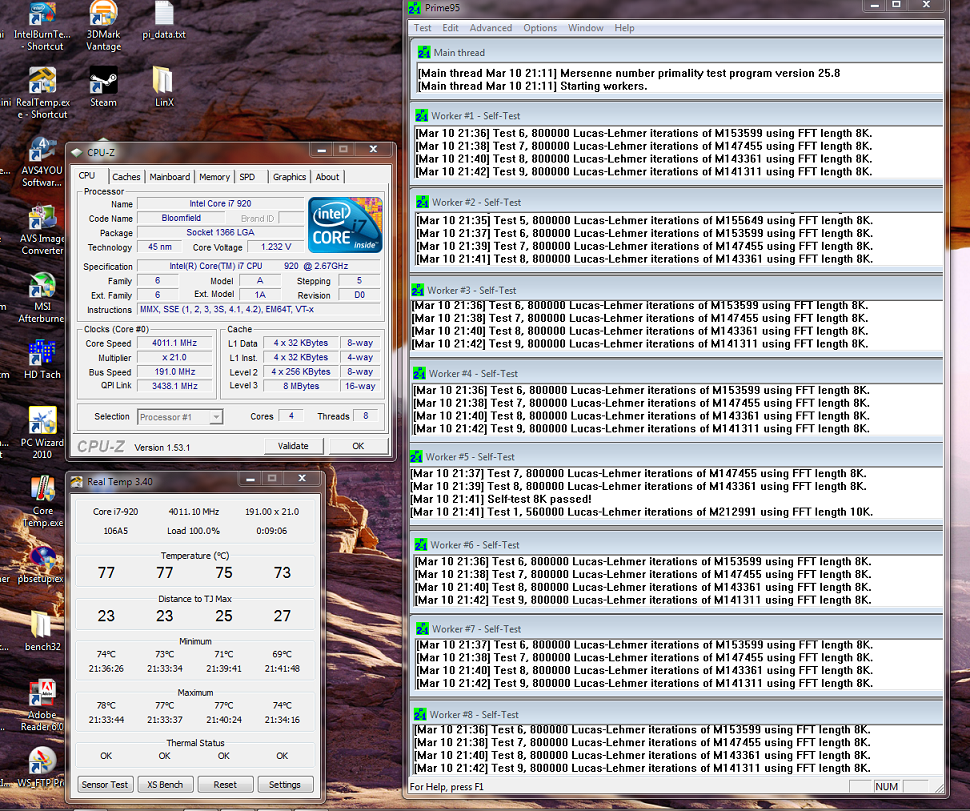
To get the first one check cpu-z under 100% load, use prime or linx etc. The second one is a little more involved, set the multi lower in the bios, way down (default cpu speeds). Set the vcore to normal. Reboot into windows, again check the actual vcore under load.
Now back in the bios (obviously put the multi back), leave/set the vcore to normal. In the advance settings set the DVID offset number to the difference between the overclock vcore and the default vcore.
e.g. on a 4Ghz clock D0. 1.2625-1.2125=0.05v
Now go and check the 100% load value in windows is the same as the original overclock value. You could also try using the default Vcore displayed in the bios, but of course that takes no account of the vdrop+vdroop. Should work though (just note, default Vcore in bios can change with turbo mode on/off). You should now see the vcore changing with the load and drop even lower with speedstep.
Some other settings that seems to be successful with it. LLC enabled, disable C1E (stops MB buzzing apparently), enable all other energy features, "C3/C6/C7 State Support" etc. Power management profile within Windows set to high performance.
Is that a D0?
What's the stock voltage of these processors supposed to be, my mobo set to auto sets it to 1.3, isn't that a bit high? Isn't it meant to be around 1.2?
Yup. Its a D0 920.
1.3v is only good for 3.8 Ghz, it needs 1.344v for 4.0 Ghz, and 1.396v for 4.2 Ghz for it not to BSOD.