
Tax query...

It's a perception because you are assuming the PA allowance is some kind of right, that it is the default position and by losing it you are then paying more when you're actually get less of a discount. Whilst mathematically they may equate to the same thing, philosophically they aren't.

No more of a right than to be taxed at 20% so I'm not sure how that is really relevant.

Unwind this, adjust that, the truth is that like many things in life stuff gets shoved in one end, some whizzing and banging goes on behind the scenes and then something comes out the other end.

In this case 20k goes in and 8K comes out. What happens in the middle is of no importance beyond governments trying to give people the "perception" that they are not being done over. You can philosophise all you like but I doubt Bacon would argue with the mathematics in this case.

 
No more of a right than to be taxed at 20% so I'm not sure how that is really relevant.

Unwind this, adjust that, the truth is that like many things in life stuff gets shoved in one end, some whizzing and banging goes on behind the scenes and then something comes out the other end.

In this case 20k goes in and 8K comes out. What happens in the middle is of no importance beyond governments trying to give people the "perception" that they are not being done over. You can philosophise all you like but I doubt Bacon would argue with the mathematics in this case.

What has Richard Bacon got to do with this?

I'm not arguing with the arithmetic, in the same way I can't argue with the arithmetic used in the 'bad' example of the Simpsons Paradox I posted. I'm arguing the conclusion being drawn from it.

My background is mainly statistical and probabilities, so I know how you can prove almost anything with numbers depending on which column you place them. The more interesting thing (and the thing most people listen to) is the conclusion.
 
What has Richard Bacon got to do with this?

I'll assume you're being deliberately obtuse :p

I'm not arguing with the arithmetic, in the same way I can't argue with the arithmetic used in the 'bad' example of the Simpsons Paradox I posted. I'm arguing the conclusion being drawn from it.

My background is mainly statistical and probabilities, so I know how you can prove almost anything with numbers depending on which column you place them. The more interesting thing (and the thing most people listen to) is the conclusion.

And mines is Physics and now commercial finance. This example is really not a case for statistical analysis.
 
Slightly off topic but what really annoys me is people who think once they're in the 40% bracket, that it's their entire salary which is then taxed at 40%, not just that over the threshold. ::eek:
 
And mines is Physics and now commercial finance. This example is really not a case for statistical analysis.

Just to clarify, I wan't suggesting it was. I was suggesting that I recognise that you can prove almost anything depending on how you choose to add it up. The arithmetic maybe entirely correct, but the conclusion drawn from it may not be the best.

So you can calculate than you are paying 60% in tax for a certain proportion of your income (as shown by nitefly and Pudney), but that doesn't mean it is mathematically the best conclusion.
 
[FnG]magnolia;26068085 said:
estebanrey, you do know that you're arguing a point of 'perception' with qualified, practicing accountants, don't you?

Am I, the two I originally starting conversing with both admitted they haven't done Income Tax in a while.

But anyway, an accountant's job is to minimise their clients payments to the exchequer and use calculations that imply their clients are getting a raw deal and therefore deserve some kind of break or deal because of it.

I wouldn't argue the finer points of the law with a lawyer, that doesn't mean I can't question the conclusions they may make about their clients actions and the wider affects it has on society.
 
Am I, the two I originally starting conversing with both admitted they haven't done Income Tax in a while.

But anyway, an accountant's job is to minimise their clients payments to the exchequer and use calculations that imply their clients are getting a raw deal and therefore deserve some kind of break or deal because of it.

I wouldn't argue the finer points of the law with a lawyer, that doesn't mean I can't question the conclusions they may make about their clients actions and the wider affects it has on society.

1) In the nicest possible way, this isn't a complicated piece of tax legislation, it's quite basic.
2) An "accountants" job isn't to reduce people's tax bills. It's to explain to people how tax works and to provide them with options if applicable. If there are no options it's to ensure they comply with the legislation.
 
OK, OK I get what you're saying. I still don't think that the 'right' way of looking at it though.

Saying you are paying 60% in tax between 100k-120k is jiggery-pokery with numbers, in reality, and more accurately, you are paying 45% on more of your income. Saying someone is paying 60% in tax between 100k-110k implies (and to most people would mean) you were paying more in tax in that window than you are taking home; but you're not.

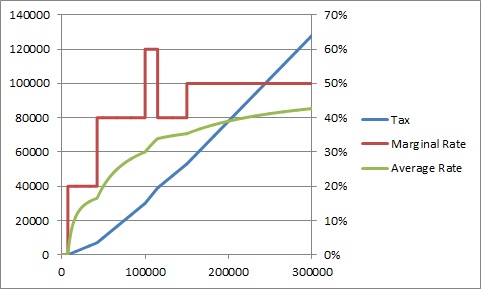
Yes you are... someone earning 110k pays 6k more in tax than someone earning 100k... and increase of 10k gross leads to a 6k more in tax... their extra 10k gross pay only nets them an extra 4k in take home pay... the majority of the pay increase, 60% of it, gets paid in tax.

in that window they are paying more in tax than they are gaining from the increase in pay and it is equivalent to being taxed at 60% for earnings between 100k and 120k
 
Going back to your 3 for 2 example, let's say one item costs £1.

The marginal cost of the first item you buy is £1, the marginal cost of the second is £1, the marginal cost of the third is £0. You're paying an average of £0.66 per item which is what you're trying to say, what we're trying to say is the marginal cost of the last item is nothing. Both are right, just different ways of looking at it.

In either case the marginal rate is easier for people to understand and apply to their situation.
 
Ferd earns 120k, Fred gets a 10k bonus... Fred pays an extra 4k in tax and gets to take home 6k more income as a result of the bonus... Fred has essentially been taxed 40% on his extra 10k earned.

Bob earns 100k, Bob gets a 10k bonus too... Bob pays an extra 6k in tax and gets to take home only 4k more income as a result of the bonus. Bob has essentially been taxed 60% on his extra 10k earned and has paid more in tax than he gets to see from his additional 10k.
 
Done on the old 50% rate but below £150k you get the idea:

Tax.jpg
 
Back
Top Bottom