

General Headphone Audio

1. There shouldn't be any noticeable difference in sound quality between the single-ended and balanced interconnects.
2. It depends on the tube amp, some amps it might be a passive passthrough in which case it can work when off, and others will work as a pre-amp and will need to be powered on.

Technically no but there is with the WARMER, the soundstage/imagine is slightly less wide with RCA output vs XLR output. I tested this in depth when testing if both outputs work at the same times without sacrificing SQ and A/B switching on the A90D showed that soundstage was better via XLR output, even though the output power of the RCA was slightly higher than the XLR.The difference was noticeable on both HE1000se and speakers.

K15 and 17 have the same 4.4 balanced input yeah, so if you have the correct cable, no reason not to use it and be fully balanced.

Thanks for the replies.

I think the only issue with balanced input on the K15/17 is going to be that it is 4.4mm based. It seems to be cheaper with more choice when buying XLR to XLR vs. 4.4mm to XLR cables. But part of me feels like the Warmer wasn't really designed with these DAC/AMPs in mind (hence that other new AMP incoming).

Regarding the OTL tube amp scenario it'll just mean I can run off one RCA output if I can turn it off. I'm only ever going to use an OTL for headphone use.
 
Last edited:

  • Like
Reactions: mrk
Just bought a Chord Mojo (2024). For £249 it was hard to resist!

Nice price. Always been curious about these, probably because they look so unique. If I'm understanding it right they (Chord) are using an FPGA chip for the internals (looks like the came chip in the new C64 Ultimate, but might be wrong). And I guess that probably helps give it a sound characteristic.
 
Nice price. Always been curious about these, probably because they look so unique. If I'm understanding it right they (Chord) are using an FPGA chip for the internals (looks like the came chip in the new C64 Ultimate, but might be wrong). And I guess that probably helps give it a sound characteristic.
It is a very smart little thing. Just been playing with the crossfeed function, which I am liking.
 
Just purchased a Gunnr. Was feeling flush tonight.
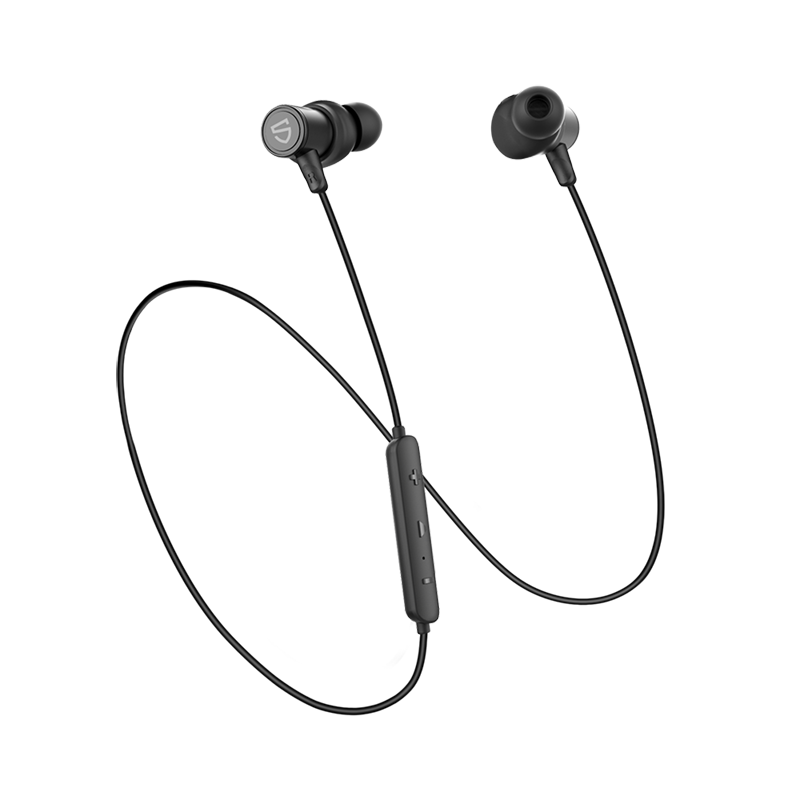
Also took delivery of the soundpeats q40 HD today. What a great upgrade compared to the older q30 (can't compare to current q30)
I'm definitely hearing things I didn't hear in the previous set but it's only for workouts. Well worth the £28.

Edit: doing some a/b testing with some hans Zimmer - why do we fall.

Massive upgrade! The old q30 could not point out certain sounds, less bass heavy, more detail, there is a big difference. Very happy with the purchase
 
Last edited:
  • Like
Reactions: mrk
I see Fiio released an update a while back for the FX15 IEMs with the FX17, at 1500 Euros it's no easy pill to swallow though lol. I have asked if I can be loaned a set to check out, let's see if they give the thumbs up!
 
Last edited:
Don't usually post on Head-fi but that audio 'delay' issue with the XMOS USB chips came up from a Mac OS user in the Fiio K13 R2R thread. Thought I'd post a quick post of what we realised earlier this year. Head-fi forum link
 
  • Like
Reactions: mrk
It's going to get more common as more people adopt USB DACs which provide superior sound to soundcards or mobo sound going forwards really. Maybe this will finally push makers to do a control panel system for Mac/Linux too eventually, although the average adopter is on Windows so maybe not actually.
 
Nice price. Always been curious about these, probably because they look so unique. If I'm understanding it right they (Chord) are using an FPGA chip for the internals (looks like the came chip in the new C64 Ultimate, but might be wrong). And I guess that probably helps give it a sound characteristic.
Yeah, that's right. It does the DAC processing through that chip, and then out the headphone sockets. the controls are known to annoy people, but they're easy enough when you get used to it. Would be nice if it had 10 band parametric EQ, it's only got a 4 band EQ. As for sound, it sounds as good as anything I've heard, although my X9 is as far as I've got expense wise. Lots of detail, bit brighter (perhaps) than the x9. For the price they're getting rid of the 2024 stock, it's a great deal.
 
It's going to get more common as more people adopt USB DACs which provide superior sound to soundcards or mobo sound going forwards really. Maybe this will finally push makers to do a control panel system for Mac/Linux too eventually, although the average adopter is on Windows so maybe not actually.
Im surprised there isnt already an opensource driver for it built into the distro's tbh
 
It's going to get more common as more people adopt USB DACs which provide superior sound to soundcards or mobo sound going forwards really. Maybe this will finally push makers to do a control panel system for Mac/Linux too eventually, although the average adopter is on Windows so maybe not actually.

Yep. This is ehere we need Steam Machine/Deck to keep making in-roads into Windows market share.

Yeah, that's right. It does the DAC processing through that chip, and then out the headphone sockets. the controls are known to annoy people, but they're easy enough when you get used to it. Would be nice if it had 10 band parametric EQ, it's only got a 4 band EQ. As for sound, it sounds as good as anything I've heard, although my X9 is as far as I've got expense wise. Lots of detail, bit brighter (perhaps) than the x9. For the price they're getting rid of the 2024 stock, it's a great deal

Sounds very good, given the price of the X9. Does this mean there's a newer one on its way?

Im surprised there isnt already an opensource driver for it built into the distro's tbh

I suppose to is a bit like Piper (mouse application on Linux) where the community fills the gaps. However I did read a Linux developer of one of these Raspberry Pi distros for music streaming (forgotten the name) who described this as a vendor issue and not software. Certainly DAC/AMPs with software on them could easily have this added to their settings panel.
 
Sounds very good, given the price of the X9. Does this mean there's a newer one on its way?
A couple of small changes, but the chip and amp are the same. All the new one does is have both a 3.5mm and 4.4mm socket (instead of 2x 3.5mm) and can now take the signal and power through the single USB C socket, rather than power through a Micro USB socket.

It will sound the same and for me using predominantly as a desktop solution, the older one is just an extra cable which is hidden anyway.
 
A couple of small changes, but the chip and amp are the same. All the new one does is have both a 3.5mm and 4.4mm socket (instead of 2x 3.5mm) and can now take the signal and power through the single USB C socket, rather than power through a Micro USB socket.

It will sound the same and for me using predominantly as a desktop solution, the older one is just an extra cable which is hidden anyway.

Ah OK ty. I did see you can buy an adaptor for the 2024 one to convert to balanced. I think Zeos featured it in his review.
 
It's that overall picture where I have always seen as an issue with places like ASR, at least on headfi people are more open to said bigger picture. Measuring a DAC is one thing, but that doesn't tell anyone how it actually sounds when it's installed within a chain, as each component has the ability to be heard differently as a whole, since nothing is truly transparent, if they were then none of this as a discussion would exist :p

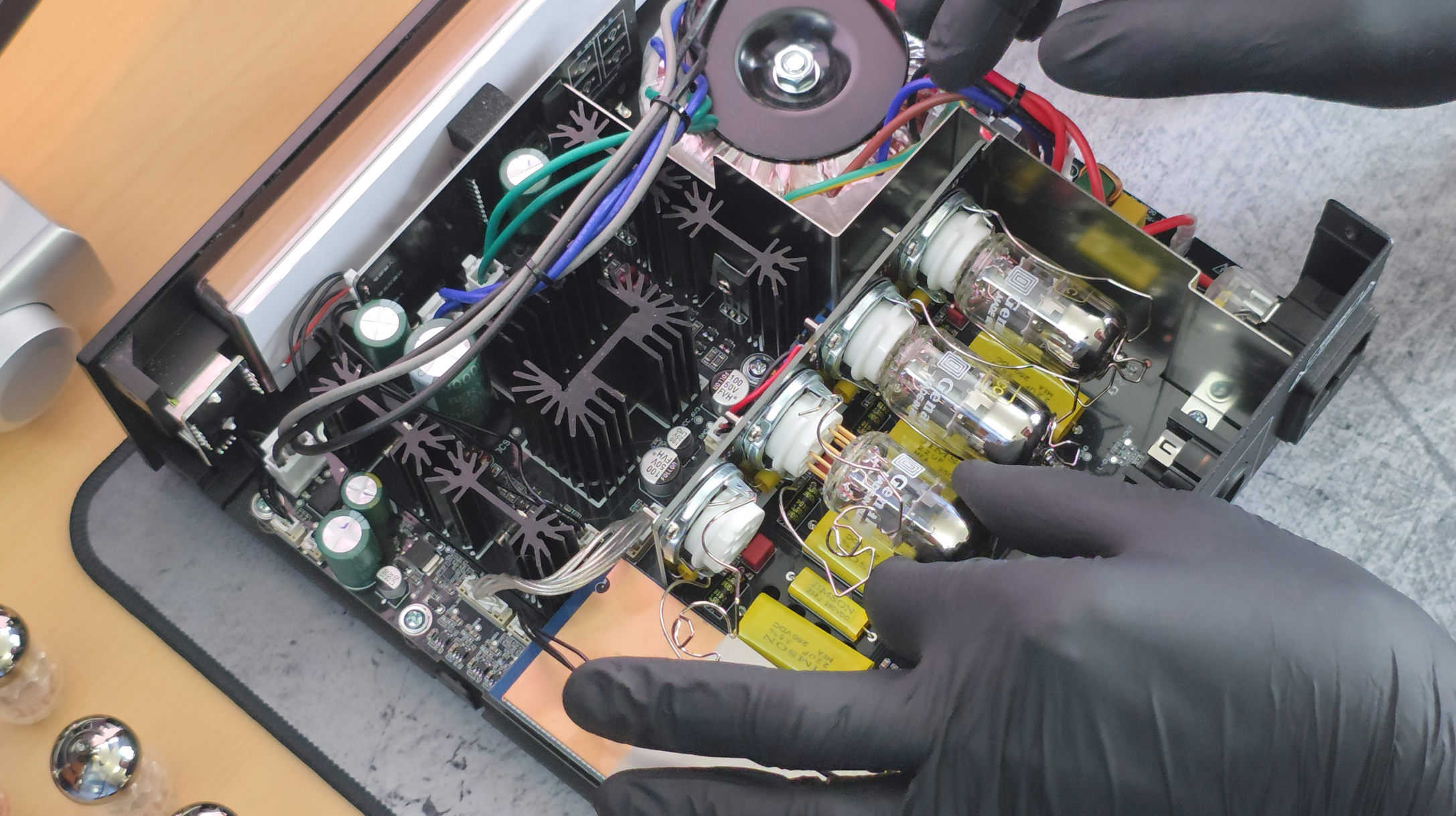
Though I see someone has posted something actually good in the WARMER thread now in relation to tube burn-in, which goes hand in hand directly with what I have observed with the stock tubes after 500+ hours:


Tubes.jpg


fcBjtTv.png


Anyways I have installed the new tubs, happy to report that the low end bass extension (slam/punch, however you want to call it) is present right out of the box, this is great as it means as time goes on it will open up like the stock tubes did.

At present that extension is more prominent than the stock tubes with 500+ hours on them. The upper midrange is slightly more forward facing though, this isn't a big deal for me as all the detail, layering and soundstage is still the same and this I believe is dictated by the R2R DAC itself. There are some minor differences in the upper end range but then again I noticed that about the stock tubes which opened up the upper end a bit more which made 90s pop music feel less direct and a bit more relaxed which is nice for my preferences.

So far so good!
Not sure if youve looked ar the asr thread for this recently but theres been a lot of discussion abour the bass roll off and its relation to amp inpit resistance and the size of the output caps. A guy measured the frequency response woth different input impedances and showed that it changed the bass roll off. If anythings worth rolling it sounds like its those caps and swapping them for larger uf rated ones.
 
I might have missed some of that but bass honestly is no longer an issue for me, it wasn't with the stock tubes after +500 hours of usage and with the gold lion tubes it seems to be better out of the box anyway but has also relaxed and opened up as the hours have piled on. I'm at a point now where I'm hearing good quality sub-bass extension and it's just fine and how I would expect it with the same music I've been playing all this time.

One guy in my youtube comments section said he changed out the sleeved caps which changed the bass too for the better so I guess yeah that could be another way to do it if you don't mind re-soldering. I will be keeping the GL tubes in though as they sound great, especially the midrange vocals which have enhanced texture over the stock tube colouration.
 
If anythings worth rolling it sounds like its those caps and swapping them for larger uf rated ones.

Bit of a tangent but a surprise discovery for me was Cornell Dubilier 930C film caps - I tried a lot of the hyped audio film capacitors, and random other models, but the 930C just dunks on them for transparency - a lot of "audio" capacitors seem to make the sound a little warmer (and hence boosts the bass a bit). Obviously depends what you are looking for - but especially for gaming usage there is a noticeable difference in detail and soundstage with the 930Cs.

(Though the best solution would be no capacitor at all - but obviously that is complicated).

EDIT: Though I will caveat that in that with the use of capacitors like this results also depend heavily on the skill of the engineer (something I'm more or less a novice at) - especially understanding the role of ESR in the equation - as that can hugely change the results even with the same value capacitors.
 
Last edited:
Bit of a tangent but a surprise discovery for me was Cornell Dubilier 930C film caps - I tried a lot of the hyped audio film capacitors, and random other models, but the 930C just dunks on them for transparency - a lot of "audio" capacitors seem to make the sound a little warmer (and hence boosts the bass a bit). Obviously depends what you are looking for - but especially for gaming usage there is a noticeable difference in detail and soundstage with the 930Cs.

(Though the best solution would be no capacitor at all - but obviously that is complicated).

EDIT: Though I will caveat that in that with the use of capacitors like this results also depend heavily on the skill of the engineer (something I'm more or less a novice at) - especially understanding the role of ESR in the equation - as that can hugely change the results even with the same value capacitors.

I dont have any experience with "audio grade" capacitors but when i replaced all of the ones in my audiolab dac the other year i used thd cheapest ones i could find on ebay and didnt notice a difference.
 
Back
Top Bottom