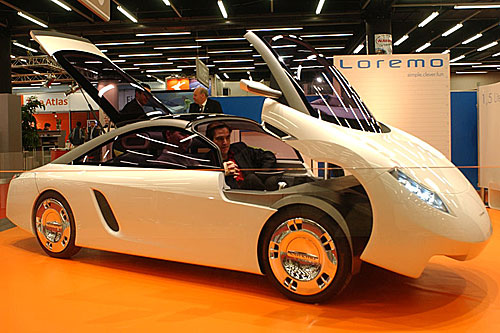
- To travel at a constant speed of 100 km/h, the prototype only needs 6.2 kW/8.4 PS - a fraction of the performance of today's cars (Golf 1.6 TDI with 77 kW and 7-speed DSG: 13.2 kW/17.9 PS).
- In electric mode, the Volkswagen XL1 needs less than 0.1 kWh (82 Wh/km) to complete a one kilometre driving course. These are record values.
CFRP body is a technical masterpiece
The development team made extraordinary strides in designing the CFRP body − in terms of its lightweight construction as well as its aerodynamics. A comparison to the Golf illustrates just how innovative the body concept of the new XL1 is.
The drag coefficient of the highly successful Golf is very good for the compact class: Cd (0.312) x A (frontal area 2.22 m2) equals a total drag figure of 0.693 m2 (Cd.A) providing this car with benchmark aerodynamic credentials in its class. Meanwhile, the Volkswagen XL1 exceeds this performance with a Cd value of 0.186 and a frontal area of 1.50 m2.
The product of these two parameters yields a total drag, or
Cd.A value of 0.277 m2 which is 2.5 times lower than that of the Golf.
CFRP is the ideal material for the body of the new XL1 because of its light weight. The XL1 Concept weighs only 795 kg. Of this figure, 227 kg represents the entire drive unit, 153 kg the running gear, 80 kg the equipment (including the two bucket seats) and 105 kg the electrical system. That leaves 230 kg, which is precisely the weight of the body - produced largely of CFRP − including wing doors, front windscreen in thin-glass technology as in motorsport and the highly safe monocoque.
A total of
21.3 percent of the new Volkswagen XL1, or 169 kg, consists of CFRP. In addition, Volkswagen uses lightweight metals for 22.5 percent of all parts (179 kg). Only 23.2 percent (184 kg) of the new XL1 is constructed from steel and iron materials. The rest of its weight is distributed among various other polymers (e.g. polycarbonate side windows), metals, natural fibres, process materials and electronics.
Lightweight construction: safer than ever: The new XL1 is not only lightweight, but very safe as well. As mentioned, this is due in part to the use of CFRP as a material. In the style of Formula 1 race cars, the Volkswagen has a high-strength monocoque. In contrast to Formula 1, however, this safety capsule is enclosed on top - for safety. Depending on the type of collision, the load path may be directed through the A- and B-pillars, cant rails and sills, all of which absorb the impact energy. Additional side members and crossmembers in the front and rear perfect the car's passive safety.
Running gear with ESP utilises high-tech materials
Running gear weight has been reduced by the use of aluminium parts (including suspension components, brake calipers, dampers, steering gear housing),
CFRP (anti-roll bars),
ceramics (brake discs) magnesium (wheels) and plastics (steering wheel body). Friction-optimised wheel bearings and drive shafts, as well as an entirely new generation of optimised low rolling resistance tyres from MICHELIN (front: 115/80 R 15; rear: 145/55 R 16), contribute to the low energy consumption of the Volkswagen XL1 Concept.