300MPG

Also why would you need aerospace quality materials? Jaguars certainly dont require aerospace grade ally from Alcoa like an airbus wing billet would! Not sure why the Vf is relevant when you havent defined the fibre (T700/T800?) nor suggested a resin?

I said it wasn't useful for working out anything for cars if you had read it.

Clearly there are differences between automotive and aerospace, i'll leave you to it :)

Edit: We use HM/HS-CF (or K-EP or CF) Phenolics for fire resistance or typically epoxy matrix, WV/UD, something like G793-5HS.
 
Last edited:
Car? Looks like a quadracycle to me.

Wouldn't like to be in a carbon fibre car in a crash. Nasty stuff.
Carbon fibre is stronger and lighter than steel, making it a safer and lighter safety cell.

When it does break, it forms really sharp shards. But Carbon fibre with kevlar in the weave just frays and stays in roughly one part when it snaps. This is what I'd want to crash in.
 
The key thing with Carbon Fibre when it comes to safety in a crash is its toughness, which is the amount of energy it can absorb before it fractures.

Carbon fibre is extremely tough due to the internal fibres fracturing and the resin holding it in one piece. A CF shell is a lot safer place to be than a Steel one of the same shape and size.

Also, I really like the look of that car. If it retails at a decent price i.e. £10,000 or there abouts then it's a winner. I have serious reservations about what it will actually cost though.
 
Wouldn't like to be in a carbon fibre car in a crash. Nasty stuff.

Wow, they have made a car that is the same weight as my 1983 golf and probably with the crash properties of it too and I can carry 5 people...

Why the ill-informed criticism? It's almost as if some people have a knee-jerk negative rejection to funky new technology. Weird on a forum like this!
 
Also, I really like the look of that car. If it retails at a decent price i.e. £10,000 or there abouts then it's a winner. I have serious reservations about what it will actually cost though.

I imagine the material cost will be atleast that. So it depends how VAG decide to sell it, much like the Veyron.

Honda lost circa £7000 per Insight apparently aswell.

I can see £22-26k ish being more realistic. The battery will be around $2500, power electronic $1500. Chassis $5k+.

I think it looks brilliant.
 
£20K or over loses it's appeal. You're trading off room, comfort, performance and practicality for economy which will be offset by the high initial purchase price.
 
Found some more data, CFRP Anti Roll bars but the total of CFRP by mass is no more than 22%

Battery could well be below the 5kWh i guessed earlier aswell.

Although I think the UK £5000 grant just requires sub 75g/km CO2 rather than a certain kWh battery as in the US EV Grant system and then 10 mile range for PHEVs (Plugins). Safety wise it more conform to European Commission whole vehicle type approval (EC WVTA, not small series) or evidence that the car demonstrates appropriate levels of safety as judged by international standards.

Bit more technical data which hints the at the cost, but atleast you would get £5k towards it.

  • To travel at a constant speed of 100 km/h, the prototype only needs 6.2 kW/8.4 PS - a fraction of the performance of today's cars (Golf 1.6 TDI with 77 kW and 7-speed DSG: 13.2 kW/17.9 PS).
  • In electric mode, the Volkswagen XL1 needs less than 0.1 kWh (82 Wh/km) to complete a one kilometre driving course. These are record values.
CFRP body is a technical masterpiece
The development team made extraordinary strides in designing the CFRP body − in terms of its lightweight construction as well as its aerodynamics. A comparison to the Golf illustrates just how innovative the body concept of the new XL1 is.

The drag coefficient of the highly successful Golf is very good for the compact class: Cd (0.312) x A (frontal area 2.22 m2) equals a total drag figure of 0.693 m2 (Cd.A) providing this car with benchmark aerodynamic credentials in its class. Meanwhile, the Volkswagen XL1 exceeds this performance with a Cd value of 0.186 and a frontal area of 1.50 m2.

The product of these two parameters yields a total drag, or Cd.A value of 0.277 m2 which is 2.5 times lower than that of the Golf.

CFRP is the ideal material for the body of the new XL1 because of its light weight. The XL1 Concept weighs only 795 kg. Of this figure, 227 kg represents the entire drive unit, 153 kg the running gear, 80 kg the equipment (including the two bucket seats) and 105 kg the electrical system. That leaves 230 kg, which is precisely the weight of the body - produced largely of CFRP − including wing doors, front windscreen in thin-glass technology as in motorsport and the highly safe monocoque.

A total of 21.3 percent of the new Volkswagen XL1, or 169 kg, consists of CFRP. In addition, Volkswagen uses lightweight metals for 22.5 percent of all parts (179 kg). Only 23.2 percent (184 kg) of the new XL1 is constructed from steel and iron materials. The rest of its weight is distributed among various other polymers (e.g. polycarbonate side windows), metals, natural fibres, process materials and electronics.

Lightweight construction: safer than ever: The new XL1 is not only lightweight, but very safe as well. As mentioned, this is due in part to the use of CFRP as a material. In the style of Formula 1 race cars, the Volkswagen has a high-strength monocoque. In contrast to Formula 1, however, this safety capsule is enclosed on top - for safety. Depending on the type of collision, the load path may be directed through the A- and B-pillars, cant rails and sills, all of which absorb the impact energy. Additional side members and crossmembers in the front and rear perfect the car's passive safety.

Running gear with ESP utilises high-tech materials

Running gear weight has been reduced by the use of aluminium parts (including suspension components, brake calipers, dampers, steering gear housing), CFRP (anti-roll bars), ceramics (brake discs) magnesium (wheels) and plastics (steering wheel body). Friction-optimised wheel bearings and drive shafts, as well as an entirely new generation of optimised low rolling resistance tyres from MICHELIN (front: 115/80 R 15; rear: 145/55 R 16), contribute to the low energy consumption of the Volkswagen XL1 Concept.


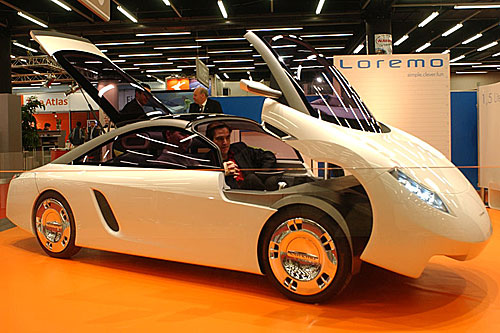
1999 Honda Insight 0.474 CdA so 0.277 is quite a drop, the EV1 was only 0.367.

The 2006 Loremo had it beat at 0.250 though!

The_Loremo_LS_at_the_2006_Geneva_Auto_Show.jpg
 
Plenty of good reasons here why it'll never take off. They should just abandon the project as none of it is now relevant and nobody is interested.

It's interesting to see what they can do with current technology if they push the boundaries. It does unfortunately show the limitations of what can realistically be done on the road though, especially with regards to peoples expectations.
 
Back
Top Bottom