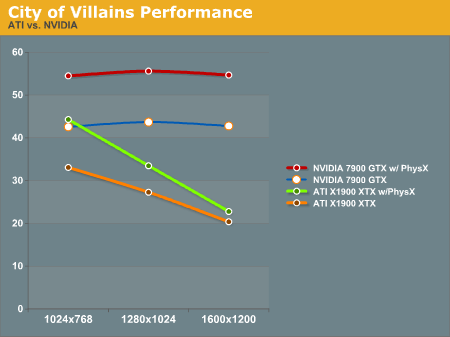
There's no question that a PhysX card will give better performance in City of Villains at the highest settings, and at times that difference can be pretty sizable. But as we found out, using a slightly lower quality physics mode will result in graphics similar to the highest mode where the PhysX card shines, but at performance levels nearly equal to the PhysX card just by using a dual-core CPU.
For someone currently using a single-core CPU and working with a limited budget, an upgrade to a dual-core CPU is going to be superior to adding the PhysX card in City of Villains, and it's going to be much more useful in games and applications where the PhysX card can't be used.
If AGEIA could even promise a consistent 25% performance boost over software mode in several games, more people would be interested in the technology. The problem is, many games are completely GPU limited, so faster physics processing doesn't necessarily help. What we end up with is the classic chicken vs. egg problem: without a large installed base of PPUs, how many developers will even bother to try and take advantage of the technology, and without software that takes advantage of the technology, who will want to buy the hardware? ATI and NVIDIA are also working on trying to accelerate physics with their GPUs, and every gamer will already have that technology available. GPU-based physics calculations might not be a good solution in games that are already GPU limited, but faster processors and PPUs won't help such games either.