

You are using an out of date browser. It may not display this or other websites correctly.
You should upgrade or use an alternative browser.
You should upgrade or use an alternative browser.
SSD Health
- Thread starter hbk123
- Start date
More options
Thread starter's posts
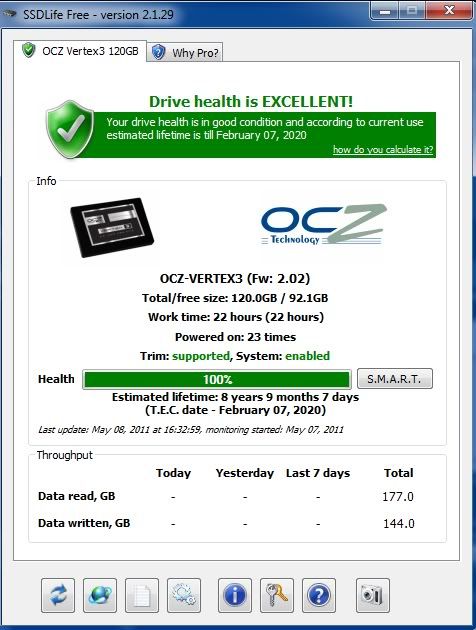

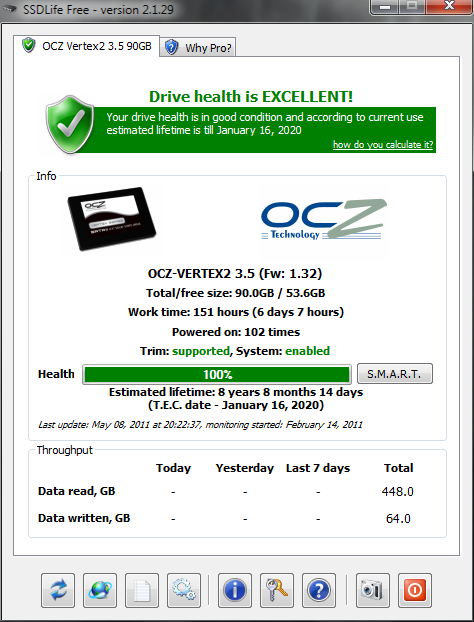


Im still in the lead..hehe
Grab the latest version of SSD Life as mine changed when I updated it.
CBA with screenshot but.. Been using this Samsung 64GB drive for 2 years now and...
Work Time 5036hours (6 months 29 days 20hrs)
Powered On 1229 times
Health 98%
Estimated life 8 years 5 months 25 days. So almost 11 years total life, not bad.
Work Time 5036hours (6 months 29 days 20hrs)
Powered On 1229 times
Health 98%
Estimated life 8 years 5 months 25 days. So almost 11 years total life, not bad.

Associate
- Joined
- 26 Nov 2009
- Posts
- 1,236
You know if you update to latest firmware it restores ssd to 100%. My X25-M went from 99 to 100%.



I'm actually thinking of going back to my velociraptor based on this.... I think the way I use my C drive isn't the best way to utilise an SSD.. Plus SSDs are not as fast as everyone claims, at least the way I use it... Great for benchmarks and reboots, hrm, none of which I do..


Dont think mines gonna last too much longer.
Bought it about 15 months ago
Your SSD shouldn't be that full for a start, especially if there's no overprovisioning (dunno if there is or not on Crucial drives).
Mine:



Soldato
- Joined
- 12 Jan 2006
- Posts
- 2,547

I'm actually thinking of going back to my velociraptor based on this.... I think the way I use my C drive isn't the best way to utilise an SSD.. Plus SSDs are not as fast as everyone claims, at least the way I use it... Great for benchmarks and reboots, hrm, none of which I do..
They beat the living *** out of my previous raid0 7200rpm hard disk pair, however I'm interested in what you think you do with your drive that's different and contrary to using an SSD?
At the moment the only thing I've been wary of putting on my SSD have been DBMS (mostly static db's I'm not worried about but I handle a couple of higher bandwidth OLTP ones that would do a lot of writes to transaction/undo/redo logs, not to mention storing the same data multiple times - e.g. table and multiple indexes), but that's out of my ignorance of how well they'd operate than any facts/evidence at this point.
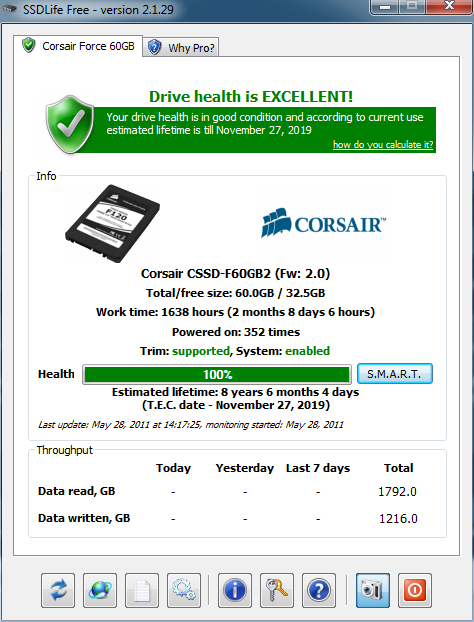


They beat the living *** out of my previous raid0 7200rpm hard disk pair, however I'm interested in what you think you do with your drive that's different and contrary to using an SSD?
At the moment the only thing I've been wary of putting on my SSD have been DBMS (mostly static db's I'm not worried about but I handle a couple of higher bandwidth OLTP ones that would do a lot of writes to transaction/undo/redo logs, not to mention storing the same data multiple times - e.g. table and multiple indexes), but that's out of my ignorance of how well they'd operate than any facts/evidence at this point.
It's just that I didn't notice *that* much difference when I changed from my raptor (it is the newest raptor as well so faster than most drives anyway), to the SSD. It was quicker on boot up, granted, but I don't feel it was noticeably faster on installing apps - maybe if I sat there with a stop watch I'd notice... but like I said I'm not gonna benchmark my drive.
I do feel like it's slowed down since I've been using it for the past 5 months, and the other thing is that SSD life is reporting 79% after only that amount of time.
I install and uninstall apps a lot cos I'm always testing and playing with stuff, graphics editing with photoshop and other graphics apps, dreamweaver and editing lots of html/php and text files etc for my work... backing up sites and upgrading them (lots of FTP) etc... then there's personal stuff, tonnes of games from steam, umm preparing graphics for selling stuff on ebay. Oh and I forgot I probably have a couple of instances of Apache and mysql running on it at various times too...
The thing is the way I work is, I use my computer desktop as I would use my desk in real life, it's my work space for all my temporary stuff and working files etc until I figure out where I want to put it long term, and my desktop is on my C drive... (don't see the point in having a fast drive but moving it all to a secondary drive - doesn't that defeat the purpose?) So basically I suppose lots and lots of saving and loading small files all the time.
In contrast I have the same drive in my media center which never sees any writes really it simply runs on my TV like a digibox... and that is still really fast and has nowhere near as much wear on it. So whilst I can see that in some situations it's a great benefit (hibernating and restoring my media center is so fast), I think the way I use it on my main PC I found it just as convenient and equally as quick in the way I use it to have a raptor - and the raptor isn't gonna die anytime soon.
Soldato
- Joined
- 12 Jan 2006
- Posts
- 2,547
to be honest there isn't much difference in it when compared to a raided velociraptor rig from a user perspective (barring bootup)
There was very little difference in performance on VM's in a machine with a reasonable amount of RAM (you get a bigger performance boost by enabling loading them all into memory)
Games aside from loading times i didn't notice all that much difference, but then didn't expect to
There was a reasonable boost in loading assets in photoshop and maya but i took that stuff off onto a slow disk anyway due to their size (only put them on to bench)
The saving in power, noise and heat you make though is somewhat more significant, my raptors were pretty loud when they were hammering away now my rig is pretty silent
I would recommend you use symlinks for your apps, when you are playing your game/app then put it on the ssd when you are not playing it as often move it off to a slower drive and create a symbolic link to it so the OS thinks it hasn't moved
http://schinagl.priv.at/nt/hardlinkshellext/hardlinkshellext.html
There was very little difference in performance on VM's in a machine with a reasonable amount of RAM (you get a bigger performance boost by enabling loading them all into memory)
Games aside from loading times i didn't notice all that much difference, but then didn't expect to
There was a reasonable boost in loading assets in photoshop and maya but i took that stuff off onto a slow disk anyway due to their size (only put them on to bench)
The saving in power, noise and heat you make though is somewhat more significant, my raptors were pretty loud when they were hammering away now my rig is pretty silent
I would recommend you use symlinks for your apps, when you are playing your game/app then put it on the ssd when you are not playing it as often move it off to a slower drive and create a symbolic link to it so the OS thinks it hasn't moved
http://schinagl.priv.at/nt/hardlinkshellext/hardlinkshellext.html
Last edited: