TV Licence Super Thread

  • Thread starter Thread starter Ken
  • Start date Start date
Screenshot-2025-11-17-142350.png

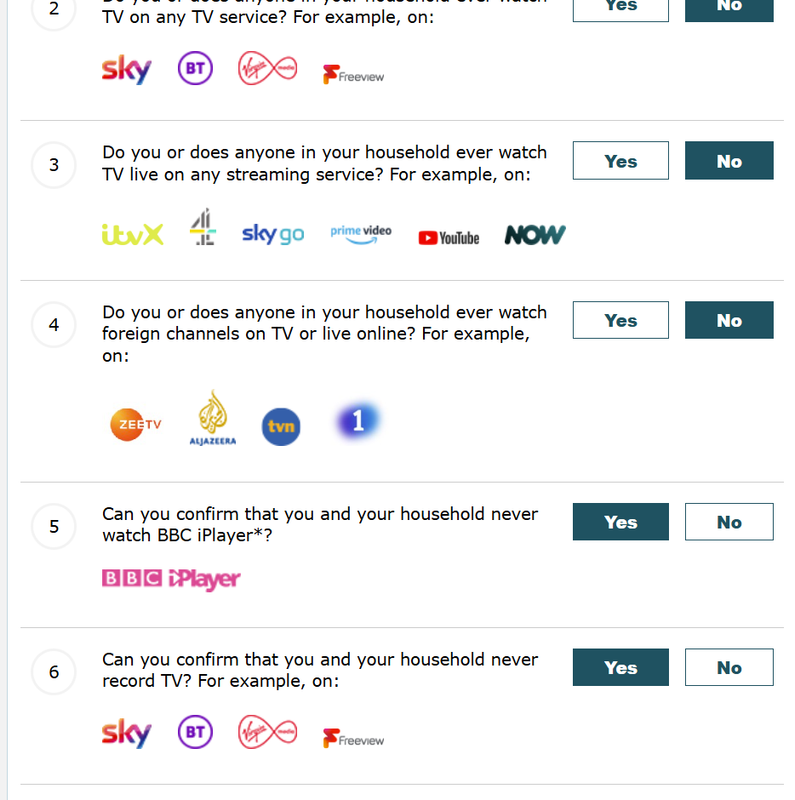
This has probably been covered loads before. But I cant believe the choice architecture they have on their form. I just went to notify them that I don't need a license for my office address and noticed it has two reverse scored question at the end to point you to needing a license if you're not paying attention and just want to answer a simple no.
 
Last edited:
Screenshot-2025-11-17-142350.png

This has probably been covered loads before. But I cant believe the choice architecture they have on their form. I just went to notify them that I don't need a license for my office address and noticed it has two reverse scored question at the end to point you to needing a license if you're not paying attention and just want to answer a simple no.
Its in poor taste, but they do this intentionally to try and catch as many people as possible. The issue is, even genuine people who do not need one get caught by it as well. Talk about shady practise.
 
Screenshot-2025-11-17-142350.png

This has probably been covered loads before. But I cant believe the choice architecture they have on their form. I just went to notify them that I don't need a license for my office address and noticed it has two reverse scored question at the end to point you to needing a license if you're not paying attention and just want to answer a simple no.
After filling out the information to let them know I don't need a licence again, I noticed the strangely worded questions. They won't be getting a licence from me because I don't need one, but it's disgusting that the website has questions that are either badly worded or meant to be confusing.
 
Oh no!


As the phrase goes "you can lead a horse to water, but you can't make it drink" seems entirely lost on the BBC as many of their producers & presenters relentlessly forge onwards with their bias and seem blind to the fact that their London centric left wing bubble is imminently about to burst.
Since Tim Davie's departure I've seen countless BBC employee's (past & present) saying we need to protect the BBC at all cost.
Why?
What exactly does one get from the beeb that cannot be sourced elsewhere for free, and without a moral bashing over the head with their group think mentality?
RIP, and not before time.
 
It's clear people are ditching the BBC.
It'll be in tax in 2027 unfortunately.

Surely no one thinks any different?

Will that be a decision for reform after the next GE?
 
Last edited:
Did I get that right that they say I need a licence to watch ‘live overseas channels on YT’?!

What on earth has that got to do with the BBC?

So if I watch a SpaceX launch, or the RedBull Hardline stream, I have to pay the BBC?!
 
I believe it only covers Live channels that are broadcast on digital TV. If it is not broadcast in the UK over the airwaves it is not covered.
And you still cannot which said channel as a Live (stream)
You will still need a licence if you wantch a foreign channel being live streamed, even if not broadcast in the UK. Whether that applies to a youtube event being livestream depends on where else it is broadcast in the world. eg if a SpaceX launch is only being shown on youtube then no licence needed.
 
Last edited:
You will still need a licence if you wantch a foreign channel being live streamed, even if not broadcast in the UK. Whether that applies to a youtube event being livestream depends on where else it is broadcast in the world. eg if a SpaceX launch is only being shown on youtube then no licence needed.

Yes you are right. I fed the whole Communications Act into an AI to summarise.

1. When you DO NOT need a TV Licence​


You can watch live YouTube broadcasts without a licence if the content is not part of a television broadcast. This typically covers:
  • Independent YouTubers: Live streams from vloggers, gamers (e.g., Twitch or YouTube Gaming streams), or independent content creators.
  • Online-only events: Live streams of events that are not being broadcast on a TV channel.
  • Catch-up/On-Demand: Watching videos or clips on YouTube after they have been uploaded (provided they are not on BBC iPlayer).
According to TV Licensing guidance, "A licence is not required to view user generated content, clips and videos on YouTube. This includes live streamed content that is not part of a television broadcast".

2. When you DO need a TV Licence​


You must have a valid TV Licence if the live YouTube broadcast is a simulcast (shown at the same time) of a TV programme. This applies if:
  • You are watching a TV channel live on YouTube (e.g., watching the Sky News or Channel 4 live feed on YouTube).
  • You are watching a sporting event live on YouTube that is also being broadcast on TV.
  • You are watching any programme on YouTube at the same time it is being shown on a TV channel.

3. The BBC iPlayer Exception​


Regardless of whether it is live or on-demand, you always need a TV Licence to watch any content on BBC iPlayer. While this is a separate platform, it is worth noting as the "live" rule differs for the BBC (where on-demand also requires a licence).

Legal Context​


The requirement for a licence is set out in Section 363 of the Communications Act 2003, which states: "A television receiver must not be installed or used unless the installation and use of the receiver is authorised by a licence under this Part".
While the Act refers to a "television receiver," regulations have updated this definition to include any device (including phones, laptops, and tablets) used to watch live television programmes.

Summary: If you are watching a random YouTuber live, you generally do not need a licence. If you are watching Sky News (or any other TV channel) live on YouTube, you do.

 
Last edited:
Lisa Nandy has launched the BBC’s Charter Review and shied away from any attempt to fundamentally reform the BBC’s funding model. Are you surprised…

“As the licence fee is a tried and tested public funding model, we are not considering replacing it with alternative forms of public funding, such as a new tax on households, funding through general taxation, or introducing a levy on the revenues of streaming services to fund the BBC…

We will consider the potential for reforming the licence fee alongside broader reform options, as set out throughout this chapter, which could support households with the cost of living. This will include looking at options to support the BBC to generate more commercial revenue and operate more efficiently to provide a sustainable long-term funding model for the BBC at the lowest possible cost for households.

At this stage the government is keeping an open mind on activities/services for which households could be required to hold a TV licence. We are seeking to understand the public’s views on the principle of reforming the licence fee, including how those views might be impacted were the cost of the licence fee to change and/or the role and scale of the BBC was altered.”
 
Back
Top Bottom