#Random Linux

I am running Bazzite on my main PC and after a week its looking like I will stay on this full time, Unless CachyOS makes faster progress or I decide I want more power than the immutable OS set up offers.
My question is that Bazzite warns you over NTFS drives and the internet is full of "it works fine for me" and "its a time bomb dont do it". Well I dont plan to use any local NTFS drives. However my "NAS" is actually a windows 11 pc using shared folders so that I can access them with my microsoft login. I can login and access it just fine using SMB but since it is NTFS I dont want to risk any data on there. I dont know enough about any of this to know if it is translated or whatever the correct term is when accessed via the network or if using it from bazzite could corrupt it?
What do you mean by CachyOS makes faster progress? CachyOS by its very rolling release nature will get updates and features quicker than Bazzite.

Don't use NTFS as a file system on Linux. BTRFS and ext4 are popular options with BTRFS being the default for /root on Bazzite. You'll need to research which one suits your needs but BTRFS will be fine.

The FS on your linux system will have 0 impact on your NAS. You can connect to it's SMB shares via mount and cifs.
 
Last edited:

I am running Bazzite on my main PC and after a week its looking like I will stay on this full time, Unless CachyOS makes faster progress or I decide I want more power than the immutable OS set up offers.
My question is that Bazzite warns you over NTFS drives and the internet is full of "it works fine for me" and "its a time bomb dont do it". Well I dont plan to use any local NTFS drives. However my "NAS" is actually a windows 11 pc using shared folders so that I can access them with my microsoft login. I can login and access it just fine using SMB but since it is NTFS I dont want to risk any data on there. I dont know enough about any of this to know if it is translated or whatever the correct term is when accessed via the network or if using it from bazzite could corrupt it?
Whatever is serving the drive through SMB will handle everything for you. It doesnt really matter to the client wether its fat32,ntfs,ext4 or anything underneath it it talks through the smb protocol so dont worry about that. The main thing is people say dont mount your windows drive directly in linux as the ntfs driver isnt perfect.
 
I finally broke something on my install. Completely my fault for messing with keychains. The ability for you to do anything on Linux is also a downside when it lets you do something that kills something. I probably could have fixed it but a new install was quicker and probably needed after all the other "fixes" I'd done after doing anything I wanted and breaking it.

I briefly thought about distro hopping but it would have been change for changes sake. EndeavourOS is just the right amount of Linux nerd for me.
 
I finally broke something on my install. Completely my fault for messing with keychains. The ability for you to do anything on Linux is also a downside when it lets you do something that kills something. I probably could have fixed it but a new install was quicker and probably needed after all the other "fixes" I'd done after doing anything I wanted and breaking it.

I briefly thought about distro hopping but it would have been change for changes sake. EndeavourOS is just the right amount of Linux nerd for me.
I recommend Installing Timeshift, it lets you restore to a known good snap shot. Saved my bacon many times as I am always testing stuff I don't understand :-)
 
I do have Timeshift but to be honest I was at the point of looking for an excuse for a reinstall. The original install was meant to be a testing ground for EndeavourOS so it had a bunch of random bits and bobs installed/removed/part removed but I ended up just using it as a daily driver as it was a stable mess!
 
Last edited:
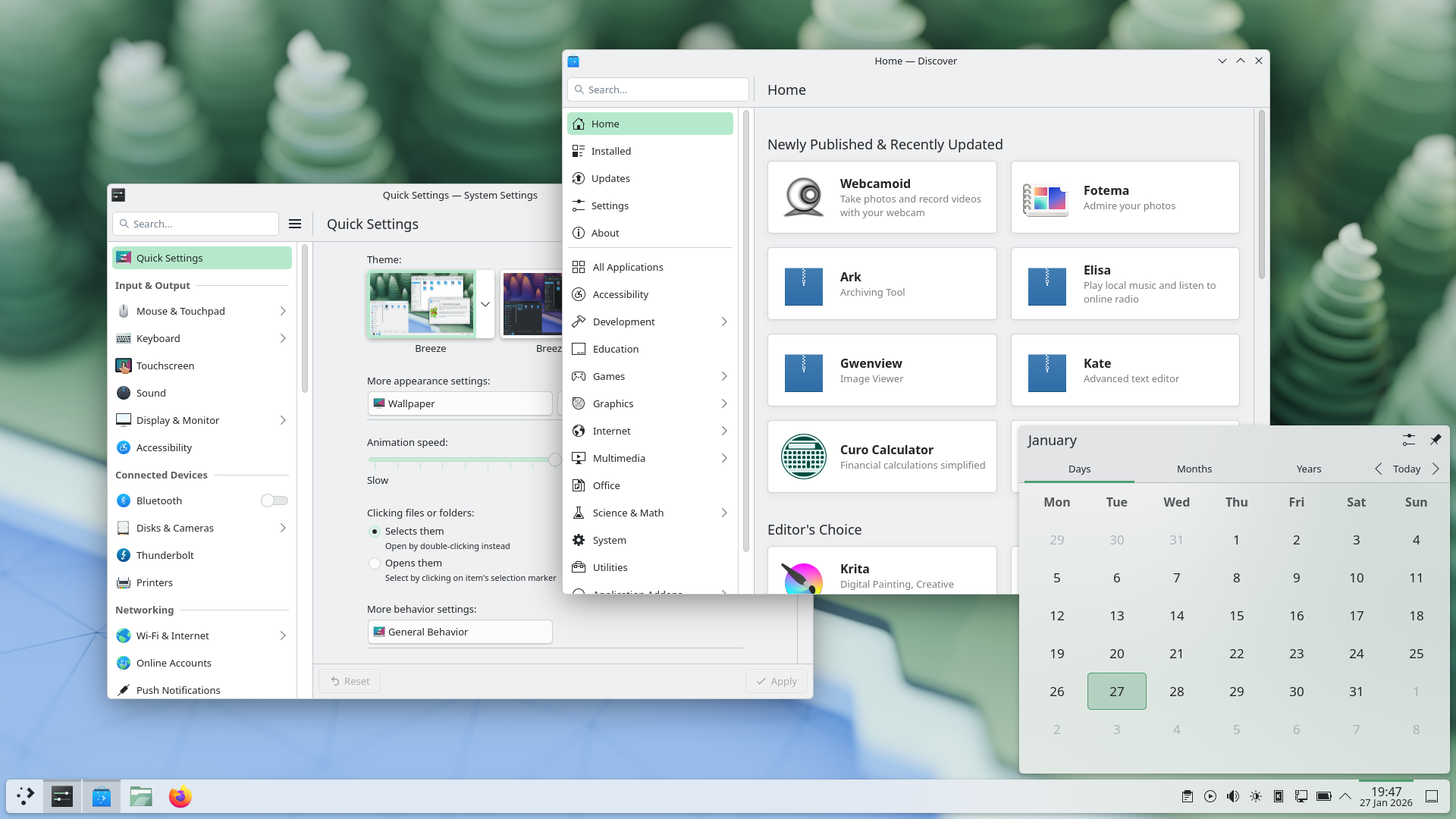
New Plasma release new wallpaper!


I think out of all the new features I'll be using the text extraction tools the most.
 

It was less than four years ago that the modern AMDGPU/AMDKFD open-source driver stack was at four million lines of C code and header files. Now with the Linux 7.0 kernel it has surpassed six million lines. Or put another way, by the same calculations Linux 7.0-rc1 is at 39.2 million with the modern AMD kernel graphics driver now making up 15% of the kernel's entire codebase as the single largest driver.

I knew it was big but i didn't realise it was that big.
 
Back
Top Bottom