Fox
I’m going to write a complete guide for you. I may cover a lot you already know, but at least it’s comprehensive enough to cover most bases. We can go from there.
First, a couple of questions:
- Does your Headunit have a 12v Remote Out?
- Give me some idea of budget
- What sort of music do you listen to?
- Where are your speaker locations, and do you have a separate tweeter and mid-bass up front
Speakers – Sizes and Mounting
We need to establish three things, for which google Fu is key; mounting locations, maximum speaker size, and mounting depth. Factory locations usually can have an adapter fitted to fit larger speakers. Large speakers = more cone area which means better mid-bass reproduction and more air moving. Mounting depth means a bigger magnet. Which means more power, more air and better timing (sort of)
Speakers – Component vs Coaxial
Coaxial speakers are the tweeter and mid-bass cone combined on one chassis. They are easier to install, but generally have lower SQ and less mid-bass (reduction in cone area, built in crossover)
Components consist of a separate mid-bass and tweeter (and sometimes more). Wired up to a small ‘junction box’ called a crossover. They require more effort and wire to install. Generally speaker SQ. Volume and Mid-bass production are much better. If you don’t have separate tweeter and mid-bass factory locations, it’s probably not worth the effort as your first install.
Speakers – Power Ratings
wRMS is what you need to worry about. More watts doesn’t generally mean more SQ or volume. You need to have a speaker that is rated at just below your what your amplifier can drive. For your application 50-100wRMS should be sufficient
Speakers – Subwoofer
Unfortunately, subs get a bad rep. However, the bottom line is simple; to reproduce lower frequencies you need to move a LOT of air, and this means bigger cone surface area.
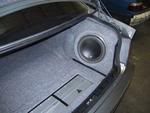
Fortunately for the consciounscous BMW owner, there are a multitude of stealth box options for you to peruse. Generally the best ones either mount into the side of the boot or in the spare wheel well. I’d recommend a side-mount one. Volume of the box plays a key roll, and needs to be matched to the specs of the subwoofer. You’ll probably find you need something like 1.2 Cubic feet in a sealed enclosure. This is a punchier, faster reacting sub without the boom. 10” will probably be the best compromise for you.
I’d recommend a rating of between 200wRMS and 400wRMS for the subwoofer.
Amplifiers – Channels, Power & Mounting
The amplifier takes the 5v digital signal from your RCA outputted from the headunit, and sends an analogue signal to your speakers. Each channel (mono) or pair of channels (stereo) is simply the positive and negative wire that run to the speakers. In this instance you’ll be using a pair of channels, left and right, for the front, and a mono channel for your subwoofer.
I’d recommend a class D amplifier for both your front speakers (stereo) and your subwoofer (mono). Modern class Ds are super efficient and run very cool, and the stereo ones these days are actually excellent. The SQ of JL Audios latest offering is mind blowing, and the amplifier is absolutely TINY.
I tend to select an amplifier with a power rating 10-20% greater than the speaker. Underpowering speakers is what kills them, unless you play at insane volume or stupidly excessive wattages.
If you get the class D you don’t need to worry much about ventilation. You can stealth mount it to the opposite side of the boot by fabricating an MDF panel and carpeting it.
Wiring – What you need to do
Here’s a list of each wiring run that you will need to do:
- 1 x power wire, split into parallel for each amplifier
- 1 x earth wire back from the amps to the battery or a ground on the chassis
- 2 x RCA pairs. From the headunit to the amps. One for the front speakers and one for the Sub.
- 4 x speaker wires. 2 pos and 2 neg. From the speaker amp to the X-Overs up front
- 8 x speaker wires from the X-Over to the front speakers. 2 wires for each midbass, and 2 for each tweeter.
- 2 x speaker wires from the subwoofer amp to the subwoofer
- 1 x Remote wire from the head unit (or other source) split into parallel for each amplifier
I’ve made you a beautiful diagram with my paint "skills".
 Thick black and red
 - Power Wire
Thin Black and Red - Speaker positives / negatives
Blue wires - RCA cables
Purple Wire - Remote Out
Here’s an example of the kit you could buy. For the whole system we’re looking at anywhere between £500 to £1200 for decent kit.
Stereo Amp - £215 -
http://www.caraudiodirect.co.uk/jlaudio-xd200-2.html
Speakers - £150 -
http://www.caraudiodirect.co.uk/hertz-energy-esk-130-3.html
Mono Amp - £230 -
http://www.caraudiodirect.co.uk/jl-xd3001-jl-audio-xd3001.html
Subwoofer - £110 -
http://www.caraudiodirect.co.uk/hel-e10w-helix-esprit-e10w.html
Wiring Kit -
http://www.caraudiodirect.co.uk/autoleads-4awg.html
You'd need proper speaker wire, an enclosure, another RCA + MDF and gubbins on top of this. The JL Audio amps I've specced are quite pricey. The SPL Dynamics ICE range is excellent, I've used them myself in systems and for the money they're stonking. I think they're ugly though. I'll be using JL Audio amps and Helix components with an Ascendant Audio Arsenal sub in my next build.
That install would probably cost £800 all in. It can be done much cheaper, and in stages.
For what it's worth. I would actually install the sub first. It's the easier job and you will be absolutey awestruck by the difference a good sub setup makes. I would also change the head unit, sorry; that 5v signal that it outputs decides the entire quality of the setup.
Ant







![[TW]Fox](/data/man-of-honor/2009.png)


 got a set from a Professional HiFi spec car for £27 inc postage