


Does the error rate scale with the number of transistors or the area of the silicon?9800x3d was $479 and 9900x3d was $599 at launch, I can't see them launching at much less than that (as well as ever rising costs for silicon).
To my understanding, 12 core CCD would also theoretically have a higher defect rate than 8 (with all other things being equal), as well as being the top dog for gaming (assuming it is).
I'd expect they'll drop lower after some months though, same as Zen4/5 have.
-
Notice regarding image hosts and attachments. See here.
-
Competitor rules
Please remember that any mention of competitors, hinting at competitors or offering to provide details of competitors will result in an account suspension. The full rules can be found under the 'Terms and Rules' link in the bottom right corner of your screen. Just don't mention competitors in any way, shape or form and you'll be OK.
You are using an out of date browser. It may not display this or other websites correctly.
You should upgrade or use an alternative browser.
You should upgrade or use an alternative browser.
AMD Zen 6 rumours
- Thread starter Grim5
- Start date
More options
Thread starter's posts
Soldato
- Joined
- 13 Sep 2010
- Posts
- 3,060
As far as I understand it, a given area of wafer is going to have a roughly uniform number of defects on a given process (but where those defects occur is mostly random), so by increasing the area of each die, you increase the chance of each die having a defect present. I guess that would also scale somewhat linearly with transistor counts. (you also get less wasted space around the edge of the wafer with smaller dies)Does the error rate scale with the number of transistors or the area of the silicon?
There's a better explanation here:
 www.reddit.com
(and as he said, that still doesn't account for dies that won't hit power/frequency requirements for a given SKU)

As far as I understand it, a given area of wafer is going to have a roughly uniform number of defects on a given process (but where those defects occur is mostly random), so by increasing the area of each die, you increase the chance of each die having a defect present. I guess that would also scale somewhat linearly with transistor counts. (you also get less wasted space around the edge of the wafer with smaller dies)
There's a better explanation here:
(and as he said, that still doesn't account for dies that won't hit power/frequency requirements for a given SKU)
One factor to also consider is that Zen 6 will be on a smaller process. So a 12 core Zen 6 die may well end up being a similar size/not much larger than an 8 core Zen 5 die.
Soldato
- Joined
- 13 Sep 2010
- Posts
- 3,060
Yeah that's true, although on the flip-side if they move to a newer/smaller process node (N2P, N2U etc.), then the initial defect rate may be higher than the more mature node.One factor to also consider is that Zen 6 will be on a smaller process. So a 12 core Zen 6 die may well end up being a similar size/not much larger than an 8 core Zen 5 die.
I was mostly referring to like for like though - i.e. a situation where Zen6 remains on 8 core CCDs/chiplets, rather than moving to 12 (as has been rumoured for ages and highest single CCD x3D is definitely what will have my attention - 12 would be a decent uplift from my 16 Zen3 cores, even in heavily threaded workloads)

I would imagine we will see 8, 10 and 12 core versions of single ccd chips.Curious to see if they do an 8 core X3D i.e. a defective 12 core X3D. I suppose a 10 core is also possible.
8 cores of a new architecture is still pretty decent, so I would expect to see them appear.
10 cores is probably what I'll look at.

I'd be surprised if they do 10, since something like 8, 12, 18, 24 would give a nice upsell.I would imagine we will see 8, 10 and 12 core versions of single ccd chips.
8 cores of a new architecture is still pretty decent, so I would expect to see them appear.
10 cores is probably what I'll look at.
You might be right. All depends on price points and whether they will sell. Given the option of 8 or 10 core Zen6, I'd pick the 10 core one to have a decent bump over what I have already.I'd be surprised if they do 10, since something like 8, 12, 18, 24 would give a nice upsell.
9 core CCD's feels a bit whacky for the 18 core. Would think its more likely to have 2x standard CCD sizes like now.I'd be surprised if they do 10, since something like 8, 12, 18, 24 would give a nice upsell.
6, 8, 10, 12 cores (1x CCD)
16, 20, 24 cores (2x CCD)

Not unheard of (at least in the Epyc Parts) e.g. 8635P which uses 12 CCD with 7 cores each (or 7663 which uses 8x7)9 core CCD's feels a bit whacky for the 18 core.
Odd number of CPU cores don't seem to sell well for whatever reason (Phenom X3 anyone?!), so being able to use up dies with odd number yields seems ideal especially for Epyc parts, but as we get to higher core count desktop parts, I think we might see more of it.

Not unheard of (at least in the Epyc Parts) e.g. 8635P which uses 12 CCD with 7 cores each (or 7663 which uses 8x7)
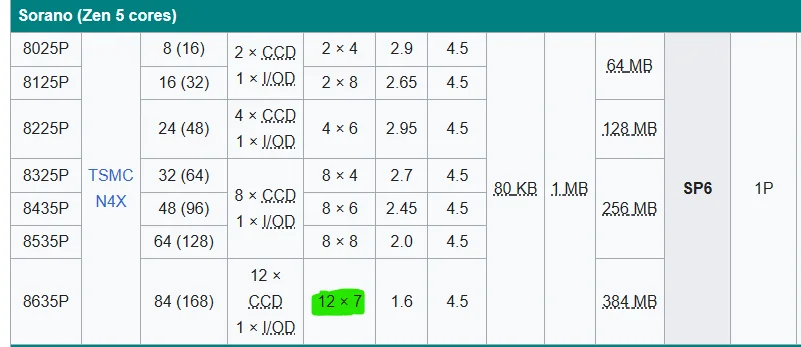
Odd number of CPU cores don't seem to sell well for whatever reason (Phenom X3 anyone?!), so being able to use up dies with odd number yields seems ideal especially for Epyc parts, but as we get to higher core count desktop parts, I think we might see more of it.
I realise i'm looking at it from a very niche enthusiasts perspective but i remember a lot of people buying Phenom X3's and the previous Athlon X3's because the forth core wasn’t fused off, it was simply firmware disabled and some motherboard's would allow you to re-enable it, it was pot luck if you actually got a working CPU after that but hey it was fun trying.
Outside of that yes odd number cored CPU's were probably a bit too weird for normies.
Last edited:

9 core CCD's feels a bit whacky for the 18 core. Would think its more likely to have 2x standard CCD sizes like now.
6, 8, 10, 12 cores (1x CCD)
16, 20, 24 cores (2x CCD)
I’d much rather have 9 cores than 8 or 11 than 10 TBH. The product line up might be a bit much, but it would be great way to salvage silicon and very much appreciated especially if the price made sense.
I’d much rather have 9 cores than 8 or 11 than 10 TBH. The product line up might be a bit much, but it would be great way to salvage silicon and very much appreciated especially if the price made sense.
I just can't see them selling a line of CPU's with every single core configuration available according to how many working cores are on the CCD. 6,7,8,9,10,11,12 core product lines, and then the dual CCD 12,14,16,18,20,22,24 cores.... Marketing nightmare.
However, it would be nice if they allowed a core unlock feature similar to the aforementioned Phenom X3's, so if you were lucky enough to bag an 8-core CCD with 9 working cores you could unlock it and use it. Would add a bit of fun to the market again at least.
I agree with @Marak Subdividing it in to so many segments is messy. I think the entry level will be 8 cores, then 10, 12, 16, 20 and 24.
They don't do a 4 core Zen 5, they might do a 6 core for Zen 6 but there is no way yields are ever going to be bad enough even on worst affected chips to warrant cutting the chip in half, the chip would cost them the same as a defective 12 core that they could sell as a 10 or 8 core so why bother cutting that many healthy cores off it....
They don't do a 4 core Zen 5, they might do a 6 core for Zen 6 but there is no way yields are ever going to be bad enough even on worst affected chips to warrant cutting the chip in half, the chip would cost them the same as a defective 12 core that they could sell as a 10 or 8 core so why bother cutting that many healthy cores off it....
Last edited:
They don't need to, as there are a few Epyc parts that use up CCDs with only 4 cores enabled, e.g. 9015 (2x 4 core CCD), 9355 (8x 4 Core) as well as frequency optimised such as 9275F that goes as far as using 8x 3 Core CCDs, in order to just use cores capable of higher speeds.They don't do a 4 core Zen 5
They don't need to, as there are a few Epyc parts that use up CCDs with only 4 cores enabled, e.g. 9015 (2x 4 core CCD), 9355 (8x 4 Core) as well as frequency optimised such as 9275F that goes as far as using 8x 3 Core CCDs, in order to just use cores capable of higher speeds.
True, but i don't think that's because the other half of those chips are defective, i think those are products for people who don't need to CPU performance but instead might need the 3TB of memory per socket.
They can still sell these things for £500 a pop in 1K batches. Because data centres.
On the Desktop cutting the CPU in half seems unnecessary when the chip costs AMD the same as what would be sold as a higher core count CPU. So just make the 8 core the cheapest one.
Last edited:
I just can't see them selling a line of CPU's with every single core configuration available according to how many working cores are on the CCD. 6,7,8,9,10,11,12 core product lines, and then the dual CCD 12,14,16,18,20,22,24 cores.... Marketing nightmare.
However, it would be nice if they allowed a core unlock feature similar to the aforementioned Phenom X3's, so if you were lucky enough to bag an 8-core CCD with 9 working cores you could unlock it and use it. Would add a bit of fun to the market again at least.
Probably not within the regular retail product stack, the packaging and naming scheme would be a bit much, but maybe AMD have enough salvaged parts to do lower core count parts at some point.
I doubt it would be possible to unlock cores on an AM5 platform TBH. First the cores would need to be functional and then you’d have spoof first the SoC (CPU) and then somehow deal with getting the motherboard and OS to recognise it. Two of those steps could potentially brick a SoC.
I agree with @Marak Subdividing it in to so many segments is messy. I think the entry level will be 8 cores, then 10, 12, 16, 20 and 24.
They don't do a 4 core Zen 5, they might do a 6 core for Zen 6 but there is no way yields are ever going to be bad enough even on worst affected chips to warrant cutting the chip in half, the chip would cost them the same as a defective 12 core that they could sell as a 10 or 8 core so why bother cutting that many healthy cores off it....
AMD could dip into the mobile parts line up for those chips.
problem with that is people keep returning the cpu till they get one that unlocks fine.However, it would be nice if they allowed a core unlock feature similar to the aforementioned Phenom X3's, so if you were lucky enough to bag an 8-core CCD with 9 working cores you could unlock it and use it. Would add a bit of fun to the market again at least.
True, people are indeed a***holes.problem with that is people keep returning the cpu till they get one that unlocks fine.