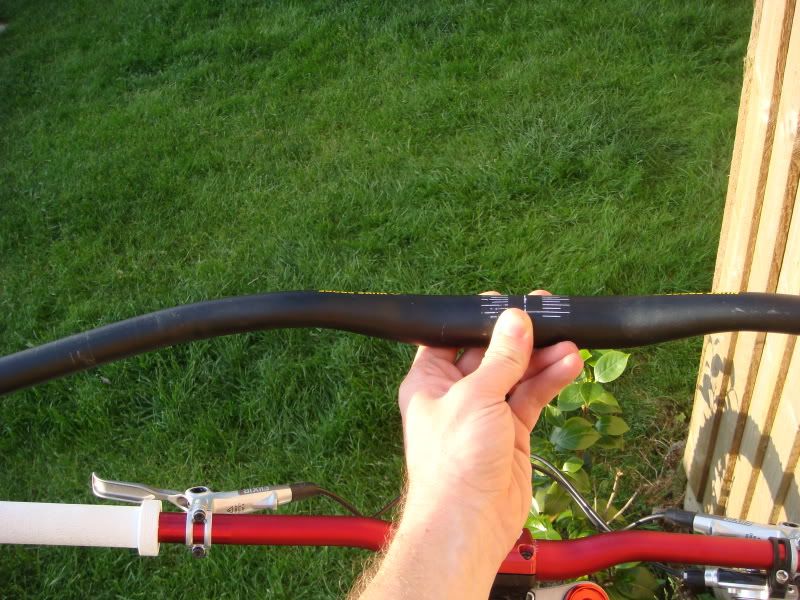
Why carbon?
Well let me be of some assistance. I have an MSc in the subject and work with it and test it every day at the top level (Formula 1). Are you sitting comfortably?...
Here's a brief guide:
For a start do not buy carbon bars for downhill or any kind of harsh riding!
Carbon composites are materials made by using a resin (usually epoxy) reinforced with carbon fibres, these can be continuous, as in woven cloths or unidirectional ribbons for example, or discontinuous short fibres or even nano tubes!
Pros:
It is light and strong and can be made into almost any shape.
Its strength can be designed into it in the desired locations depending on fibre placement and number of plies (layers).
It can be very stiff, or very compliant (depending on how it is designed and made etc).
It has excellent fatigue life (verging on the infinite).
It can absorb huge amounts of energy when it fails (hence great for making helmets).
It can be tough (depending on the resin).
It has excellent damping and shock absorption properties.
Cons:
It is expensive.
Its purely elastic nature means that it does not locally yield at points of high stress, unlike metals which relieve stress concentrations by deforming plasticly around the point.
It is not indestructable.
When it breaks in tension it goes with a BANG and without warning.
When it breaks in compression it crumbles (with a not so big bang).
When it breaks it splinters (health hazard, in more ways than one).
It is weak in any direction other than the fibre direction.
It can be brittle (depending on the resin).
So you can see why they are not good for handle bars, where there are many stress concentrations with everything that is bolted to it. These can induce failure. Carbon composites are best joined by adhesive bonding, not with mechanical fasteners like nuts and bolts (see cons).
Now, Carbon Nano Tubes (CNTs) Not to be confused with Carbon Ultra Nano Tubes are minute (on the nano scale) tubes of carbon. Imagine a sheet of carbon atoms, one atom thick rolled into a tube. These are some of the stiffest and strongest (to weight ratio) fibres known to man. Hence if used correctly as a reinforcement can make some very strong stuff indeed. However CNT's are very expensive to make. Recent developments in technology have reduced the costs though and we can now see such technology in things like bicycle handle bars. However, still at a price of a couple of hundred pounds a gram of CNTs (or something ridiculous) I wonder how the likes of Easton make a bar entirely from CNT reinforced composite for the price of £70. I imagine they use a tiny amount of CNTs in their bars. Meaning the rest of the bar would likely be made up from woven carbon (as some of those photos suggest).
Anyway if you've read this far - well done, I hope this has been interesting.
In summary: Don't buy carbon bars, waste of money.
I might add that carbon can be used to make ideal frames (Lahar for example) and some components. It just takes good design. Metal inserts bonded into the carbon structure are a good way to provide locations to thread / bolt to etc. However there can be problems with bonding Alu to carbon (thermal expansion and stiffness differences, galvanic corrosion etc).