

• Notice regarding image hosts and attachments. See here.

MOT fail thread

Also, some light reading for you guys..


Our proposal​

To control excess emissions from in-use vehicles, we propose to make it a legal requirement that all road vehicles in-use in GB from 1 January 2001 must have their ECS maintained in such a way that the maximum level of emissions and other requirements of the control system continue to operate as set by law at the time of manufacture.

We intend to update regulation 61A to make use of existing sections of the Road Traffic Act 1988:


  • section 42: use of a vehicle that does not comply with construction and use requirements
  • section 75: alterations to vehicles
  • section 76: fitting or supply of unsuitable vehicle parts
Depending on the circumstances, breaches of these sections can result in fines of between £1000 and an unlimited amount following successful prosecution in the magistrates’ court.

This means that the following will be prohibited:


  • using a vehicle on the road which has been maintained or modified in a way that means it no longer meets the emissions standards that it was approved to
  • allowing a vehicle to be used on the road which has been maintained or modified in a way that means it no longer meets the emissions standards that it was approved to
  • modifying a vehicle yourself, or allowing a vehicle to be modified, in a way that means it no longer meets the emissions standards that it was approved to
We have chosen not to distinguish between excess emissions caused by poor maintenance of a vehicle and those caused by modifications made to vehicles.

Similarly, we do not propose to distinguish unintentional and deliberate modifications made to the ECS, nor whether these are through hardware or software alterations. The environmental and health impacts of excess emissions are the same, regardless of the reason. Such distinctions can also be difficult to evidence and would make enforcement unreasonably difficult.

We also want to encourage good vehicle maintenance, which may avoid more expensive repairs following catastrophic failure.

In short, if you own a vehicle with the dpf/egr system removed then it's time to move it on, so you aren't left holding the baby.

 

Raises questions around the accountability of MOT testers.
Sometimes even the same garage. I bought a car that had corroded brake lines as an advisory on its latest MOT, when i got it tested they didnt pick them up so thought they must have been done. (I did ask the selling garage about it but they couldnt say).
A year later it fails due to the corroded lines and they were quite damning of them until i pointed out they passed the car the year prior, without any advisorys.
 
Anyone have a guess what the problem is?

IMG_7578.webp
 
I knew you could get flat ethernet cables, brake pipe is a new one on my though :cry:
Unbelievably it still somehow managed to get fluid to the caliper and show effort on the brake test..
IMG_7576.webp


It's been done deliberately as far as I can see, but for what reason I've no idea (I could understand it if the hose had burst or whatnot to stop a fluid leak)
Tbh, I've given up trying to find reason in some of the crazy stuffs I see.
 
Looks like it went under the arm at some point, maybe someone jacked it up there? Crazy that it still passed fluid though.
 
I would have thought that it would have been a "Braking efficiency below requirement - Offside rear". Amazing that it still works.
 
In short, if you own a vehicle with the dpf/egr system removed then it's time to move it on, so you aren't left holding the baby.

Something which is pretty bad in this respect is manufacturers killing off production of EGR and DPFs and/or related components for specific models as soon as they can leaving people in the lurch if they have a failure - I know even a few main dealers giving people a steer towards getting DPF deletes done, etc. on some vehicle models because the parts backlog is so bad and/or you can spend months before one comes up via ebay or breakers, etc.

There may need to be some kind of regulation for it :s

EDIT: Then you get brands like Infiniti where a lot of garages don't realise it is just a Nissan or Renault part with a different product number :s
 
Last edited:
DVSA banner

Regulations around LED replacement (LEDr) headlamps are changing​

Driver and Vehicle Standards Agency sent this bulletin at 08-10-2026 04:53 PM BST
dvsa-logo-digital_crop.png
Checking IVA vehicle


Regulations around LED replacement (LEDr) headlamps are changing​

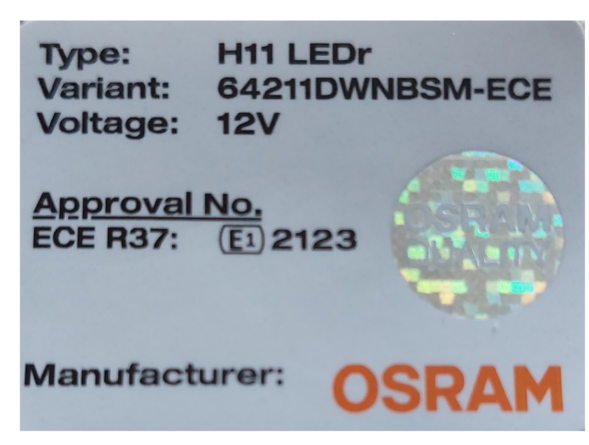
New rules mean that MOT testers can pass retrofitted ECE approved LED replacement headlamp bulbs into halogen headlamp units, as long as they are accompanied by an approval sticker.
Previously, LED bulb conversions in halogen headlamps have been rejected at MOT test because it was assumed there was no approval. This was because testers had no practical means of determining whether a fitted LED light source was approved, so they would fail for ‘light source and lamp not compatible’.​

What has changed?​

Manufacturers of ECE approved LEDr products will now supply a secure approval sticker inside the product packaging at the point of sale. It must be permanently applied to the vehicle, such as inside the engine bay and be readily visible to the tester.
The sticker must include all the references in the picture, though the design may be different, depending on the manufacturer.​
LED bulb sticker

This applies to class 3 (tricycles), class 4 (cars), class 5 and 7 (vans) vehicles.
The change will be reflected in the MOT testing manual section 4.14 - Compliance with requirements from 14 October 2026.​
 
Back
Top Bottom